
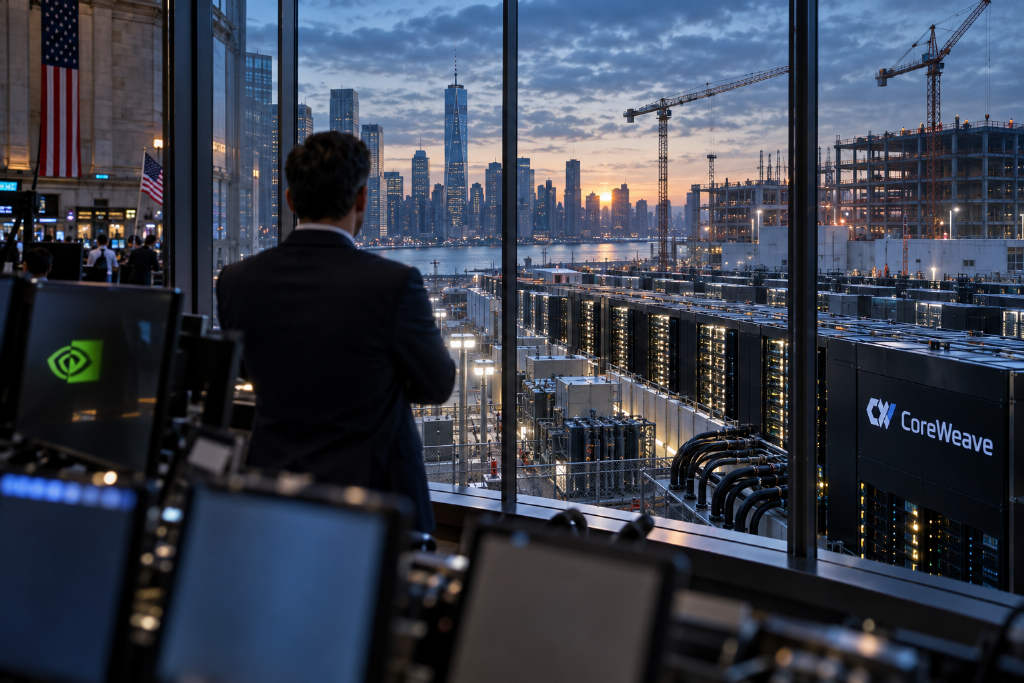
Global technology stocks were hit by a broad sell-off this week, wiping more than $1 trillion from the combined market value of the world’s 20 largest tech names and intensifying doubts about returns on AI infrastructure spending. At that moment, Nvidia CEO Jensen Huang made two public appearances in quick succession: first in a Bloomberg interview from Stockholm defending CoreWeave, then in a nearly 140-minute BG2 podcast conversation focused on the question hanging over the market — who will actually pay for the buildout of AI compute.

The BG2 interview was released before the U.S. stock market opened on Oct. 15 Eastern Time, shortly before 7 a.m., when traders, analysts and quant funds on Wall Street were preparing for the session.
CoreWeave became a central pressure point
CoreWeave was one of the most closely watched fault lines in the technology sell-off. According to ICE Data Services, the five-year credit default swap spread used to insure against a CoreWeave debt default jumped as much as 74.5 basis points intraday to a record 1,194.5 basis points, implying a five-year default probability above 60%.
The stress reflected concern over CoreWeave’s debt-fueled expansion in compute capacity. Nvidia is both a hardware supplier to the company and its second-largest shareholder, holding about 10%. That structure — a supplier financing a buyer that then purchases the supplier’s products — has fueled questions about the financial durability of the AI infrastructure boom.
Huang’s comments in Stockholm directly pushed back against that pricing in credit markets. He told Bloomberg that CoreWeave is getting stronger every day and said, 「I’m optimistic. Their cost of capital is actually coming down.」 He also said Nvidia does not need to provide any form of backstop support for CoreWeave.
Markets reacted quickly. CoreWeave shares closed up 5.94% on the day, halting a two-session slide of more than 18%. The Nasdaq later erased all of its losses. Barron’s, in a market wrap, wrote that a few calming words from the 「AI godfather」 Huang were enough for investors.
Huang says the market is asking the wrong question
One of the deeper drivers behind this week’s sell-off was a broad challenge to the economics of AI infrastructure: if revenue growth at OpenAI and Anthropic slows, who pays for trillions of dollars in compute buildout?
In the BG2 interview, Huang said that framing misses the point. He broke Nvidia’s compute demand into three roughly comparable segments.
The first, about one-third, has nothing to do with AI labs. He described it as foundational computing demand spanning molecular dynamics, physics simulation, quantum chemistry, classical machine learning such as fraud detection at Visa and Mastercard, and recommendation systems. 「Even with no AI at all, Nvidia would not be zero,」 he said. 「That part of the business grows 30% to 40% a year.」
The second, around one-quarter to one-third, comes from frontier AI labs. Huang said the market tends to focus on two labs, while he sees five or six, including Meta, Grok, Gemini, Anthropic and other emerging organizations. 「If you tell me that represents less than a third of our business, about a quarter, that’s fine,」 he said.
The third, also roughly one-third, comes from thousands of startups renting compute. Huang compared that segment to the next generation of Amazon Web Services. He said 80% of those companies use open-source models to build domain-specific intelligence in areas such as physical AI, biology AI and materials science. 「Think of this large block of cloud computing as the next generation of AWS. That is AWS today, except built for the future,」 he said.
His conclusion was direct: 「Betting trillions of dollars of construction on the revenue of two labs is a very big mistake.」 He added that he is happy to work with and support them, and that they may become some of the most important technology companies in history. Still, he said, their revenue does not need to come anywhere close to $1 trillion for the investment case to work.
Why he thinks demand keeps accelerating
Huang also laid out why he does not expect compute demand to slow in a straight line.
His argument rests on two compounding factors. First, inference — or thinking — is orders of magnitude more expensive than simple generative output. AI systems have to explore multiple options, plan, reflect, prune and preserve what he called strategic optionality, all of which consumes significant compute. Second, the more capable a model becomes, the more work it gets hired to do. 「It uses more compute to do work, but it does the work well, so we hire it to do more work,」 he said. 「Put those two things together, and demand accelerates. It doesn’t decelerate.」
He described last year’s key unlock as 「harness」: working memory management, knowledge graph construction — which he likened to offline compression during sleep — and tool use. In his view, those three developments turned large language models from chatbots into agents that can do real work inside enterprises. 「Programming is the first deployment scenario,」 he said. 「Design and creativity are the next wave.」
Huang said OpenAI and Anthropic each currently have only about 2 to 3 gigawatts of compute, which he called very small relative to what is coming. Yet even at that scale, he said, AI has already solved the Navier-Stokes equations, one of the millennium mathematics problems. 「This is the worst intelligence we will ever have from here on,」 he said. 「It only gets better.」
By 2027, the bottleneck shifts to the physical world
On buildout constraints, Huang offered a clear view: demand is only going higher, but land, permits, power and construction labor will be the real obstacles.
BG2 host Brad Gerstner, citing SemiAnalysis data, said 43 gigawatts of AI compute capacity are expected to be added next year, more than the current global installed base, followed by another 40 gigawatts the year after. Huang said he agreed with the demand-side implication of those figures, while warning that real-world limitations would slow how much can actually be deployed. 「Land, power, shell,」 he said. 「That will be one of the most important obstacles.」
In Huang’s framework, power scarcity could even strengthen Nvidia’s market position. His reasoning is that Nvidia’s architecture delivers the highest tokens per watt globally. When electricity becomes tight, customers are pushed toward the platform with the highest output per unit of energy. 「When power is reduced, the quality of the compute you put in has to be the highest,」 he said. 「We are the most rentable, fungible and durable.」
He also said the market value associated with each gigawatt of Nvidia compute has risen from about $18 billion to more than $20 billion and now exceeds $40 billion, with the figure still climbing. Nvidia accounts for about 40% of capital spending by cloud service providers, or CSPs, and about 80% on the non-CSP side, including on-premise deployments and new cloud providers. 「Six years ago, our share of global capital spending was still in the single digits,」 he said.
Huang’s long-term AI infrastructure math
Huang also gave a longer-term framework for the size of AI infrastructure, which he sees as one reason the market is underestimating the durability of compute demand.
Before AI, he said, annual global spending on computing infrastructure was already around $500 billion and growing on its own. He then added the impact of the end of Moore’s Law: 「If you want twice the number of transistors, no matter how long you wait, you will pay twice as much.」 In that context, semiconductors were already on track to become the world’s largest industry. Add AI demand and a new startup cycle, and by the end of this decade annual buildout should reach $3 trillion to $4 trillion, closer to $4 trillion, including about $1.5 trillion for pure compute, he said.
Looking further out, Huang said, 「If someone told me annual infrastructure build and refresh spending reached $10 trillion, I would not be surprised at all.」
On Nvidia’s own financial strategy, he said the company is using more than 50% of free cash flow for share buybacks, with the figure at about 60% last quarter. He also pointed to two new growth vectors: enterprise software licensing charged annually based on the number of GPUs, and revenue-sharing arrangements with some cloud service providers. Both, he said, are relatively independent from hardware sales and rest on Nvidia’s installed base and ecosystem.