
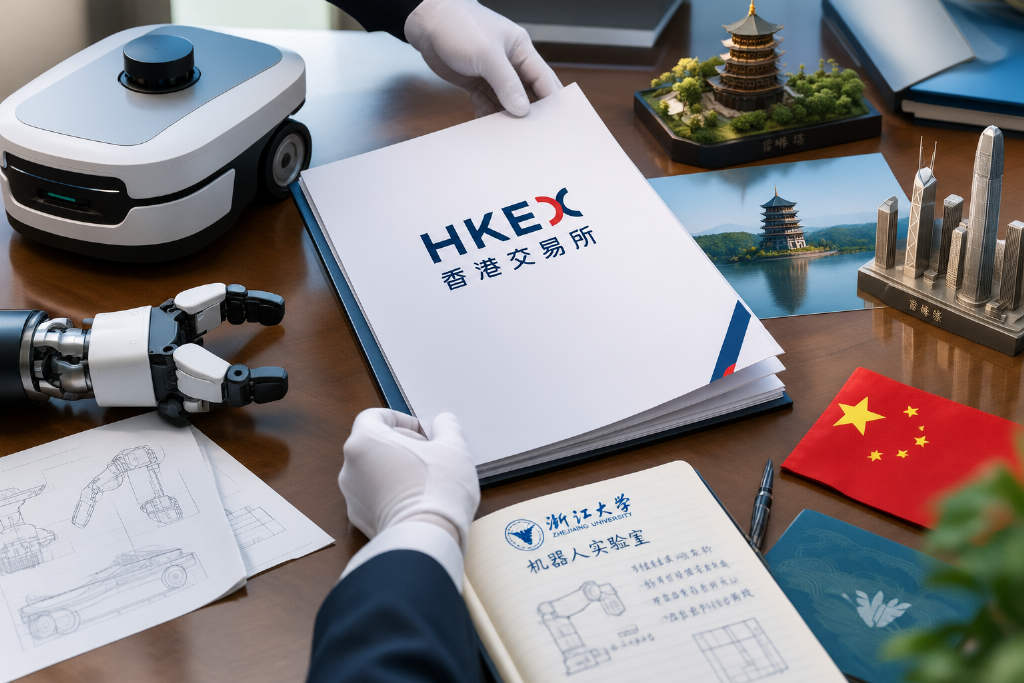
Jiazhi Technology Co., Ltd. has filed again for a main-board listing on the Hong Kong Stock Exchange, seeking to go public under Chapter 18C. The company was founded by Xiong Rong, a professor at the College of Control Science and Engineering at Zhejiang University.

According to Tiantian IPO, Xiong is among the early pioneers in China’s robotics competition scene. Her track record stretches back to 2001, when she led Zhejiang University students to build the school’s first-generation soccer robot. Over the following decades, she continued to lead teams in domestic and international competitions. In March this year, the International Federation of Robotics released its list of the 11 Women Shaping the Future of Robotics 2026, and Xiong was the only Chinese name on it.
From a university lab to a startup
Xiong grew up in Taicang, Suzhou. When she was in middle school, she passed by a computer training class in her county and signed up on impulse. Over one summer, she became familiar with BASIC and saw, for the first time, a computer playing chess against a human. In the 1990 college entrance examination, she applied to the computer science department at Zhejiang University.
Seven years later, she completed her master’s degree in computer science at Zhejiang University and stayed on at the State Key Laboratory of Industrial Control Technology. Her early work there included managing the lab’s email and servers, designing web pages, and taking part in some basic software development.
The shift came in 2000. Chu Jian, then director of the lab, heard that soccer robot research was gaining momentum overseas and asked whether she wanted to try it. Xiong came from a computing background and was not trained in mechanical engineering or electrical control. At that point, she did not even have a clear concept of what a robot was in practical terms, but she still took on the project.
There was no ready-made team. She posted a recruitment message on the Zhejiang University BBS and eventually started from scratch with three students, forming the university’s original robotics team. China’s robotics industry was still in its early stages, and books on the subject were scarce. Xiong spent her free time in the library gathering whatever materials, papers, and technical literature she could find, while also taking students on research trips.
After hearing that Northeastern University had assembled its own soccer robot system, she made a special trip there to learn from the team. But when she saw the system, which had taken two years to build and still wobbled even when moving in a straight line, she was struck by how difficult the task would be.
Soccer robots came first, then commercialization followed
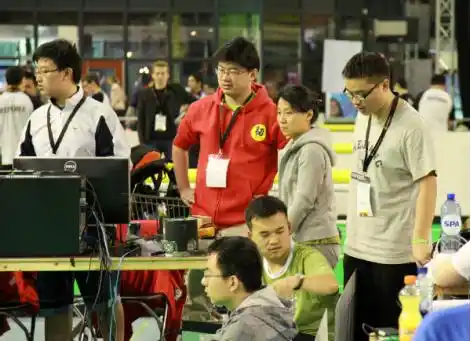
One year later, Xiong and her students developed Zhejiang University’s first FIRA soccer robot. That marked the start of the team’s run in robotics competitions at home and abroad. The Zhejiang University team she led won the small-size robot soccer World Cup four times. In the 2019 final, it beat Germany’s ER-Force team 1-0.

Xiong’s work in robotics was closely tied to generations of students. In those early years, the lab resembled a small startup more than a conventional academic research space. There were few prior examples to follow. Team members later recalled that the room often carried the burnt smell of soldered circuit boards.
In 2015, the team developed what the report described as China’s first trackless autonomous-navigation AMR intelligent handling robot. Around 2016, practical demand for industrial mobile robots began to emerge, and the market and investors started paying closer attention. The team decided the results could no longer stay inside the lab.
In July 2016, Xiong and several students founded Jiazhi Technology in Hangzhou. The company was established with registered capital of 5 million yuan. Xiong held 49%, while Chen Shouxian, who later became CEO, held 2.4% at the time.
Chen had joined Xiong in robotics competitions while he was still a student and won a world championship with the team. Much of Jiazhi’s core founding group came from the robotics lab under Zhejiang University’s Institute of Intelligent Control. Teachers and students who once tuned robots together and stayed up late preparing for competitions became startup partners.
Industrial intelligent logistics became the focus
At the beginning, the company’s direction was not immediately clear. Chen later recalled that around 2017, the team explored service robot applications in hotels and shopping malls, at one point feeling like it was carrying a hammer and looking everywhere for nails. After comparing scenarios, they concluded that industrial environments, with their demands for positioning accuracy, reliability, and environmental adaptability, were a better match for the team’s long-standing strengths in mobile robotics.
Xiong’s view was that the team was also capable of developing autonomous driving systems and service robots. Even so, it chose to focus on industrial intelligent logistics, based on the value that segment could bring to manufacturing upgrades.
To deploy AMR systems for a leading domestic panel maker, Jiazhi stationed a team inside the factory, spent two to three months sorting through dozens of process flows on the module production side, and went through repeated rounds of adaptation with the client. It eventually customized a dedicated robot and put about 200 units into use in one batch.

That is how Jiazhi’s products were refined, inside factories and through repeated operational adjustments. In 2018, its first AMR product, EMMA V1, reached commercialization. In 2020, the company launched the outdoor mobile robot LUNA 2. In 2021, it introduced the commercial omnidirectional heavy-load OMNI and the fork-picking FOLA series. In 2022, it entered the mobile manipulation robot segment. In 2025, it launched the embodied-intelligence mobile chassis NERA-P.
Funding rounds built up over a decade
Capital followed as the company expanded. Just six months after it was founded, Jiazhi received angel investment from Ginkgo Valley Capital. It later brought in Paladin, Ankong Technology, Yunyi Investment, Huiyou Investment, and Hongrong Capital, among other backers.
In 2021, ByteDance-affiliated Quantum Leap and Lenovo Capital joined the cap table. Xianghe Capital then led the B+ round, with Shenzhen Capital Group and others participating. After that, SUPCON Technology, Fangguang Capital, and several Zhejiang local state-owned funds added more money. At the beginning of 2026, the company completed a C++ round at a post-money valuation of 2.13 billion yuan.
That decade of operations is now reflected in its prospectus. Revenue came in at 74.95 million yuan in 2023, 110 million yuan in 2024, and 260 million yuan in 2025. In the first half of 2026, revenue reached 169 million yuan, up 25% from a year earlier. The company shipped 891 robots during the period and had about 500 million yuan in contracts on hand at period end.
Industrial AMR remains the core of the business. In the first half of 2026, robot solutions contributed 147 million yuan, accounting for 87.3% of total revenue.
Robot companies are crowding into the IPO market
The listing pace for robot companies has been picking up. Huayan Robotics, Estun, LeDong Robotics, SEER Robotics, and Rokae have completed Hong Kong listings. On Aug. 19, Unitree Technology listed on Shanghai’s STAR Market. In early September, Mech-Mind debuted in Hong Kong, and Youdi Robotics completed its offering.
According to incomplete statistics cited by Tiantian IPO, more than 50 robot-related companies are lining up at the Hong Kong exchange alone. AgiBot, DEEP Robotics, and Leju Robotics have already entered the IPO process. LimX Dynamics, Galbot, Zhifang, and Variable are among those that have also signaled listing plans. At the same time, a number of companies, including Xinghaitu, Zhongqing Robotics, Songyan Power, X-Movement, Stardust Intelligence, and Fourier Intelligence, have completed shareholding reform and moved into IPO preparation.
To some extent, this marks what the report called a ten-year appointment for China’s first generation of robotics startups. Around 2015, as artificial intelligence and intelligent manufacturing gained momentum, research achievements from university labs began moving into industry. Jiazhi was part of that wave. Ten years later, venture capital firms, industrial capital, and local state-backed investors that bet on the sector are now approaching a possible exit window.
A broader group of Chinese robotics companies is moving toward the capital markets, trying to enter the public market before the current financing window narrows further. At the same time, capital is concentrating more quickly in a small number of leading names. The report said that since the start of 2026, sector leaders have secured financing worth tens of billions of yuan in only a few months, while companies below the top tier have seen fundraising slow materially.
Chapter 18C opens a route, but not a soft landing
Robotics remains a long-cycle, capital-intensive business. Every stage requires money: technology development, prototype testing, supply-chain buildout, on-site deployment, commissioning, after-sales support. For companies still investing heavily and not yet generating stable profit, an IPO is a key step toward public-market financing and M&A tools, while also creating exit conditions for early shareholders. Companies that remain outside the market still face pressure tied to follow-on funding, valuation, and cash burn.
Hong Kong’s Chapter 18C provides a route for specialist technology companies that do not meet the profit tests under Chapter 8 of the main board rules. It is designed to support listing fundraising for product commercialization and business expansion, while imposing corresponding eligibility, disclosure, and investor-protection requirements.
Even so, listing is not the same as arriving safely. The report noted that in March this year, Huayan Robotics drew more than 5,000 times subscription in its public offering, yet its shares at one point fell below the issue price on debut. Two months later, EFORT W.F.C. Technology did not bring in cornerstone investors and did not set up an over-allotment option, but its stock still jumped 80% on the first trading day, taking its market value above HK$13 billion. As more robot IPOs hit the market, secondary-market responses are diverging.
Primary investors may focus on technical route, team background, and long-term upside. Public-market investors ask harder questions about gross margin, customer concentration, collection cycles, and cash flow. Zhou Zhifeng, managing partner at Qiming Venture Partners, previously told Tiantian IPO that robot and embodied-intelligence companies face three major tests after reaching the public market: the ability to commercialize at scale, whether the technology route can converge, and whether they can improve hardware cost, gross margin, and supply-chain management. In his view, 2027 will be an important validation window for robotics and embodied-intelligence companies.
For Jiazhi and its peers, the filing is only the start. The harder stage comes after that.