


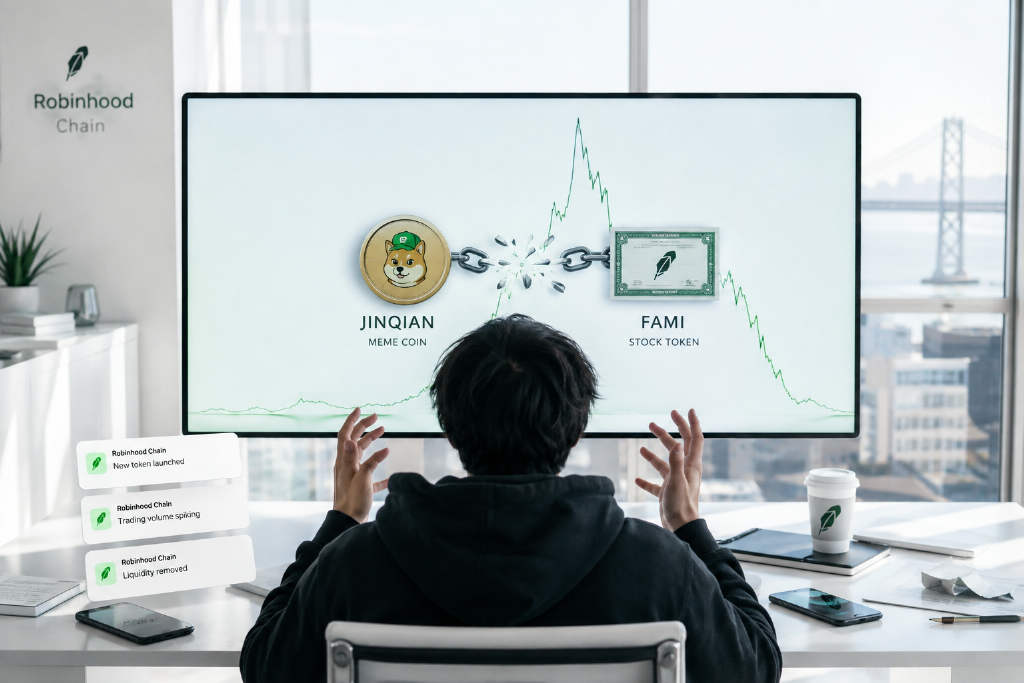
JINQIAN, a stock-paired meme token on Robinhood Chain, exploded to an $80 million market capitalization within an hour of launch on the night of Sept. 2. In the next hour, it dropped to $10 million. By publication time, its market cap had shrunk to about $3 million.
The move was tied to a broader narrative that a meme coin could funnel demand into tokenized equities and eventually force buying in the U.S. stock market. For a brief stretch, JINQIAN was framed as a possible crypto version of a GameStop-style squeeze. What followed looked very different.
Rune’s post set up the trade
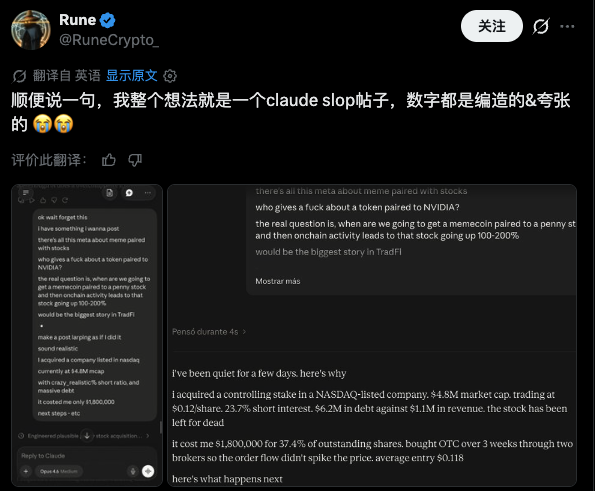
The story began with a Sept. 1 post from overseas KOL Rune. He said he had spent $1.8 million in an over-the-counter deal to buy 37.4% of a Nasdaq-listed company. According to the post, the company had a market capitalization of $4.8 million, a share price of $0.12 and short interest of 92.3%.
Rune said the plan was to tokenize the company’s stock on Robinhood Chain and then issue a meme coin paired with that stock token. In his telling, if the community traded the meme token, demand would spill into the stock token, which would then affect the issuer’s purchases of an equivalent amount of real U.S. shares and create a short squeeze in the equity market.
That idea quickly spread because it tapped into a familiar retail narrative: crypto traders versus institutions, retail versus Wall Street. One day later, JINQIAN arrived.
JINQIAN paired with FAMI as Farmmi shares jumped
JINQIAN was paired with the stock token FAMI. Farmmi, which trades on Nasdaq under the ticker FAMI, is a company that mainly sells mushrooms.
As JINQIAN’s market cap climbed, the on-chain price of FAMI also rose. During U.S. trading hours, Farmmi shares touched $0.47, a gain of more than 300% in one hour.
On the surface, that looked like confirmation that meme token demand could move into an equity linked by a token pair. Later details undercut that interpretation.
FAMI was not an official tokenized stock
The article says the FAMI token used in the pairing shared the same ticker as Nasdaq-listed Farmmi, but it was not an official tokenized stock. It also says the asset did not appear on Robinhood’s official contract list.
That point matters. If JINQIAN trading pushed up demand for FAMI on-chain, the issuer behind that token may not have been buying Farmmi shares in the actual stock market at all. The squeeze mechanism imagined by Rune may never have existed in practice.
After JINQIAN collapsed, Rune moved to distance himself. The article says that while he had been asking the community for an airdrop, he later posted that his earlier claims about acquiring a U.S.-listed company were Claude-generated "AI slop" and entirely made up.
If on-chain demand did not transmit, who bought the stock?
Rune’s clarification was described in the article as a self-protective move. It says investors who lost money were already preparing to contact the FBI to have him arrested.
The more interesting question was what actually pushed Farmmi shares higher. If JINQIAN-driven trading demand in the on-chain FAMI token did not pass through to the real equity market, why did the stock rise anyway?
The answer offered in the piece is that meme traders themselves bought the stock. Some participants tried to get ahead of market makers and Wall Street players by buying Farmmi shares before those players were supposedly forced to step in. Because Farmmi is a small-cap stock, retail buying alone was enough to send the shares up by more than threefold in a short period.
0xSun’s breakdown of the JINQIAN/FAMI structure
Chinese-speaking KOL 0xSun later outlined how an on-chain stock squeeze would work under a more standard structure. Retail traders who do not already hold the stock token buy the meme coin first, pushing up the price of the stock token that sits underneath the liquidity pool. Market makers then see an arbitrage gap, buy the underlying stock, convert those shares into tokenized stock on-chain and pull pricing back toward parity. Their stock purchases would then push the real shares higher and reinforce the squeeze.
0xSun said that was not what happened in JINQIAN/FAMI. In his analysis, a non-compliant project team issued the FAMI token on-chain, retained minting authority and may also have left the liquidity pool unlocked. In that case, FAMI was essentially just an on-chain token using the same name as Farmmi.
Because Farmmi itself had a very small market capitalization, the setup fed a wave of on-chain speculation. Retail traders piled into JINQIAN, lifting FAMI as the pool asset. Some traders then took the logic one step further and bought Farmmi shares directly, which in turn pushed up the stock price.
Under that sequence, Farmmi did rise, but not because a formal tokenized-stock pipeline forced buying in the underlying market. As the article puts it, the result was right while the process was wrong.
The broader "Meme coin squeezes Wall Street" pitch
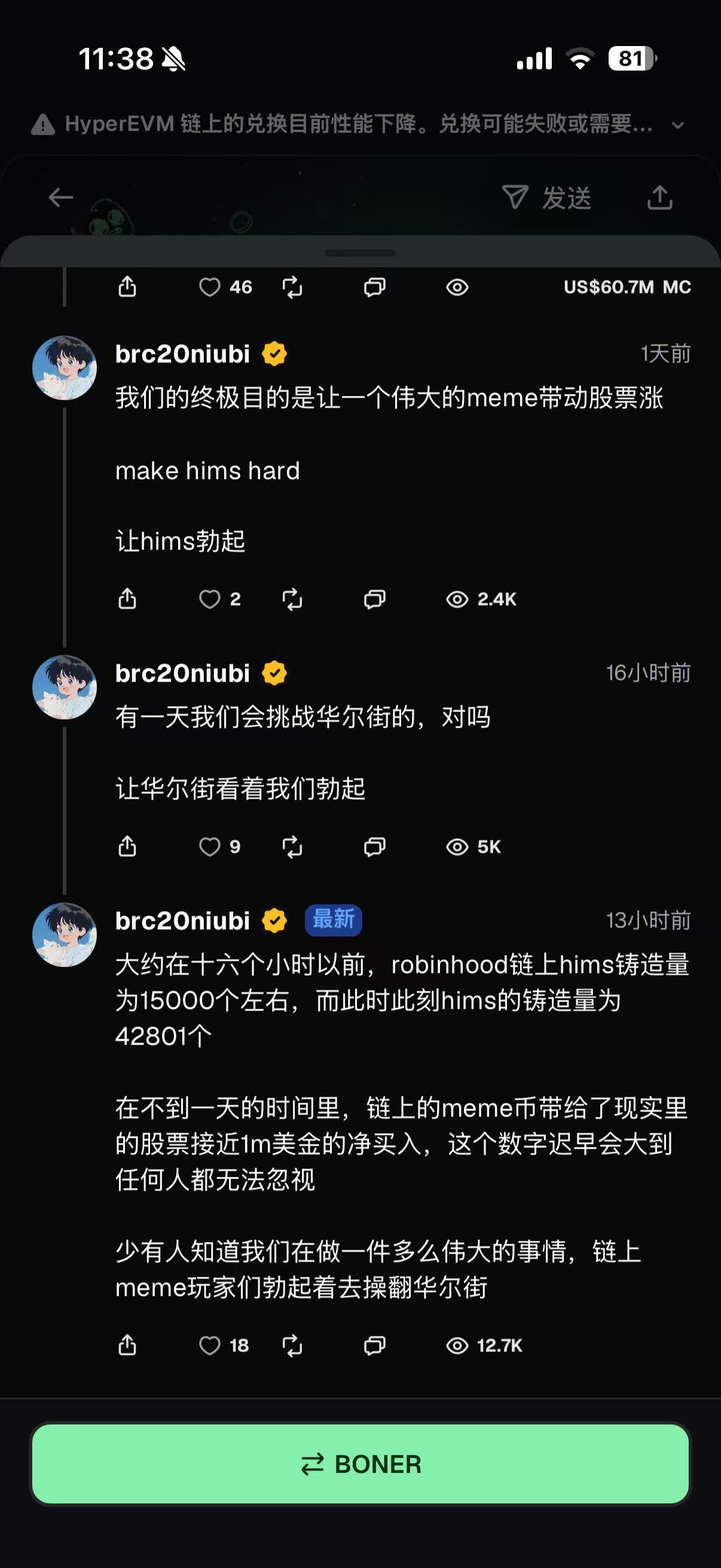
The article widens the lens beyond JINQIAN. It says JINQIAN was not the only stock-paired meme token sold with a "Meme coin squeezes Wall Street" story. A more prominent recent example is BONER, which was reported at a $44 million market capitalization.
BONER is paired with the stock token HIMS. Hims, which trades under HIMS, is described in the article as a company mainly selling erectile dysfunction medication. Chinese-speaking meme KOL Wang Xiaoer publicly promoted BONER and said its ultimate significance was to make meme-driven stock gains real and to challenge Wall Street.
The article argues that using a meme token to lift a linked stock token is, at bottom, an indirect and inefficient form of market manipulation. The so-called flywheel is presented as a mechanism through which market makers or project teams use retail speculation to channel money into the underlying stock market and create short-term price gaps.
But that demand is driven by sentiment rather than fundamentals. It is fragile. Even if a token briefly trades at a large premium to the underlying stock, arbitrage and price reversion are likely to drag it back toward the share price quickly.
Why the timing and structure matter on Robinhood Chain
The article also says there is only one issuer of stock tokens on Robinhood Chain: Robinhood itself. Only authorized participants, or APs, can subscribe for and redeem those tokens directly with Robinhood.
Even when an AP subscribes for stock tokens, the transfer of capital into the real stock market is not instantaneous. The process is constrained not only by U.S. equity trading hours, but also by compliance, settlement and custody procedures.
That creates a basic mismatch. Meme-driven FOMO on-chain can burn through in a matter of hours, while any transmission of demand into the stock market may not even have started during that same window.
Profit still keeps the narrative alive
The article ends by noting that whether the thesis works in reality may not matter much to some traders. It says Wang Xiaoer is already sitting on more than $800,000 in unrealized profit on BONER.
For retail traders, Wall Street and institutions remain a convenient shared opponent in market storytelling. A trade that promises profit while claiming to corner that opponent is naturally compelling.
JINQIAN’s path from $80 million to about $3 million in roughly two hours, though, put the risk of that trade in plain view.