
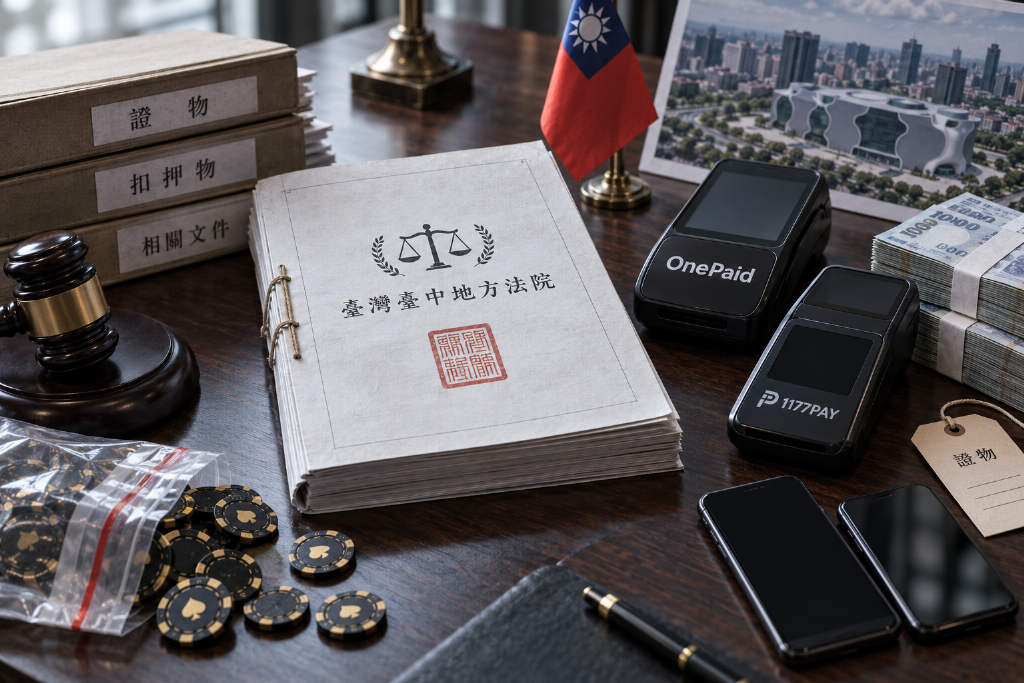
The Taichung District Court issued a first-instance ruling in the Jiuzhou gambling group case on Oct. 2, sentencing group president Chen Zheng-gu to 11 years and 8 months after combining convictions for organized crime and bribery. The court also ordered the confiscation of more than NT$32.9 billion in illegal business proceeds. According to the ruling, companies tied to the group developed two third-party payment systems, OnePaid and 1177PAY, specifically to collect gambling funds for the group’s own betting websites. The case remains subject to appeal.
45 defendants and 10 companies were included in the ruling
The case covered 45 defendants in total, including 35 individuals and 10 companies. In addition to Chen, former Taiwan eSports League chairman Hsu Pei-ching was sentenced to a combined seven years, while Chen’s key aide Shih Chen-kang received five years. The remaining 32 defendants were given prison terms ranging from five months to five years and eight months. The 10 companies were fined between NT$10 million and NT$80 million.
Court says the group built its own payment rails to collect gambling funds
The collegiate panel found that the group had a detailed internal division of labor. Gambling websites were operated and maintained by three companies — Ganggu, Xianggu, and Oubosen — and served customers across Taiwan, China, Vietnam, the Philippines, and Indonesia.
On the payments side, the court said Ganggu developed OnePaid and Yiyiqiqi developed 1177PAY. The ruling found that both systems were used to connect the websites to illegal funds. When prosecutors filed charges in 2024, they alleged that from 2017 to May 2023, the group collected about NT$43.8 billion in gambling funds through the two systems.
How the money moved through virtual accounts, money rooms, and nominee accounts
Investigators from the Ministry of Justice Investigation Bureau explained the system’s operation during the 2024 probe. As described in the ruling, gambling websites first used shell companies to register as merchant members of third-party payment firms. The payment firms then issued virtual account numbers to gamblers, who wired money into those accounts.
- The virtual accounts were in fact linked to the payment companies’ own bank accounts, where the money first arrived.
- Staff in so-called money rooms then used online banking to move the funds into nominee accounts held by fake merchants.
- Because both the receiving side and the payout side were controlled by the same group, banks only saw transactions between payment companies and merchants, cutting off the visible link between gamblers and the casinos.
The ruling also described where the money went next. Funds from Ganggu were transferred to Weiqun Technology to cover payroll and the development of new gambling platforms. Other funds were laundered through offshore companies, cross-border remittances, underground remittance channels, and investment companies. The ruling said money also flowed through Babajiu and Xinxin into luxury car rental and trading, and through Caicheng and Donghui into land purchases and property development projects.
Bribery findings involved cash, a vehicle, lodging, and gifts
The court also found that between February 2023 and May 2024, Chen and Hsu bribed Lin Ming-tso, then head of the Taichung Criminal Investigation Corps and later promoted to police inspector at the Criminal Investigation Bureau, in exchange for investigative secrets that would help Jiuzhou avoid scrutiny. The ruling noted that Lin has since changed his name to Lin Kang-cheng.
The benefits identified by the court ranged from cash to a vehicle and lodging. The arrangement began with a NT$200,000 transfer from Hsu. Lin then used a Range Rover Sport P400 free of charge. The vehicle had a market price of NT$4.62 million, and the court calculated that the free use saved him about NT$401,000 in rent. He also stayed in a serviced apartment suite in Taichung arranged by Hsu, producing rental benefits of about NT$261,000.
The court also found that Chen, through Hsu, sent premium pu-erh tea and arranged for Lin to use an infrared device valued at NT$1.2 million. The most expensive item was a bottle of whisky. After obtaining search-related intelligence, Chen instructed Hsu to deliver a 71-year Macallan RED series bottle worth NT$2.58 million as a gesture of thanks, according to the ruling.
Proceedings involving Lin were separated
Lin himself was not sentenced in this ruling. The court said he had been hospitalized and bedridden with a malignant spinal cord tumor and was unable to appear in court, so the debate stage could not be completed and his portion of the case was separated for later proceedings.
When prosecutors indicted him in August 2024, they accused him of taking bribes in breach of duty, shielding a criminal organization, shielding gambling offenses, leaking secrets, and money laundering. Those counts remain prosecutorial allegations and are still awaiting further trial proceedings.
Court set confiscation below prosecutors’ NT$43.8 billion estimate
The confiscation amount differed from the figure sought by prosecutors. Prosecutors estimated illegal gains at NT$43.8 billion, but the court said that estimate was clearly too high. It ultimately confiscated NT$31.69044 billion in illegal business proceeds from Ganggu and NT$1.2995 billion from Yiyiqiqi, for a combined total of more than NT$32.9 billion.
Sentencing cited destruction of evidence and continued operations after searches
In explaining the sentence, the court said news that investigators were preparing to search Ganggu leaked out, and defendants then destroyed evidence on a large scale. The ruling also said the group did not stop operating after the searches. Core defendants asked subordinates to report their personal situations, and Weiqun continued to allow illegal funds to flow in.
The court added that Chen and others mostly denied wrongdoing or admitted only lesser offenses, which was one reason the court imposed heavier sentences.