

JPMorgan said in its latest report that Hyperliquid may face growing pressure on its market position as regulated U.S. crypto perpetuals trading platforms continue to emerge and competition in prediction markets builds. The bank also said inflows tied to HYPE, Hyperliquid’s native token, have cooled in the ETF market, pointing to softer momentum.
The report was led by JPMorgan Managing Director Nikolaos Panigirtzoglou. The analysts wrote: “We believe the market share of decentralized trading platforms such as Hyperliquid is facing severe challenges. Whether HYPE can eventually surpass other tokens such as Solana (SOL) or XRP in market capitalization remains to be seen.”
Regulated U.S. venues could pull liquidity away
JPMorgan said the first major challenge for Hyperliquid comes from competition with regulated U.S. crypto perpetuals platforms.
According to the analysts, decentralized derivatives venues have long carried a range of structural concerns, including unlicensed derivatives activity, weak anti-money laundering (AML) and know-your-customer (KYC) controls, potential market manipulation and hacking risks, oracle failures, and comparatively limited consumer protection.
JPMorgan said, “As regulated U.S. crypto perpetual products come to market, liquidity is likely to be reshuffled more quickly, with capital moving back in size from offshore and decentralized platforms to compliant domestic U.S. markets.”
Prediction market push brings another layer of competition
Beyond derivatives trading, Hyperliquid has also been expanding into prediction markets in an effort to open up new sources of trading demand.
The report said the platform completed testing earlier this year and formally launched Outcomes in May. The product offers contracts similar to those used in prediction markets, allowing users to trade on event outcomes.
JPMorgan said the prediction market segment is already crowded. Existing platforms and newer entrants are both competing for share, leaving Hyperliquid with another heavy competitive burden.
The analysts added that HYPE’s token value is closely tied to trading activity on the Hyperliquid platform, especially the fee income generated by its perpetuals business. If trading volume growth slows, that would directly weigh on HYPE’s fundamentals.
HYPE ETF inflows have slowed since July
JPMorgan said those competitive pressures are also showing up in HYPE ETF flow data.
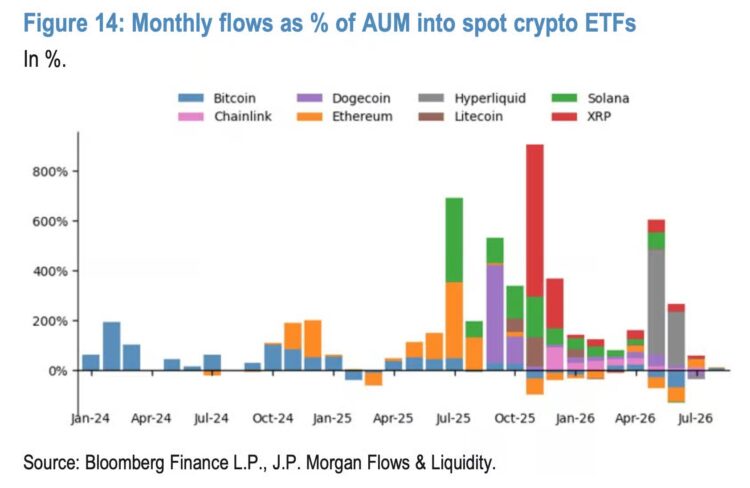
According to the report, HYPE ETFs posted their strongest inflow records in May and June when measured as a share of assets under management, but buying interest has faded since July.
The bank said that pattern does not match the broader crypto ETF market. While the overall crypto ETF segment saw larger outflows in May and June, it returned to modest net inflows starting in July.
Bitcoin ETFs and Ether ETFs still dominate the market, with assets under management of about $77 billion and $10 billion, respectively. Other crypto ETFs are in the roughly $2 billion to $3 billion range, mainly covering products tied to Solana (SOL), XRP, and Hyperliquid (HYPE).
Two indicators now matter most, JPMorgan says
Even with ETF demand stalling, JPMorgan said institutions still show some interest in HYPE. Based on the bank’s data, HYPE currently ranks as the fourth-largest asset in corporate crypto treasury holdings, behind only Bitcoin, Ether, and Solana.
The analysts concluded: “Ongoing tracking of HYPE ETF flows, as well as changes in Hyperliquid’s market share in derivatives and prediction markets, will be the most important indicators for assessing the future outlook for the platform and the token.”