
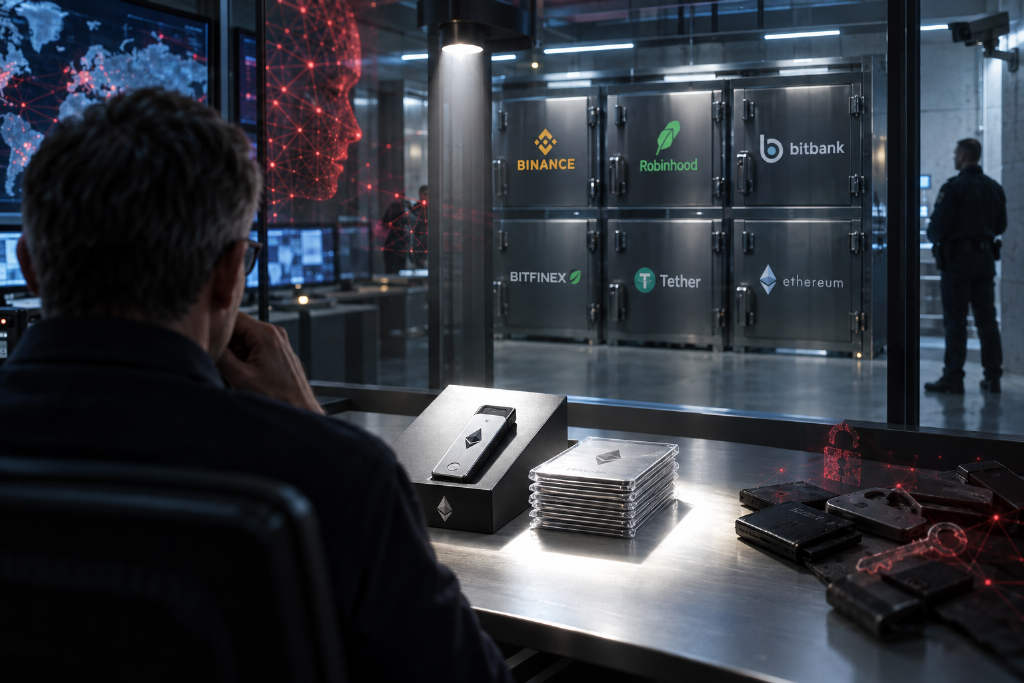
Ethereum Foundation senior researcher Justin Drake has escalated his warning on cryptographic risk, saying AI could break elliptic curve cryptography within “months” and possibly sooner than quantum computers. In a widely circulated post on X, he called for a broad move of crypto assets into fresh wallets built for deep cold storage.
Drake wants the industry, starting with its biggest players, to move most digital assets into new “bunker” wallets that have never signed a transaction. In his view, those wallets reveal less information on public ledgers and could give holders a layer of protection during an initial wave of attacks.
Fresh wallets are at the center of Drake’s proposal
Drake is urging people to create new wallets and store most of their tokens there, rather than leaving funds in addresses that have already signed transactions. A never-used wallet typically exposes only a hash of its public key on-chain. By contrast, a wallet that has already transacted publishes its raw public key in transaction signatures.
Protos notes that this is essentially a restatement of a long-standing Bitcoin security practice: do not reuse addresses. Satoshi Nakamoto wrote in October 2008, “A new key pair should be used for each transaction to keep them from being linked to a common owner.”
Drake framed the idea as a way for large, well-known wallets, including Satoshi’s, to absorb the first wave of attacks before smaller holders are hit. At the same time, his warning is not limited to a narrow set of targets. His position is that AI is coming for everyone.
Vitalik Buterin responded on October 7, 2026: “I don't recommend anyone scramble to move their funds to new wallets today. But we should take the risks to cryptography from AI-accelerated math seriously, and minimize our exposure to not just quantum-vulnerable cryptography, but also potentially AI-vulnerable cryptography.”
He says the biggest custodians should move first
In the X post, which Protos said drew millions of views, Drake asked the industry to enter “bunker mode” through a mass migration to fresh addresses. He said the largest entities and their billionaire operators should get their assets into bunkers first.
He named four major custodians directly: Changpeng Zhao’s Binance, Vlad Tenev’s Robinhood, Babak Zanjani’s Bitbank, and Giancarlo Devasini’s Bitfinex and Tether. Drake’s argument is that firms of that scale should lead the shift.
Why he thinks “bunker” wallets buy time
According to Drake, a Bitcoin wallet that has never transacted exposes only a public key hash on-chain. If an attacker gains the ability to break Bitcoin’s Elliptic Curve Digital Signature Algorithm, or ECDSA, that attacker would first need to reverse the public key hash and then derive the associated private key before stealing any BTC from such a wallet.
He argues that this extra step could matter. A hacker powered by AI or quantum capability might start with easier targets, namely wallets whose public keys are already exposed, such as Satoshi’s wallets.
“Bunker life” means rarely touching the wallet
Drake’s model of bunker life treats never-transacting wallets as deep cold storage. They should not transact except in an emergency.
If a transaction becomes necessary, he says it should be followed immediately by a full sweep of funds into another new wallet that has never transacted, ideally within the same block of transactions. He also states clearly that “Exiting bunker mode safely will require post-AI cryptography” that blockchains like Bitcoin do not currently have in consensus.
From quantum warnings to AI-generated math
Drake has spent months warning about cybersecurity threats tied to quantum computing. In March, he co-authored a paper with Google Quantum AI that suggested breaking ECDSA could be possible with 1,200 logical qubits, a 20-fold reduction from prior assumptions about the physical hardware needed for that kind of breakthrough.
In June, he put the odds of “Q-day” — the day quantum computers crack major forms of modern cryptography — at 10% by 2030 and 50% by 2032.
His latest concern is non-quantum AI systems. Protos said OpenAI published a batch of AI-generated mathematical results on Tuesday. Drake took that release as a sign that mathematical superintelligence may have arrived, warning: “In my opinion it is now reasonable to brace for the possibility that ECDSA breaks before Qday, in the worst case in months not years.”
The Protos report presents Drake’s proposal as a reframing of an established Bitcoin security habit, now placed in the context of a possible AI-driven break in cryptography.