
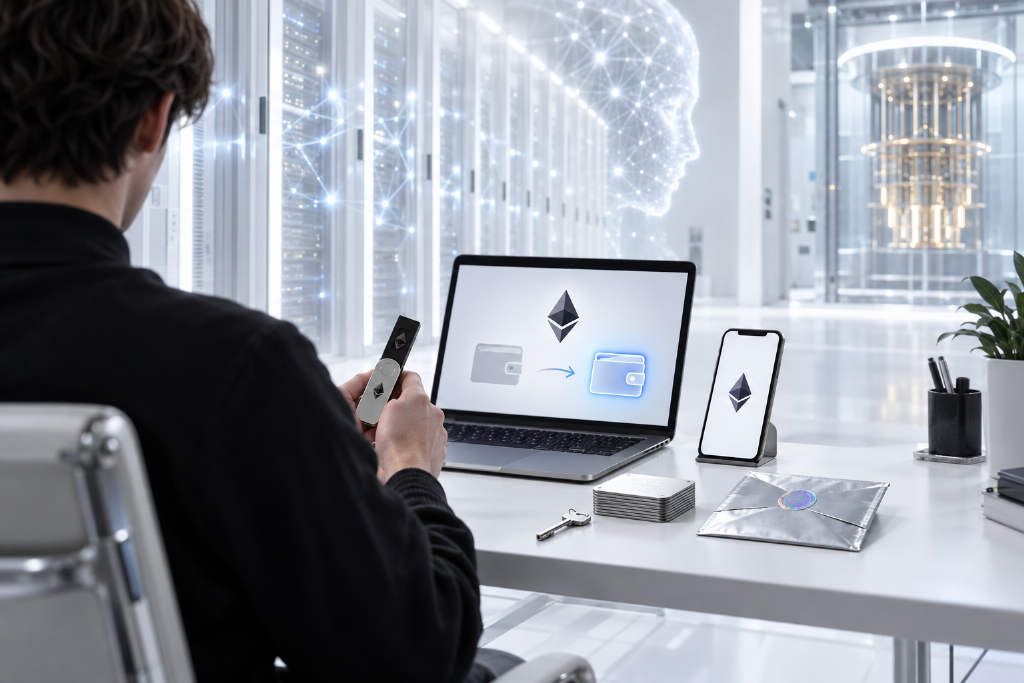
Ethereum researcher Justin Drake said the crypto industry should prepare for what he called "bunker mode," urging users to gradually move assets to fresh addresses as artificial intelligence advances could weaken the cryptography that secures today’s blockchains.
In a post on X on Wednesday, Drake said recent progress in AI, especially OpenAI’s release of mathematical breakthroughs, suggests AI could eventually make it possible to break the elliptic curve digital signature algorithm, or ECDSA, which is widely used to secure cryptocurrency wallets.
"It is now reasonable to brace for the possibility that ECDSA breaks before qday, in the worst case in months not years," Drake wrote.
The warning points to a scenario in which AI enables attackers to recover private keys from exposed public keys earlier than expected, well before sufficiently powerful quantum computers become available.
Mathematical advances sharpen the concern
"Recent days have been humbling for human mathematical intuition. Long-held, unquestioned hypotheses have fallen," Drake said.
On Tuesday, OpenAI released hundreds of new mathematical findings spanning topics including algebra, theoretical computer science and mathematical logic.
Last month, the company said it used a team of 10,000 autonomous AI agents running in parallel to solve the Navier-Stokes equation in 88 hours, describing it as one of the most famous and difficult unsolved problems in mathematics and physics.
Drake said elliptic curves may be especially exposed to superintelligence.
"Curves carry rich structure, with room for fancy tricks like Schoof, Frobenius, pairings. (By contrast, hashes are designed to minimize algebraic structure.)" he wrote.
Drake calls for a controlled move to fresh addresses
"My personal recommendation is to set in motion a controlled mass migration of assets to fresh addresses," Drake said.
He said large and sophisticated crypto holders should be the first to move funds to new addresses. He also recommended moving any remaining funds to a new address after signing a transaction.
His reasoning was that, for these address types, a fresh address hides the public key behind a cryptographic hash, reducing exposure to attacks that require knowledge of the public key.
Signing a transaction can reveal that public key, which is why Drake said the remaining balance should be moved afterward.
Still, he stressed that any migration should be gradual and carefully managed. "A rushed migration would do more harm than good," he said.