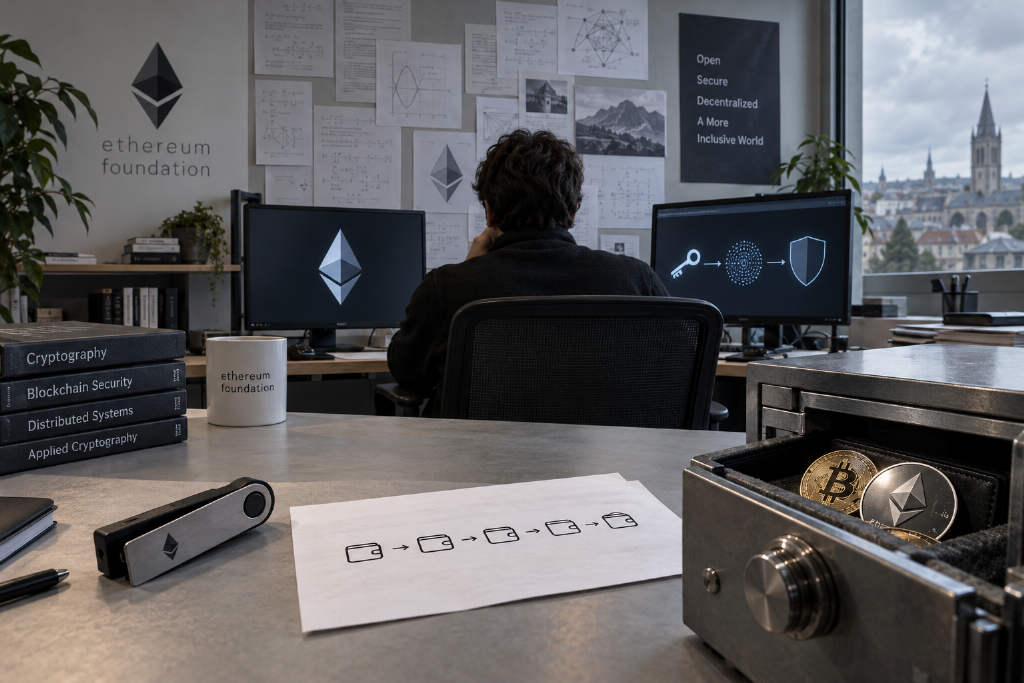
Ethereum Foundation core researcher Justin Drake called on the blockchain industry to enter "bunker mode" after citing OpenAI's release of 722 mathematics papers on Oct. 6. Drake said the development suggests mathematical superintelligence is approaching quickly and warned that AI could eventually enable rapid recovery of ECDSA private keys. He urged users to gradually move assets to fresh addresses and keep public keys hidden behind hashes where possible.
Drake said large holders and trading platforms should move first, while avoiding panic. He also noted that smaller BTC wallets still retain some protection from what he described as "Satoshi's shield." In parallel, he called for faster adoption of hash-based cryptography such as SPHINCS as a standard for the post-AI era.
Responding to Drake's comments, Vitalik said users can prioritize storing funds in addresses that have never sent a transaction when operationally convenient. At the same time, he said users should not rush to move assets immediately, because the migration process itself carries a risk of fund loss. He also suggested that multisig wallets rely on off-chain signature confirmation as much as possible to avoid exposing signature data publicly.
Ethereum Foundation core researcher Justin Drake said on Oct. 8 that the blockchain industry should enter "bunker mode" to prepare for a possible AI-driven threat to ECDSA private keys.
Drake calls for gradual asset migration
In his post, Drake urged the industry to gradually move assets to new addresses and keep public keys hidden behind hashes. The goal, he said, is to reduce exposure if AI reaches the point where ECDSA private keys can be recovered quickly.
He said large holders and trading platforms should take the lead, while avoiding panic. Drake also said smaller BTC wallets still have some protection from what he called "Satoshi's shield."
Warning follows OpenAI's release of 722 math papers
Drake tied the warning to OpenAI's publication of 722 mathematics papers on Oct. 6. He said the papers included disproofs of several long-standing conjectures, including the Erdős unit distance problem and the n log(n) integer multiplication lower bound, and argued that this shows mathematical superintelligence is getting closer at a fast pace.
Push for hash-based cryptography
Drake also called for faster adoption of hash-based cryptography, including SPHINCS, and said it should become a standard in the post-AI era.
Vitalik warns against rushed transfers
Responding to Drake's proposal, Vitalik said users should prioritize storing funds in addresses that have not initiated transactions when that is practical. He did not recommend an immediate, rushed migration of assets, saying the transfer process itself carries a risk of fund loss.
He added that multisig wallets should use off-chain signature confirmation as much as possible to avoid exposing signature information publicly.
This article was originally published by Bit.Fan. For more cryptocurrency news and market insights, visit www.bit.fan. Disclaimer:
The market information, project data, and third-party content displayed on this platform are for industry information sharing only and do not constitute any form of investment advice or return commitment.
Cryptocurrency trading carries high risks. Users should fully assess their risk tolerance and make independent decisions. All profits, losses, and legal responsibilities are borne by the users themselves.