
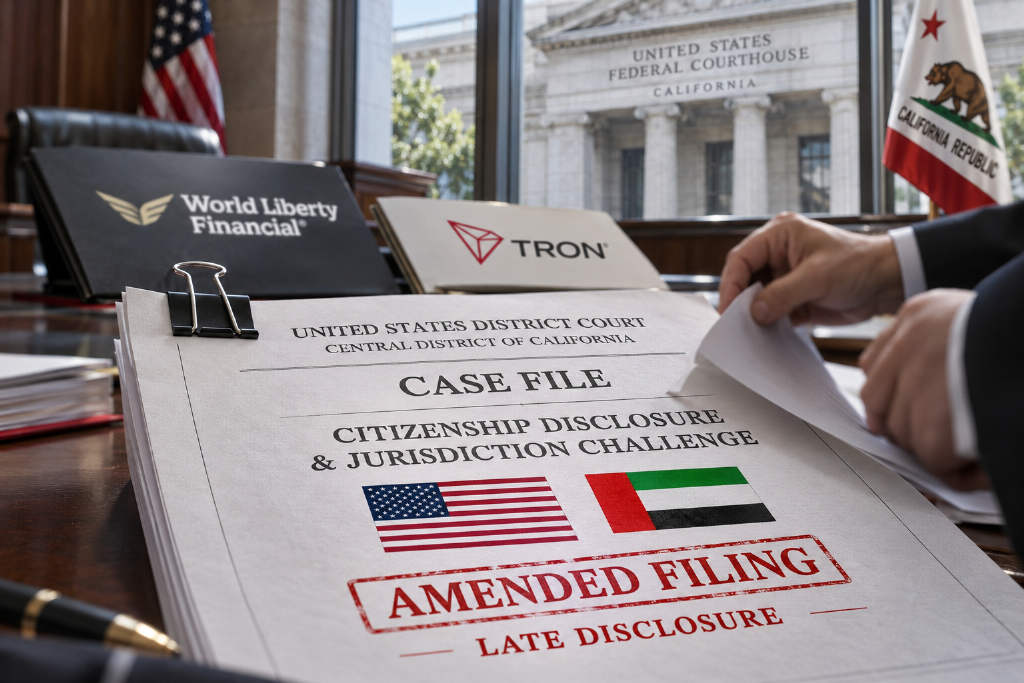
Tron founder Justin Sun has asked a federal court in California to sanction World Liberty Financial (WLFI) and its lawyers, accusing the Trump family-linked crypto company of updating its corporate disclosure months after the case began to add a United Arab Emirates citizenship connection that could undercut federal jurisdiction.
The dispute has moved beyond arbitration and into a fight over where the case can be heard. In a post on X, Sun said WLFI originally told the California federal court that it was a Florida citizen. Months later, after a judge ruled that some of his claims could stay in open court instead of being sent entirely into confidential arbitration, WLFI amended that disclosure and added the UAE as a place tied to its citizenship status.
From major investor to plaintiff
Sun had been one of WLFI's earliest and largest investors. According to the source material, he agreed in November 2024 to buy $30 million of WLFI tokens and later increased his total investment to $45 million.
The relationship broke down in April 2026. Sun then sued WLFI in California federal court, alleging that the company fraudulently induced him to invest and later unlawfully froze the tokens he held, preventing him from using assets he had already purchased. The source says WLFI publicly defended the freeze at the time.
Disclosure changed after an August ruling
The key turn came in August. After a hearing that month, the court ruled that some of Sun's claims would remain in public court while others would go to arbitration. Less than a week after that decision, WLFI revised its corporate disclosure filing.
Before the revision, WLFI had identified itself only as a Florida citizen. Afterward, it listed 22 entities across its ownership chain and asserted citizenship in Florida, Delaware, Puerto Rico and the UAE.
Why the UAE link matters
The issue goes to the threshold for federal jurisdiction in the United States. The source material says federal courts generally cannot hear this kind of case when both sides have foreign citizenship. WLFI is now arguing that the court lacks jurisdiction on that basis.
Sun's position is that any foreign ownership or foreign citizenship connection should have been disclosed from the outset. He argues that his legal team spent months and hundreds of thousands of dollars fighting an arbitration request before WLFI, in his view, turned to its UAE roots only after it could not fully keep the case out of public court.
Sun wrote on X, 「WLFI was very proud to be an American company when it was selling tokens.」 He added that the company discovered its UAE roots only when it needed a path out of U.S. federal court. He is asking the court to hold WLFI and its lawyers accountable, calling the filing misleading, and has said he plans to bring the case again in California state court once the sanctions motion is resolved.
WLFI has not commented, and the court has made no finding of concealment
According to Sun's account, WLFI's lawyers said they learned of the UAE citizenship only after the original filing had been submitted. WLFI did not respond to a request for comment on the latest allegations, according to the source.
At this stage, the accusations remain disputed. The source explicitly says the court has not found that WLFI intentionally concealed anything.
UAE ties had already drawn political and regulatory attention
Viewed over a longer timeline, the case is not just a falling-out between an investor and a crypto project. The source says WLFI's UAE connection surfaced publicly in February 2026, when Abu Dhabi royalty bought a 49% stake for $500 million, prompting senators to call for a national security review.
Then in August, the UAE side again appeared with a 49% stake in the Trump family's trust bank plans. Until now, those links had largely been discussed as political controversy and regulatory concern. In this civil case, they are being used as part of an argument about when the company knew enough to disclose them.
What comes next
Two issues now stand out. The first is whether the sanctions motion can clear the court's high bar. The source notes that sanctions against lawyers usually require proof that a filing was misleading and caused real costs, and Sun's claim of hundreds of thousands of dollars in legal fees is central to that argument.
The second is what happens if the case is refiled in California state court. The source says state court would not face the same federal jurisdiction limits, but moving the same dispute to a different court could reset questions around timing, discovery scope and the damages that may be sought. Whether WLFI has found an exit or only a longer route through litigation will depend on rulings in the months ahead.



