
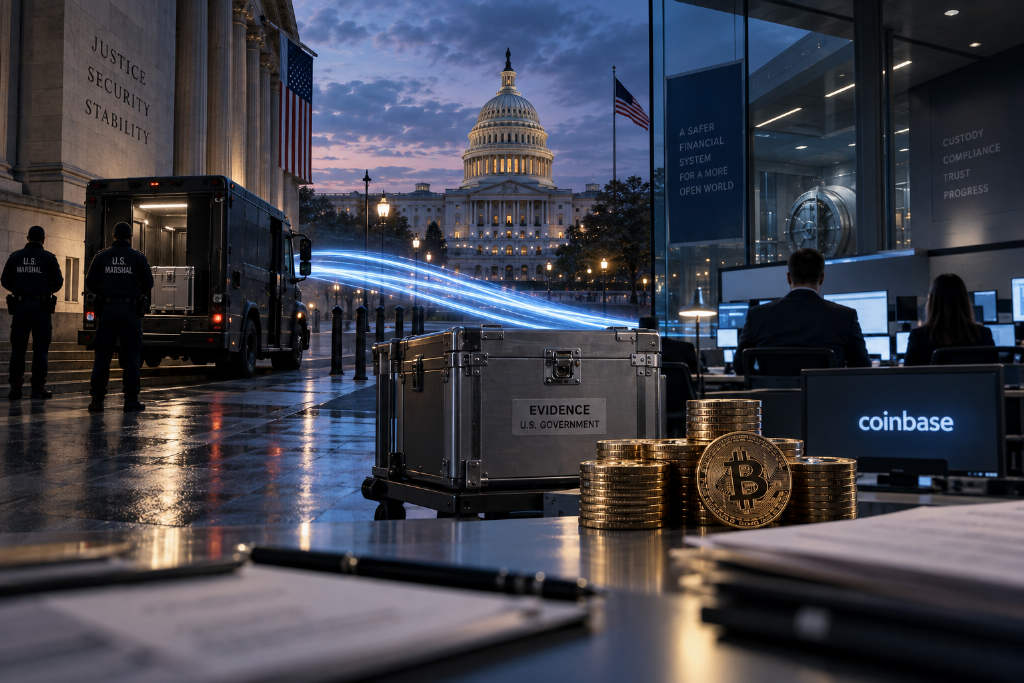
K33 Research said in a new weekly report that the U.S. government moved about 17,700 BTC to Coinbase Prime this week, including coins linked to the Bitfinex hack case, but said the transfers mostly look like custody operations rather than direct selling.
U.S. government sends BTC to Coinbase Prime
According to the report, the U.S. government transferred about 17,700 BTC to Coinbase Prime this week. One transaction involved 12,267 BTC tied to the Bitfinex hack case. Labeled government holdings fell from 324,527 BTC to 306,795 BTC after the move.
K33 added that if wallets that appear to be government-controlled but are not yet labeled are included, about 21,500 BTC may have entered Coinbase Prime. The coins moved through test transactions and one-time addresses before being consolidated into deposit addresses.
The firm said most of the transfers probably do not indicate selling. Since 2024, Coinbase Prime has served as custodian for the U.S. Marshals Service, so moving coins there can be part of a custody workflow.
K33 said the Bitfinex-related coins are still tied up in the claims process, with the Department of Justice seeking to return the BTC in kind. It added that the strategic bitcoin reserve’s no-sale restriction applies only to fully forfeited coins and still allows returns to victims.
The report also noted that about 1,200 BTC tied to FTX and HashFlare moved this week. Those coins may be sold because victims could be compensated in cash through remission procedures. K33 said those funds used the same deposit address as the Bitfinex tranche, pointing to an account controlled by the U.S. Marshals Service.
Bitfinex distribution timing is the main supply issue to watch
K33 said that around 15,000 BTC out of roughly 109,700 BTC in Bitfinex claims moved over two days. In its view, that may suggest distribution preparations are underway, or that there is a ruling the market has not yet seen.
Bitfinex has pledged to use at least 80% of net recovered funds to repurchase LEO. If the coins are distributed and then sold, as much as about 85,000 BTC could come to market over 18 months, or roughly 150 BTC per day, according to the report.
Treasury withdraws two older crypto rule proposals
K33 said a notice released Monday showed that the Financial Crimes Enforcement Network, or FinCEN, is withdrawing two older crypto rule proposals.
One was a 2023 plan that would have designated international crypto mixing as a primary money laundering concern and required banks to report related transactions down to wallet addresses and IP addresses.
The other was a 2020 proposal that would have required identity verification and recordkeeping for transactions involving self-custody wallets.
FinCEN said the definition of mixing was too broad, could chill legitimate privacy use, and would impose heavy reporting burdens on institutions.
Robinhood adds BTC and expands crypto push
Robinhood added $25 million worth of bitcoin to its balance sheet, the report said. Senior Vice President Johann Kerbrat said the purchase was meant to show the company’s commitment to crypto.
Kerbrat also said the amount is small for a company with a market value of about $100 billion and would not materially change Robinhood’s direction.
K33 noted that other public companies are still buying. Strategy added 334 BTC last week and now holds 848,000 BTC.
The purchase fits into a broader crypto expansion. Robinhood plans to launch perpetual futures trading for eligible U.S. users in the coming months. Its Layer 2 chain has reached $1.05 billion in total value locked since launching in July.
Kerbrat also said demand for Robinhood’s stock tokens has hit the trading volume cap allowed under the U.S. Securities and Exchange Commission’s innovation exemption.
In brief
- Standard Chartered will expand crypto custody services in Singapore.
- Moody’s assigned a B3 rating to Sky Protocol, while institutional interest in USDS is rising.
- Coinbase Pro is set to return, and after integrating Deribit it will form Coinbase Global Exchange.
OpenAI math release revives debate over crypto security
On Oct. 6, OpenAI published 377 mathematical discoveries generated by its advanced internal AI models, covering algebra, number theory and computer science. Many of the proofs were verified with Lean, software used to check the logic of mathematical arguments. K33 said the release showed stronger AI capability in higher mathematics, but none of the findings involved breaking modern cryptography.
Even so, the publication triggered concern across the crypto sector. Bitcoin and Ethereum rely in part on the assumption that attackers cannot derive private keys from public keys. Earlier discussions around that risk focused mostly on future quantum computers. OpenAI’s progress raised a different question: whether AI could find shortcuts that let ordinary computers break protections long considered secure.
Justin Drake warns, Vitalik Buterin urges caution
Ethereum researcher Justin Drake warned on Oct. 7 that AI-driven discoveries could weaken the signature systems used by Bitcoin and Ethereum. In his worst-case scenario, a breakthrough could arrive in months rather than years.
Drake urged the industry to prepare for what he called “bunker mode,” recommending that funds gradually be moved to unused addresses whose public keys have not yet been exposed. Those addresses keep the public key hidden until funds are spent, offering an extra layer of protection.
Ethereum co-founder Vitalik Buterin acknowledged the potential risk but did not recommend immediate transfers. He said poorly executed moves could create losses now, while the AI threat remains hypothetical.
Buterin also warned that AI could uncover weaknesses in newer cryptographic methods, including some designed to resist quantum computing. He said the industry should pay more attention to hash-based security systems, which may offer stronger protection against unexpected mathematical discoveries.
Cryptography experts say there is no evidence of a real break
Several cryptography experts pushed back on those warnings. Coinbase head of cryptography Yehuda Lindell said there is no evidence that AI has weakened elliptic curve cryptography, the mathematical foundation behind many digital signature systems.
Lindell said solving hard mathematical problems does not automatically mean existing security assumptions have failed. He added that any genuine breakthrough would threaten far more than crypto, extending to banking websites, software security and other digital infrastructure.
The disagreement reflects a broader debate over whether precautionary action is justified without evidence of an actual vulnerability. K33’s conclusion was that the discussion is mainly about preparing for possible future challenges, not responding to a confirmed security failure.
BTC fell after the OpenAI release, but macro conditions also weakened
K33 said BTC fell from about $86,000 to $80,000 in the days after OpenAI’s announcement. It also said that move should not be viewed in isolation.
The Nasdaq pulled back as well after testing record highs, and risk assets broadly weakened over the same period. In K33’s view, the wider macro backdrop was the main driver.
Author: K33 Research
Translated by: TechFlow