
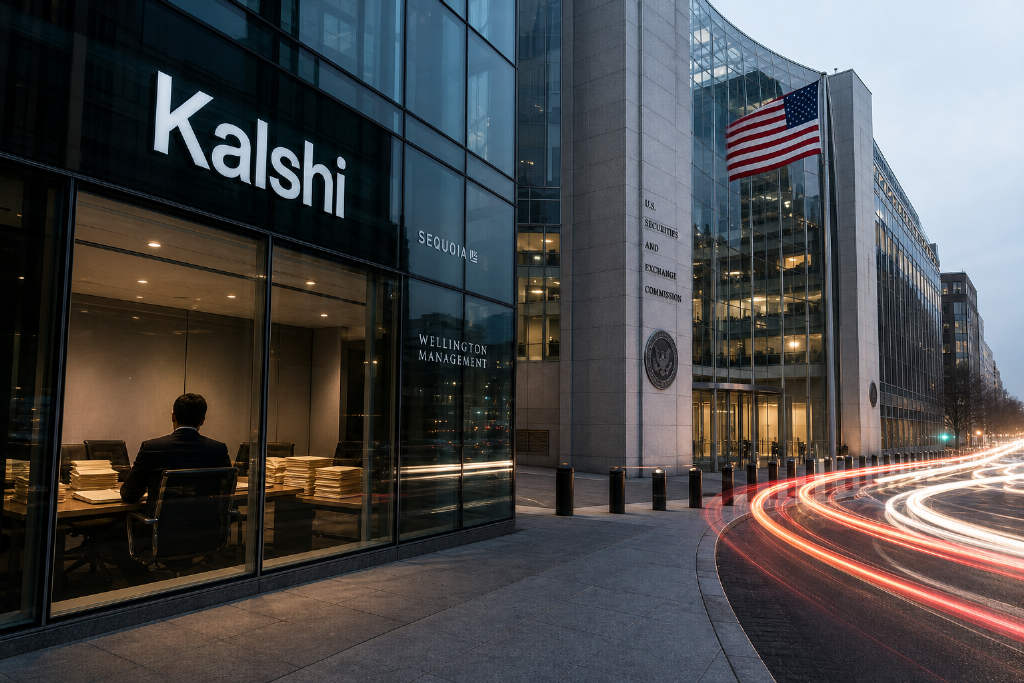
Prediction market platform Kalshi disclosed in a new U.S. Securities and Exchange Commission Form D filing that it has raised about $1.12 billion through multiple private equity sales since April 3, including the $1 billion Series F round it closed in May.
The filing indicates Kalshi has approval to raise roughly $1.5 billion in total, leaving about $380 million available under that amount. At the same time, the source said the company is discussing a new financing round at a $40 billion valuation.
New round under discussion at a $40 billion valuation
According to the source, the new round is sized at $750 million, with Sequoia Capital and Wellington Management identified as the main investors. The Information reported earlier this month that Kalshi and the two firms had entered deep talks on that financing at a targeted $40 billion valuation.
Financial Times reported in June that the funding could be completed in the third quarter of this year. The SEC filing disclosed at the end of August adds to signs that capital is still moving into the company.
Valuation nearly doubled in less than three months after the May Series F
The $1.12 billion total includes the $1 billion Series F round led by Coatue in May. Investors in that round included Sequoia Capital, Andreessen Horowitz (a16z), IVP, Paradigm, Morgan Stanley, and ARK Invest. Kalshi was valued at $22 billion in that financing.
If the company completes the new round at $40 billion, that would imply an $18 billion increase from the prior valuation and a near doubling in less than three months.
July trading volume reached $40 billion
Kalshi recorded $40 billion in trading volume in July, well ahead of the combined $12.9 billion reported for Polymarket and Polymarket US. The source said that put Kalshi at more than three times the total of those two platforms.
The report said the biggest difference between Kalshi and Polymarket lies in the regulatory route each platform has taken. Kalshi received an exemption from the Commodity Futures Trading Commission in 2022, allowing it to operate in the United States through regulated contracts.
- Institutional investors can participate within a regulated structure rather than using offshore arrangements or DeFi protocols.
- Its contracts can cover economic indicators, political elections, climate events, and technology developments.
- Those contracts operate within the CFTC regulatory framework.
The source also described Sequoia’s participation in both the Series F round and the round now under discussion as an important signal.
IPO timing and valuation remain key watch points
The report said Kalshi has repeatedly been asked about listing plans over the past year, and its CEO has confirmed the company is considering an initial public offering. With the valuation moving from $22 billion to $40 billion, attention has shifted to the company’s IPO window.
Among the points highlighted in the source, one is revenue visibility. Kalshi’s annualized revenue has surpassed $2 billion, with growth tripling over six months. The report said that offers some support for a $40 billion valuation, though future quarterly growth will remain under scrutiny.
Another issue is whether that valuation can hold. The source said Kalshi would need to show that its market lead over Polymarket can last at least 12 to 18 months, and that its regulatory advantage will not be narrowed by policy changes.
Legal risk also remains. The source said Connecticut sued Kalshi on Aug. 27, alleging that its sports contracts amount to unlicensed gambling. Whether that litigation risk has already been priced into the proposed $40 billion valuation remains unclear.
The report added that a $40 billion private-market valuation is not the same as public-market capitalization. Even so, it described Kalshi as the first player in the prediction market sector with real IPO-ready characteristics. What comes next will depend on how quickly capital is secured, how the regulatory fight develops, and whether Polymarket can close the gap through its decentralized path.