
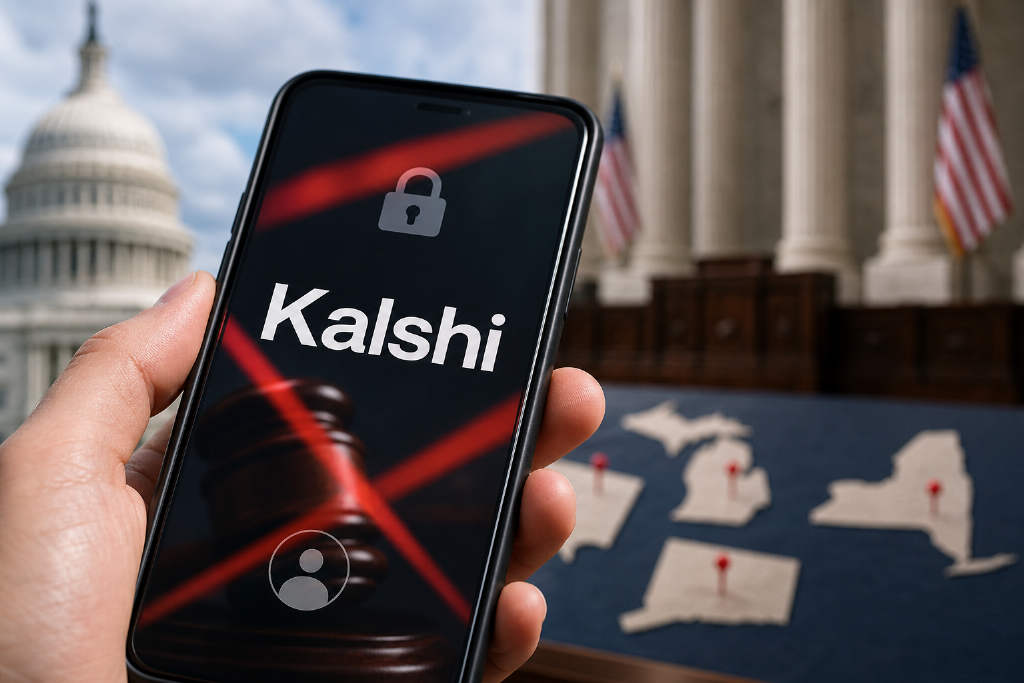
Kalshi is running into mounting resistance across the United States as state regulators and courts move against the prediction market platform, even as the Commodity Futures Trading Commission pushes to build a broader federal framework for the sector.
Users in Washington state lost access to Kalshi this week after a state court, in a lawsuit brought by the state, found that the platform amounted to illegal gambling locally and ordered it to stop offering most event contracts to Washington residents.
In an email sent to users, Kalshi said: 「The State of Washington has blocked your right to freely trade on Kalshi.」 With users in Michigan and Nevada already blocked earlier, the company is now facing pressure from multiple states at once.
Washington, Connecticut and New York are all part of the fight
Washington Attorney General Nick Brown said: 「Kalshi has profited by marketing wagers on sports, elections, natural disasters and even events tied to war with Iran. Under this order, Kalshi is barred from offering bets on most such topics in Washington.」 The attorney general’s office said the court had determined the platform constituted illegal gambling in the state.
On Thursday, Kalshi asked the court to reconsider the ruling, arguing that the state was applying a double standard. According to the company, six days after the court order, the state said it would not enforce against Crypto.com while an appeal is pending, even though Crypto.com offers what Kalshi described as the same prohibited business model. In its motion, Kalshi said: 「The event contracts the state says cannot be tolerated on Kalshi are now freely available to Washington residents, with the state’s blessing, from a competitor in a position identical to Kalshi’s.」
The conflict extends beyond Washington. Connecticut regulators were in federal court this week pressing to apply gambling law to Kalshi. New York continues to challenge recent emergency action by the CFTC that was intended to protect Kalshi’s business in the state. Massachusetts, Minnesota, Ohio, Maryland, Utah and Arizona have also seen legal conflicts, most of them focused on sports betting.
CFTC chairman backs a full regulatory structure
While states tighten pressure, support from the federal level is becoming more explicit. CFTC Chairman Mike Selig has made defending the agency’s 「sole jurisdiction」 over prediction markets a priority and has begun working on a series of formal rules.
At the first meeting of the agency’s Innovation Advisory Committee, Selig said regulators had either 「buried their heads in the sand」 or tried to ban these event contracts outright. He said: 「The CFTC has never built a complete regulatory framework to address the unique policy considerations raised by these products.」
The CFTC is supposed to have five commissioners, but only Selig remains. That gives him room, for now, to act unilaterally on policy decisions. He said that beyond recent rule proposals, the agency would soon modernize oversight of event contracts and 「establish consumer protection requirements」 covering product governance, market design and incentive structures.
TD Cowen policy analyst Jaret Seiberg wrote in a client note that the CFTC’s commitment to consumer protection could reduce the risk that senators attach restrictions on prediction markets to the September farm bill or other legislation.
CME’s Terry Duffy confronts Kalshi and the CFTC
The debate spilled into open confrontation at the advisory committee meeting, where Selig and Kalshi Chief Operating Officer Luana Lopes Lara sparred with CME Group Chief Executive Officer Terry Duffy.
Duffy said prediction markets involve 「a lot of things that are susceptible to manipulation, and that is very bad for our industry. We are not carnival barkers.」 His remarks highlighted the hostility many established derivatives firms feel toward the emerging business.
The larger question is who gets to regulate prediction markets
Prediction markets have recently drawn wider attention from lawmakers and have also triggered opposition from parts of traditional finance. The immediate issue is timing. If the CFTC can move quickly on consumer protection requirements and event contract rules while state bans are spreading, it may strengthen the argument for exclusive federal jurisdiction and persuade Congress to hold back.
If state restrictions continue to spread while a federal framework remains unsettled, the industry could end up operating under a more fragmented regulatory system. Kalshi’s double-standard argument involving Crypto.com may carry weight, but the final answer will depend on the appeals court.
For market participants, the dispute shows how quickly a single state court can disrupt a platform’s legal footing. In an environment where a federal framework and state-level enforcement coexist, compliance costs can rise sharply.