
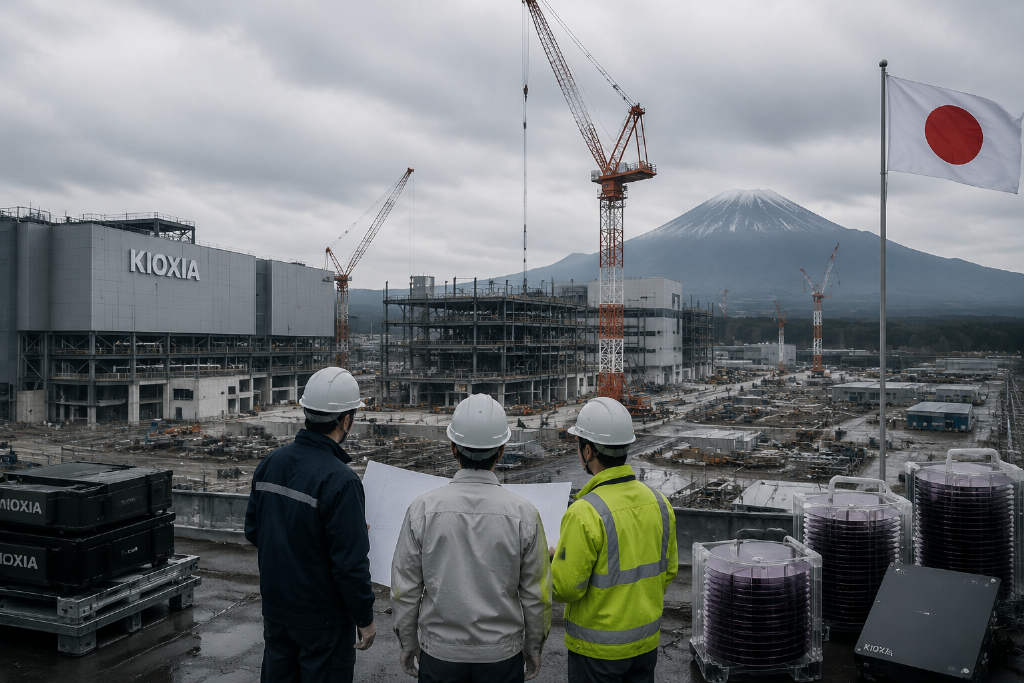
Kioxia is set to pour more than ¥1 trillion into Kitakami, in Iwate Prefecture, to put up a third advanced NAND Flash wafer fab. The bet is tied to a jump in enterprise SSD demand as generative AI pushes data centers to add more storage.
Kioxia adds more NAND capacity in Iwate
Nikkei, cited by ABMedia, said Kioxia recently laid out the plan for its Kitakami Plant in Iwate Prefecture. Total spending will top ¥1 trillion, roughly $6.27 billion, for a third advanced NAND Flash fab. The report tied that outlay to fast-rising demand for high-capacity, high-performance enterprise SSDs used in data centers.
ABMedia said the project also has strategic subsidy backing from Japan’s Ministry of Economy, Trade and Industry. Japan has spent the past few years trying to rebuild its semiconductor sector, backing Rapidus and bringing Taiwan Semiconductor Manufacturing Co. to Kumamoto. And in that setting, helping Kioxia stay competitive in NAND Flash is part of Japan’s push to avoid falling behind Samsung and SK hynix.
Taiwan and Japan sit in different parts of the memory market
The report said Kioxia’s expansion does not put Taiwan’s memory sector at a competitive disadvantage. If anything, the two sides still fit together closely, both in product focus and in supply-chain roles.
Macronix and Winbond are aimed at niche NOR Flash and lower-capacity memory for automotive and industrial control use, while Nanya Technology is focused on DRAM. Kioxia, on the other hand, is centered on high-capacity, high-layer 3D NAND Flash.
ABMedia also said Kioxia’s expansion leans on support from Taiwan’s backend supply chain. It named Powertech Technology for packaging and testing, and module makers such as ADATA and TeamGroup for distribution and product flow. Of those partners, Phison was described as the closest. Closer than the rest. Their cooperation stretches as far as jointly setting specifications.
Phison’s connection with Kioxia dates back to 2001
ABMedia said the relationship goes back to Phison’s early stage in 2001, when Toshiba, Kioxia’s predecessor, invested in the company. According to the report, Kioxia is still one of Phison’s major shareholders.
The business split is pretty clean. Kioxia supplies NAND wafers. Phison takes its controller IC and firmware strengths and turns those wafers into complete SSD modules, then sells turnkey solutions. Phison also joins in joint development manufacturing, or JDM, for Kioxia’s next-generation chips, and provides ODM services for Kioxia’s own consumer and enterprise SSD brands.
The report said that when the memory market is stuck in oversupply, Phison serves as a steady outlet for Kioxia. But when shortages hit, Kioxia gives Phison priority on wafer supply. ABMedia called that setup a key buffer for Phison when the market swings.
Phison CEO K.S. Pua says the shortage has no end in sight
Phison CEO K.S. Pua has said repeatedly in public that “The NAND Flash shortage has no end in sight” ("NAND Flash shortage has no end in sight") and argued that the current shift in the memory market is structural, not cyclical. He said demand used to move up and down with PCs and smartphones, but AI has now become the biggest new variable.
He said AI-generated data is shifting from text measured in KB, to images measured in MB, and then to video data measured in GB and TB. In his words, AI server customers might cut DRAM purchases because of budget pressure, but they cannot cut storage: “How much data you can process and store directly determines your revenue” ("How much data you can process and store directly determines your revenue").
Pua also said it usually takes four years from an investment decision to construction, equipment installation, and mass production. So Kioxia’s current ¥1 trillion commitment will not fix the near-term supply squeeze. He estimated that shortages in the second half of 2026 will be worse than in the first half, and that the supply-demand gap could grow wider in 2027.
To get ready for that kind of market, Phison has adopted what ABMedia called an aggressive inventory strategy. Pua said the stock is there to cover enterprise and cloud service provider, or CSP, projects with lead times of one to two years. His point was blunt: the real issue ahead is not whether pricing is high, but whether supply can be locked in at all.