
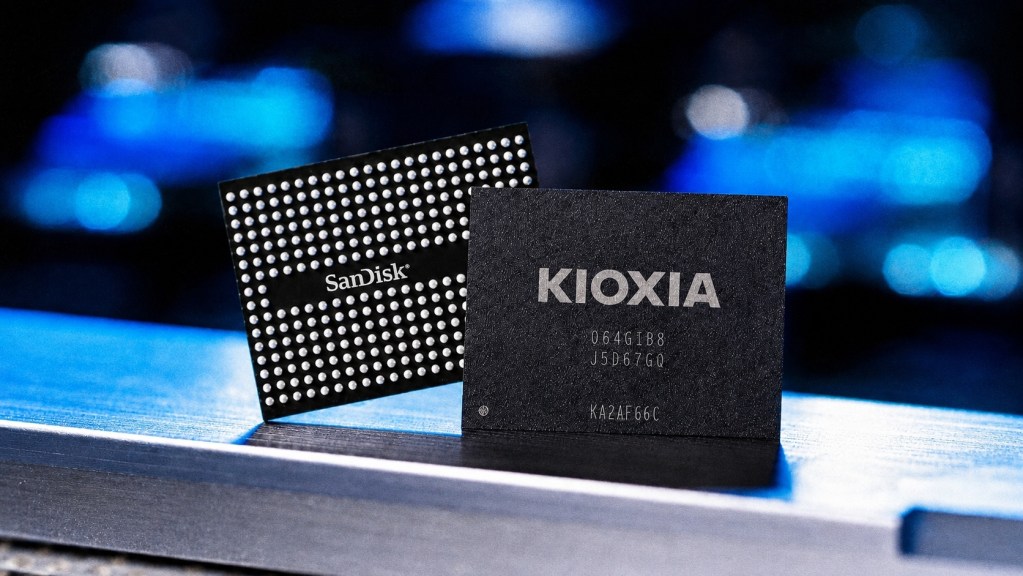
Kioxia started mass production of its 10th-generation 3D NAND, BiCS10, in early July at its K2 Fab in Kitakami, Iwate, Japan, according to a report from South Korean outlet Zdnet. The company has also rolled out a new data center SSD based on the technology with support for PCIe 6.0. Analysts say the cost of ramping yields on the new process may be one of the main reasons Kioxia and partner SanDisk guided below market expectations this quarter.
BiCS10 moves into commercial production with 332 layers
The report said Kioxia formally began mass production of BiCS10 in early July at its K2 Fab in Kitakami. BiCS10 uses a 332-layer vertical stacking design, putting the company into the commercial manufacturing stage for NAND products with more than 300 layers.
Generation naming and layer-count definitions vary across manufacturers, which makes direct comparisons difficult. Even so, the milestone carries clear competitive weight.
TrendForce data cited in the report showed Kioxia held a 13.9% share of the global NAND market in the first quarter of 2026, behind Samsung Electronics at 31.6% and SK hynix at 17.6%, ranking third worldwide. While its revenue scale still trails the South Korean manufacturers, the industry has broadly recognized Kioxia’s aggressive pace in technology development, especially in high-performance NAND tied to AI demand.
PCIe 6.0 SSD and UFS 5.0 products target AI storage demand
Kioxia has extended BiCS10 into two AI-related storage markets.
On the data center side, the company introduced the CM10 enterprise SSD with PCIe 6.0 support. Compared with the previous generation, sequential read performance is up by as much as 92%, while random read performance has improved by about 85%. The report noted that PCIe 6.0 SSDs only entered mass production this year, and CM10 is one of the few products already commercialized for that standard.
For on-device AI, Kioxia plans to begin mass production of UFS 5.0 embedded memory by the end of this year. UFS 5.0 is the latest mobile storage standard to enter commercial use this year, with data processing speed roughly doubling from UFS 4.1. Kioxia’s UFS 5.0 product uses an in-house controller and eighth-generation NAND, targeting premium smartphones with AI features.
Yield ramp costs weigh on near-term margins
The production shift is also showing up in the companies’ financial outlooks. Citrini analyst Jukan said BiCS10 mass production may be one reason Kioxia and SanDisk recently issued forecasts that came in below market expectations.
Chipmakers moving to a new process generation usually go through a yield ramp period at the start. During that phase, unit production costs stay elevated while shipment volumes have not yet reached scale, which directly squeezes gross margin.
Kioxia and SanDisk have long shared capacity through the Flash Forward JV, meaning the cost of the process transition can feed into both companies’ financial performance. Put simply, the faster BiCS10 moves through its generational upgrade cycle, the more visible the short-term pain may become in earnings reports.
Samsung answers with V10 NAND and Hybrid Bonding
Samsung Electronics is also accelerating its response, choosing August to begin mass production of its 10th-generation V-NAND, or V10. The new generation introduces Hybrid Bonding and a 3-stack structure for the first time, with an estimated 430 layers. The report said that gives it an edge over traditional packaging in connection density and signal efficiency.
Industry sources cited in the report said Samsung’s V10 has so far only completed internal Product Readiness Approval, or PRA, and large-scale equipment investment has not started yet. That leaves near-term shipment volumes limited.
AI demand is pushing a new NAND upgrade cycle
As the NAND market enters a new production cycle for PCIe 6.0 and UFS 5.0 in the second half of 2026, major suppliers including Kioxia and Samsung are accelerating generation upgrades during a period of expanding AI demand.
The report said the tension between technology leadership and near-term financial performance is hard to avoid. For Kioxia and SanDisk, the yield ramp tied to BiCS10 is part of the cost of moving early in this round of NAND competition. As more product lines move toward scaled production, the market’s competitive structure and profit profile may be reset around the first half of 2027.