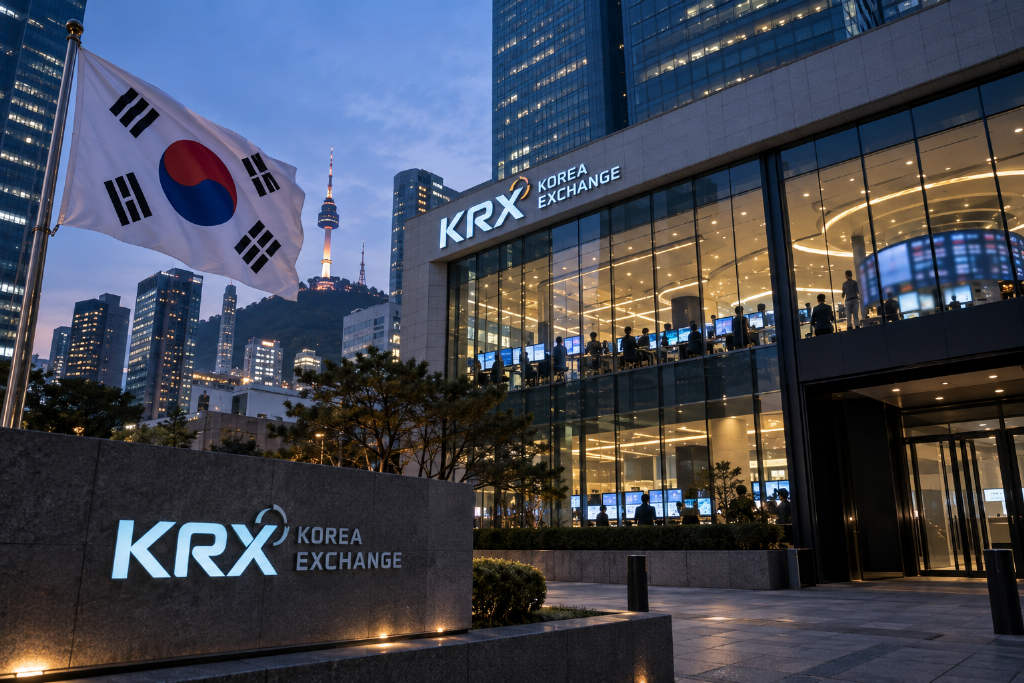
The Korea Exchange has formally launched after-hours trading for stocks, allowing investors to continue trading after the regular market closes. Under the new arrangement, standard trading hours remain unchanged at 9 a.m. to 3:30 p.m., while an added post-close session now runs until 8 p.m. local time.
The exchange also said its planned pre-market session, which had been scheduled to go live the same day, has been postponed to the end of 2027. The delay came after the securities industry raised concerns over the burden of IT system development and staffing requirements.
On another closely watched issue, the Korea Exchange said exchange-traded funds, or ETFs, and exchange-traded notes, or ETNs, will not be included in after-hours trading for now. The exchange cited concerns about market volatility in explaining that decision.
The update was carried by Odaily, citing CCTV Finance.
The Korea Exchange has officially launched after-hours trading for stocks, according to Odaily, which cited CCTV Finance.
Regular stock trading hours remain 9 a.m. to 3:30 p.m. Under the new system, investors can keep trading after the normal close until 8 p.m.
As for pre-market trading, the Korea Exchange had originally planned to launch that session on the same day. That rollout has now been pushed back to the end of 2027 after the securities industry said IT system development and staffing would create a heavy operational burden.
The exchange also addressed whether exchange-traded funds and exchange-traded notes would be included in after-hours trading. It said ETFs and ETNs will not be part of the after-hours session for now, citing concerns over market volatility.
This article was originally published by Bit.Fan. For more cryptocurrency news and market insights, visit www.bit.fan. Disclaimer:
The market information, project data, and third-party content displayed on this platform are for industry information sharing only and do not constitute any form of investment advice or return commitment.
Cryptocurrency trading carries high risks. Users should fully assess their risk tolerance and make independent decisions. All profits, losses, and legal responsibilities are borne by the users themselves.