
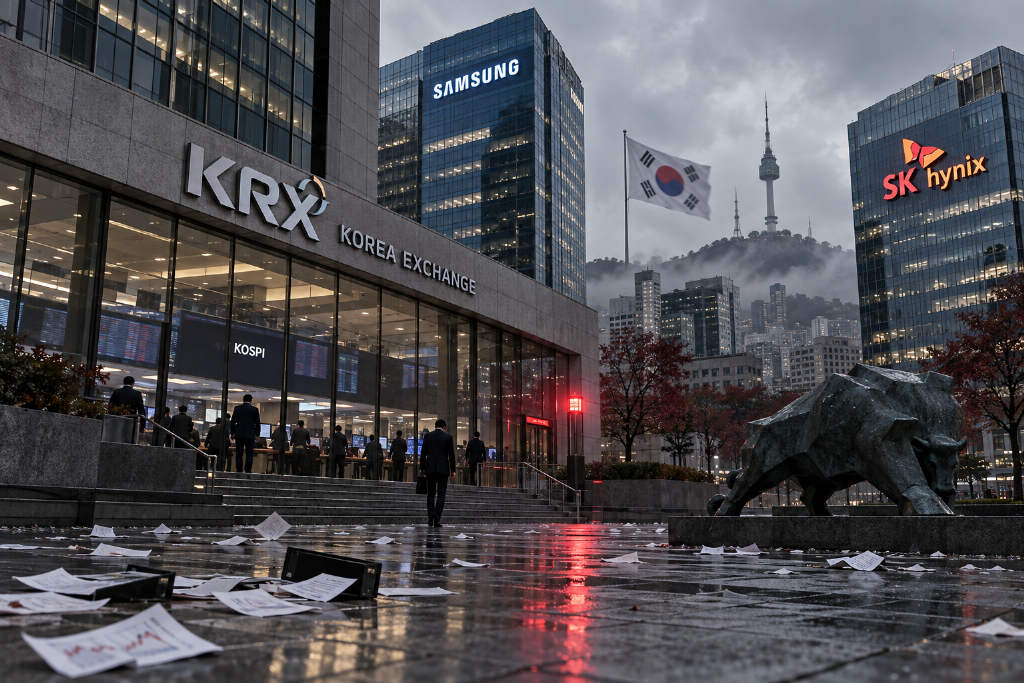
South Korea’s stock market suffered another steep sell-off on Thursday, with the KOSPI falling as much as 9.3% intraday, enough to trigger its 10th circuit breaker of the year and halt trading for 20 minutes. The index closed at 5,554, down 7.6% on the day, marking a seventh straight daily loss.
KOSPI drawdown from June now exceeds 40%
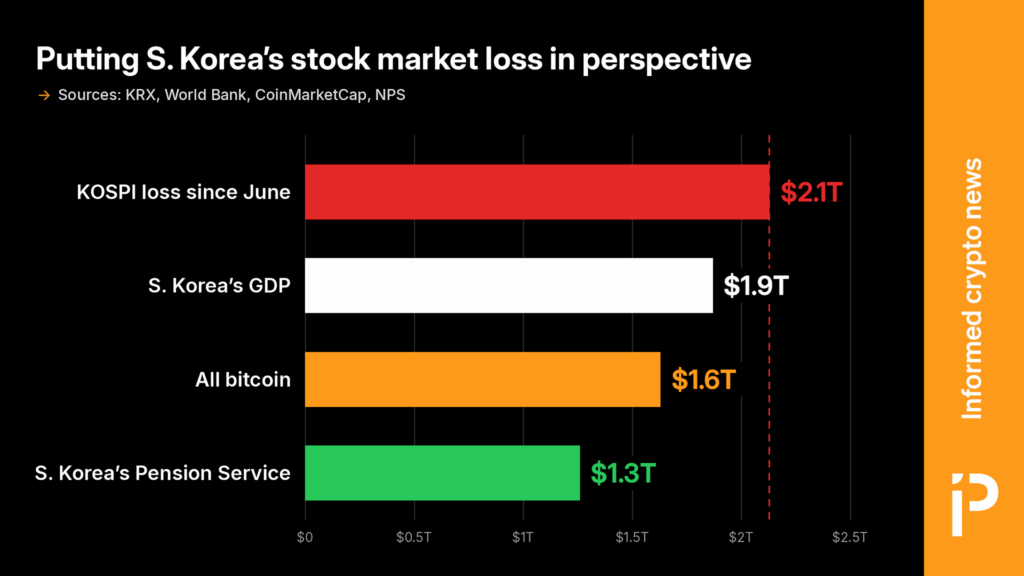
According to Protos, the KOSPI has now fallen more than 40% from its June peak, erasing more than $2 trillion in market capitalization. By the publication’s comparison, that loss is larger than South Korea’s full-year economic output of about $1.9 trillion in 2025 and also greater than the estimated value of all BTC in existence, about $1.6 trillion.
The report also said the decline exceeds the asset size of South Korea’s National Pension Service, the world’s third-largest retirement fund, which holds about $1.3 trillion in savings. Those assets have also shrunk alongside the stock market, according to the article.
“Black Thursday” hits a benchmark closely watched at home
Protos described the KOSPI as the domestic benchmark South Korean investors follow in much the same way US investors track the S&P 500. After the latest rout, South Korea’s AI-focused stock market has fallen from sixth place to 10th place among the world’s national stock markets.
South Korean media dubbed the session “Black Thursday.” With the drawdown now above 40%, the slide is nearing the 43.7% median decline recorded during the country’s earlier market crises, including 1987’s Black Monday, the 1997 Asian financial crisis, the 2000 dot-com crash, and the 2008 Global Financial Crisis.
Samsung Electronics and SK Hynix drove much of the decline
Samsung Electronics and SK Hynix, two AI chipmakers, make up roughly half of the KOSPI’s market capitalization, the report said. Because of their disproportionate underperformance in recent months, those two companies account for about 70% of the KOSPI’s drawdown since its June peak.
July was the KOSPI’s worst month since the 2008 Global Financial Crisis, but October is already nearing the full scale of July’s losses and could be on track to perform even worse, according to Protos.
Volatility surpasses BTC, Protos says
Protos said South Korea’s stock market is now more volatile than BTC. The report also noted that the country’s stock exchange has paused trading 38 times this year.
Retail investors amplified the swings through leveraged single-stock ETFs, the article said, adding that the finance minister apologized for introducing those products. Goldman compared this month’s sell-off with March 2020 and August 2011, calling them the only two episodes in the past 20 years of KOSPI trading that saw selling this severe without a rebound day.
Emergency meeting called by financial regulator
South Korea’s stock market entered the global top 10 in January after overtaking Germany at a market capitalization of $3.25 trillion. By June, it had climbed above $5 trillion to rank sixth. It now stands in 10th place.
On Thursday, the chairman of South Korea’s Financial Services Commission called an emergency meeting and instructed financial services firms to “maintain vigilance” and to “actively respond to ensure financial market stability and investor protection.”