



Hyperliquid has taken another step toward the U.S. market. On Oct. 27, the decentralized derivatives platform confirmed that Payward, Kraken’s parent company, plans to become the first operator to deploy a perpetual futures market on its HIP-3 framework through an entity regulated by the U.S. Commodity Futures Trading Commission, or CFTC.
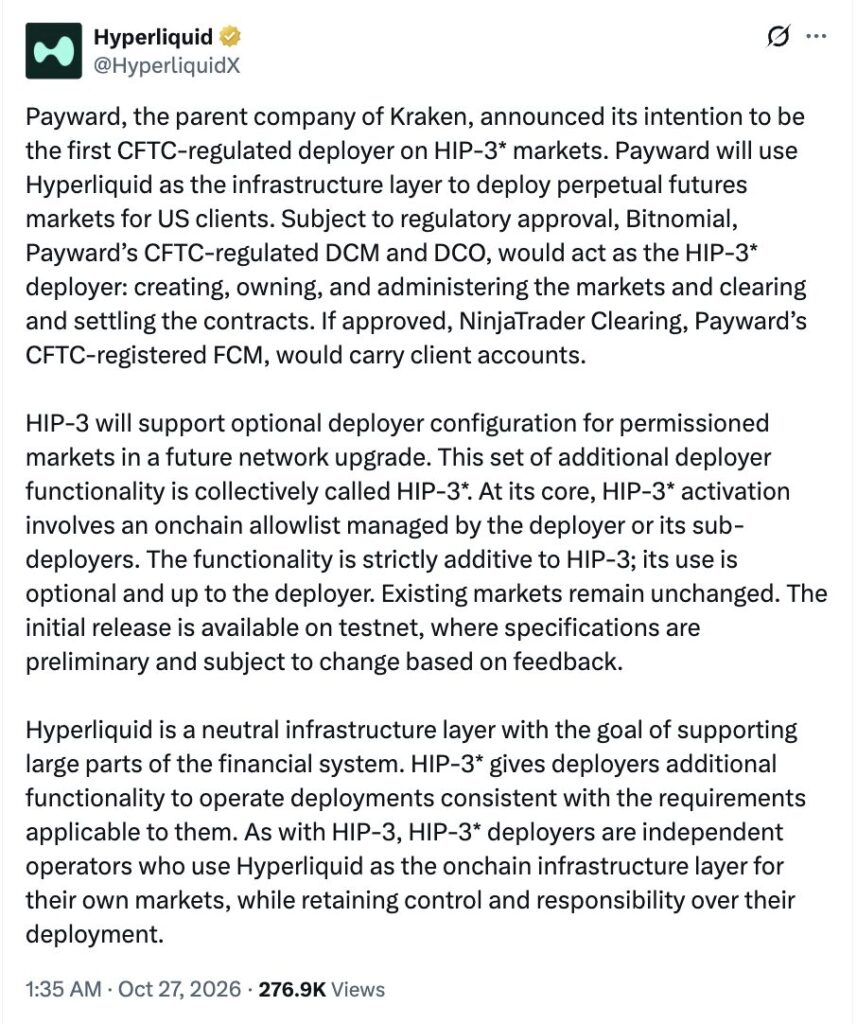
Under the structure described in the report, Bitnomial, a Payward subsidiary, would be responsible for trading, clearing and settlement. NinjaTrader Clearing would manage customer accounts, giving eligible U.S. investors a regulated route to participate in onchain perpetual futures trading. The feature is still in testing, and a formal launch remains subject to regulatory approval.
Hyperliquid confirms the proposed structure
Payward had already announced its plan to enter Hyperliquid on Sept. 16. The latest update is Hyperliquid’s formal confirmation of the partnership structure and its disclosure that HIP-3 will support permissioned perpetual futures markets.
According to Payward’s announcement, Bitnomial holds CFTC-regulated designated contract market, or DCM, and derivatives clearing organization, or DCO, registrations. NinjaTrader Clearing is a registered futures commission merchant, or FCM. U.S. customers would need to open accounts through regulated entities and meet the access-list requirements set by Bitnomial and NinjaTrader before they can trade the contracts.
The model would allow licensed financial institutions to use a decentralized blockchain to execute and record trades without turning the entire Hyperliquid protocol into a traditional centralized exchange.
HIP-3* adds an onchain allowlist option
Hyperliquid’s existing HIP-3 mechanism allows third parties to deploy their own perpetual futures markets, with underlying assets that can include cryptocurrencies, stocks, commodities and other assets.
The newly proposed HIP-3* adds an optional permissioned-market feature. Deployers would be able to restrict participation through an onchain allowlist so the market can meet specific access requirements.
That does not mean Hyperliquid’s existing open markets will all shift to identity-verified access. The feature is optional, and current markets would remain unchanged. Under the structure described in the article, Hyperliquid would provide the onchain infrastructure, while Bitnomial would take responsibility for market operations, trade clearing and related regulatory obligations. Whether the setup satisfies U.S. requirements on market surveillance, customer assets and trading risk still depends on regulatory review.
Platform scale and market data
By market size, Hyperliquid is already one of the main onchain derivatives venues. A DeFiLlama snapshot cited in the article and dated Oct. 27 showed about $204.7 billion in 30-day perpetual futures volume and roughly $7.55 billion in open interest. Across the protocol, 30-day fees were about $79.65 million and revenue was about $63.49 million.
On the token side, HYPE remains about 21% below its all-time high of $97.96 reached in September this year. The article said the regulatory partnership news alone is not enough to confirm that the token has re-entered an uptrend.
Potential HYPE demand and remaining risks
Hyperliquid’s HIP-3 deployment model requires deployers to stake HYPE. If more institutions adopt the framework in the future, that could in theory increase demand for the token’s utility.
Still, Payward has not disclosed the final number of markets it plans to deploy, the size of those products, expected trading volume, or the exact HYPE staking arrangement. Because of that, the cooperation announcement cannot be directly translated into a measurable increase in token demand.
Liquidity concentration is another issue raised in the report. According to Payward’s September announcement, about 98% of open interest in HIP-3 deployed markets at that time was concentrated in a single deployer, pointing to a highly concentrated market structure and liquidity distribution.
For Hyperliquid, the significance of the arrangement is not limited to adding a large exchange-related partner. The article frames it as an attempt to build a repeatable model in which regulated financial institutions can run derivatives markets directly on public blockchain infrastructure. If approval is ultimately granted, Hyperliquid could expand from a decentralized perpetuals venue used mainly by crypto traders into onchain trading infrastructure serving traditional financial institutions.
Until approval is secured and products are launched, however, that remains a direction of development rather than realized revenue growth.