
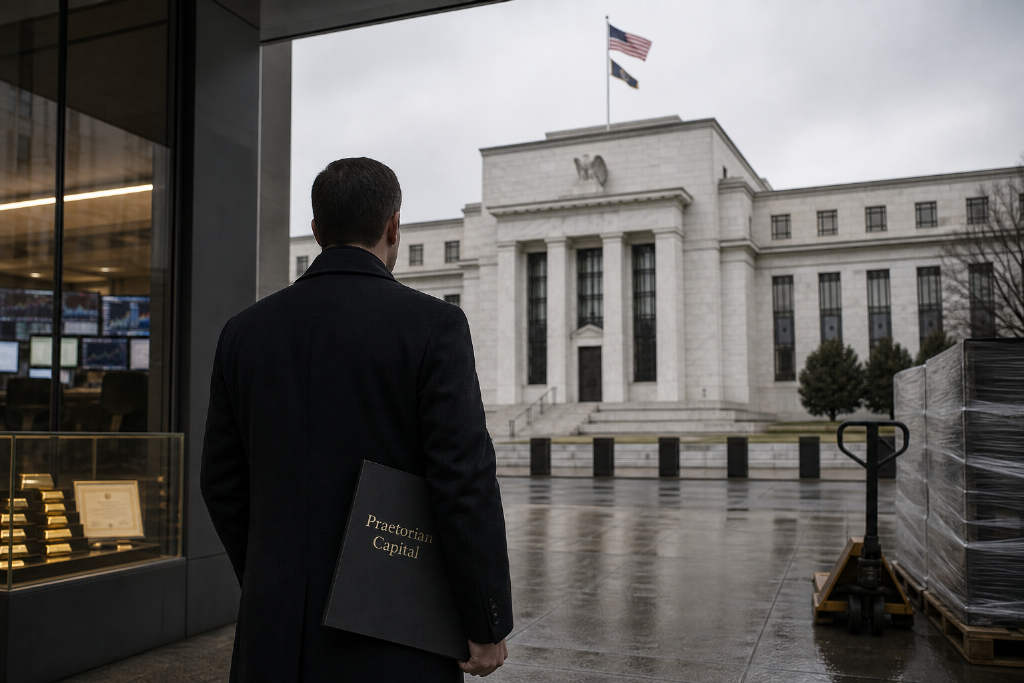
Harris “Kuppy” Kupperman, founder and chief investment officer of Praetorian Capital, said the Federal Reserve killed off the 2022 recovery and left the U.S. centered on maintaining what he called a “permanent asset bubble.”
The remarks came in a program recorded on Aug. 28, 2026. The piece was written by Maggie Lake and translated by TechFlow. In the interview, Kuppy laid out his “economic feudalism” thesis, explained how he arrived at it, and described how Praetorian has repositioned around that view.
A multi-speed economy
Kuppy began with inflation. He said he is not sure inflation should automatically be treated as the enemy. If wages are rising, that is inflation. If goods are getting more expensive because demand is strong, that is inflation too, but it also reflects healthy demand and a healthier economy.
He described the U.S. as a “multi-speed” economy. In his view, current interest rates are clearly too high for homebuilding, car purchases, or anything else that requires financing. Data centers are different. He said those projects are mostly funded with cash, and they are driving a large share of economic growth. That leaves the Fed, in his words, struggling to manage an economy moving at different speeds.
Even so, he argued that what the country needs is real GDP growth, and that real growth often starts with nominal GDP growth. Inflation-led growth is not necessarily the central problem, he said, so long as the economy is expanding alongside it. The bigger fear, in his view, is stagflation.
“Monetary policy killed the recovery in 2022”
Kuppy called 2022 the first real recovery in the 14 years since the global financial crisis. Then, he said, monetary policy stepped in and shut it down.
Looking back on that year, he said restaurants were full, people were traveling, and the economy felt strong. Inflation was high, but he argued that people actually felt better then than they do now. Now, he said, people feel squeezed.
He acknowledged the political side of the inflation fight. Voters in democracies do not want inflation, and they have a say in policy. Still, he said he believes ordinary voters want economic growth even more than they want low inflation.
The “economic feudalism” framework
Kuppy said he built the theory to answer a specific question: why are businesses struggling when nominal GDP is still running at 6% to 7%, especially in consumer-linked sectors such as restaurants, retail, residential construction, and autos?
He said a “K-shaped economy” explains part of the picture, but the phrase makes the outcome sound accidental, as if some people simply do well and others do not. He does not see it that way. He called it a long-running structural problem with intent behind it.
At the government level, Kuppy said the policy is to maintain a “permanent asset bubble.” In his version of economic feudalism, policymakers want asset inflation, so they keep injecting liquidity into the system. Some of that liquidity leaks into the real economy and creates inflation. At the same time, policymakers try to slow those spillovers, and he said one way to do that is to keep the dollar overvalued.
That liquidity, he argued, strongly supports the stock market while hollowing out the economy underneath it. If business owners choose to buy stocks instead of investing in plants and equipment, he said, it reflects a simple calculation: productive investment no longer offers a high enough return on capital, while existing assets can be bought and sold on the expectation that someone else will pay more tomorrow.
How he sees the U.S., China, Europe, and Japan
Kuppy said other regions have their own versions of economic feudalism.
In China, he said policymakers “hate” rising asset prices. He said China has suppressed the stock market for 20 years and recently punctured its property bubble, with the goal of becoming an export power.
In Europe, he said policymakers want people poorer, are conflicted about asset bubbles, lean more toward real estate, and at the same time invest in U.S. equities. He said climate policy and regulation are being used to slow the economy and effectively block growth.
In Japan, he said policymakers genuinely want growth but do not know how to get there.
He grouped the U.S., China, Europe, and Japan together as four large blocs that are all stuck in different ways. The common thread, he said, is that if most of the population has little disposable income, and that outcome is intentional, then consumption weakens, the multiplier effect disappears, growth fades, and liquidity can be pushed into assets instead.
Why 2022 was the turning point
Kuppy said people were spending the money they had received after the pandemic, and that cash was moving quickly through the economy. He said that moment “absolutely terrified the global elites.”
His argument is that the pressure showed up everywhere at once. Tech stocks were falling, rates were rising, real estate was repricing on cap rates, venture capital was starting to struggle, and private equity was getting squeezed by higher labor costs. Profit margins were under pressure. At the same time, cleaners and gardeners were still asking for raises. In his telling, the people at the top felt squeezed too, and the response was simple: this could not be allowed to happen again.
That, he said, is why Jerome Powell raised rates “like a madman” and pulled the handbrake on the economy. He added that the U.S. was not alone and that other countries moved in the same direction. Once he saw that pattern, he said, he concluded it was a policy choice rather than an accident.
If the policy goal changed, asset prices would pay the cost
Kuppy said an economy can be run toward different ends. If the objective is to build the largest and most dynamic middle class, policy can be organized that way. If the objective is to fight inflation, policy will do that. If the objective is to become an export powerhouse, the system can be pointed there too.
His view is that the U.S. appears to want asset bubbles. If policymakers reversed course and returned to prioritizing a large, vibrant middle class, asset owners would bear the cost. Stocks would fall, he said, and a long repricing period would follow. The wealth effect would reverse.
He gave a rough level for that adjustment. If valuation multiples dropped back to historical ranges in the mid-to-high teens, he said, the S&P 500 would be around 3,000, “maybe that’s the level.”
His preferred fix: tax foreign capital inflows
Kuppy said he does not think the government should directly target the stock market. Instead, he proposed taxing foreign capital inflows.
His example was a 5% fee on foreign buyers purchasing U.S. assets such as NVIDIA. If that happened, he said, the problem would correct quickly: foreign money would go home, the dollar would fall, and many of the imbalances would ease. He called that an elegant solution, rather than what he described as putting tariffs on penguins and picking fights with Canada.
He does not expect it to happen. Stocks would fall, baby boomers would feel poorer, and large corporations would feel poorer too. In his view, that is why policymakers will not take that route and will instead continue with the same feudal structure.
Why he thinks AI accelerates the same pattern
Kuppy said people are cheering AI because it accelerates feudalism. In his description, the end goal of AI is to replace human workers inside companies. If people do not have jobs, he said, it becomes hard to see who will buy the products. From the perspective of asset owners, though, the setup is attractive because it can drive higher profits and stronger asset performance.
He tied that point to data center financing. How do you fund trillions of dollars of data centers, he asked. His answer: by having tens of millions of people using apps like Robinhood to trade and put in $5,000 at a time. He described “monkey JPEGs” as the gateway phase and said the real objective is to get people to finance the very data centers that may eventually replace their jobs.
How Praetorian is positioned
Kuppy said the theory changed the way Praetorian invests. He had long been associated with hard assets and the real economy, and he said the framework originally grew out of his attempt to understand why his consumer retail holdings were performing poorly even when GDP growth looked decent on the surface.
Now, he said, Praetorian does not own real-economy assets in any meaningful sense.
“We don’t own anything that’s dependent on GDP,” he said. “They’ve told you they’re building a giant casino and calling it a stock exchange.”
Instead, the firm owns brokers, exchanges, and the “plumbing” behind them. The bet, he said, is that the top 1% will do well and the top 0.1% will do even better. Those trades, in his view, work best if feudalism keeps advancing toward its endpoint.
The thesis shapes his trading in other ways too.
- “We don’t short anything. I sympathize with anyone who does.”
- “I also wouldn’t run massively leveraged longs. Even in Weimar, there were brutal drawdowns.”
Jackson Hole, the 2% target, and pushback on the thesis
On Jackson Hole, Kuppy mentioned Kevin Warsh’s statement that the Fed remains committed to bringing inflation back to 2%. Kuppy said Warsh “said a lot,” but in his view did not say very much. He added that he does not think Warsh was there to stir things up; he thinks Warsh was looking for a rationale for rate cuts.
Kuppy is skeptical of the 2% target itself. He said policymakers have never really studied why 2% is the right number.
As for the strongest criticism of his theory, he said many people think he is crazy because politicians say they support the middle class. His response was that he is not claiming a Davos-style conspiracy in which elites sit together and script events. He is saying the top tier experienced a panic in 2022 and came away with a shared conclusion: never again.
He pointed to 2008 as another “never again” moment. If the stock market and banks had been allowed to fail then, he said, the U.S. might be in a better place now. In his framing, that would have meant 18 bad months instead of 10 bad years.
The article ends with a note that the material is for reference only and does not constitute investment advice, and that readers should consult a qualified financial adviser and weigh their own risk tolerance, investment goals, and broader financial plan.