
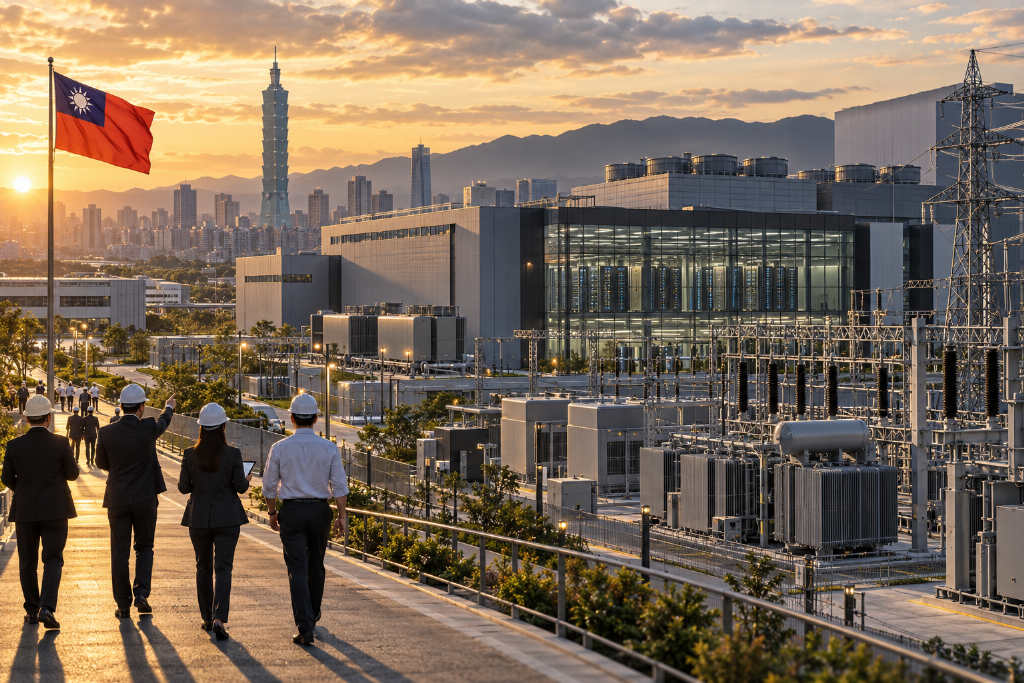
Taiwan President Lai Ching-te said the government has already incorporated economic growth, AI industry expansion, and the electricity demand of computing centers into its planning, and that under the current plan Taiwan can maintain a stable power supply through 2035. He added that the government expects to build computing facilities with about 1GW of power capacity by around 2040, excluding facilities that foreign companies may build in Taiwan.
Lai made the comments in an interview on the financial program Yutinghao’s Finance Corner. The nearly hour-long discussion covered AI policy, financing risks, industrial resource allocation, labor issues, U.S.-Taiwan trade, central bank policy, energy planning, housing, and labor supply.
Pressed by host Yu Ting-hao on whether AI could concentrate resources and widen inequality, Lai said he remains optimistic about AI over the long term, while adding that the government has also prepared for a scenario in which demand weakens.
AI growth, small business support, and the “big helping small” approach
Yu first raised the concern that AI is rapidly absorbing water, electricity, talent, and financial resources, while the benefits may be concentrated in a small group of technology companies. He asked how the government plans to keep other industries from being crowded out and spread the gains from economic growth more broadly.
Lai said Taiwan cannot rely only on semiconductors and servers for growth. He pointed to legislation and a planned NT$100 billion fund aimed at helping small and micro businesses upgrade and transform, including support for financing, talent development, expansion into overseas markets, and services through a single-window system.
He also described a “big helping small” approach. In his view, Taiwan once had agriculture supporting commerce and industry, then commerce and industry supporting technology. Now that the technology sector has matured, it should help pull traditional industries forward and bring smaller businesses into technology supply chains.
Lai cited TSMC and ASE in Kaohsiung as examples, saying that if companies can complete testing and validation locally, they may gain access to the supply chain. He said he wants larger companies to provide cooperation opportunities so that smaller firms can win orders as well.
When Yu asked whether the government should prioritize companies that generate strong exports and profits or industries with lower profits but more jobs, Lai said both matter. He said Taiwan has about 1.71 million small and micro businesses that provide about 9 million jobs. Large tech companies may generate high output, he said, but they cannot absorb the full labor force, and society needs space for different professions and industries.
He also pointed to a trillion-NT-dollar infrastructure direction covering transport, flood control, social housing, and healthcare, saying investment outside the technology sector can help sustain employment. He said regional revitalization would combine local industry, culture, and tourism resources to give younger people a chance to return home and build careers there.
AI targets for 2040
Lai said the government wants to be a “responsible promoter” of AI, meaning industrial development should be balanced with social sustainability, human autonomy, privacy, cybersecurity, transparency, fairness, and accountability, so that technological advances do not widen the gap between rich and poor.
According to Lai, the government’s new top 10 AI construction priorities include talent development, sovereign AI, computing centers, stable power supply, and balanced regional development. On the technology side, he said the focus is on silicon photonics, quantum computing, and robotics.
He also laid out numerical targets. By 2040, the government wants to train at least 500,000 AI application workers, help at least 1 million small and micro businesses adopt AI, and build a software platform industry worth NT$1 trillion. The aim, he said, is to bring AI into daily life and across industries, and make Taiwan one of the world’s top five countries for AI application and development.
Yu then challenged whether the government, before asking companies to use AI to raise productivity, should first reduce administrative procedures and control spending rather than create more committees and budgets. Lai replied that a “smart government” is part of a smart nation, and said ministries had already reported to the Presidential Office’s Economic Security Council on how to introduce AI to improve efficiency and services. He did not provide quantified figures for budget savings or cuts in administrative procedures during this part of the interview.
Power demand and the 1GW computing plan
Electricity was one of the central issues in the interview. Yu argued that manufacturing AI hardware and operating AI systems over time involve different power consumption patterns, and said the government cannot look only at demand from fabs and hardware production.
Using air conditioners as an analogy, he said the electricity required to make an air conditioner is not the same as the electricity required to run it around the clock. If Taiwan wants to develop sovereign AI and large data centers, he asked, could long-term power demand be underestimated.
Lai said the country plans to build roughly 1GW of computing facilities by around 2040, with foreign companies’ projects counted separately. He noted that GW refers to facility-scale power capacity, while actual computing performance would still depend on chips and system configuration.
He said the government has already factored in stronger-than-expected economic growth as well as demand from computing centers, advanced computing, and the AI sector. Under the current plan, he said, stable power supply through 2035 is not a problem.
On water supply, Lai referred to a western Taiwan water-resource interconnection project, saying the government is increasing flexibility through pipelines and cross-regional dispatching. The policy goal, he said, is to allow semiconductors to keep growing while ensuring other industries can still access the resources they need.
Renewables, nuclear power, and the energy mix
Lai said Taiwan still relies mainly on natural gas and coal for power generation and acknowledged that renewable energy remains insufficient. He said he wants the renewable share to keep rising, reaching 30% in 2035 and possibly moving higher.
Yu then asked whether Lai’s more open stance on nuclear power reflects an active policy push or a response to outside pressure. Lai did not choose either “active” or “passive.” Instead, he said no energy source should be ruled out on ideological grounds, and short-term interests should not come at the expense of environmental sustainability.
He repeated the condition that “nuclear safety must be assured, nuclear waste must have a solution, and society must have consensus.” If those conditions are met, he said, the policy can move ahead. He also said the relevant law has already passed and Taiwan Power Co. is going through restart procedures, adding that the government must respect the rule of law and public opinion. In the end, he said, professionals still need to determine whether safety standards are met, whether nuclear waste can be handled, and whether social consensus exists.
When it comes to trade-offs among stable power supply, low electricity prices, decarbonization, and energy independence, Lai said those are all factors in the government’s energy assessment, but he did not set a clear order of priority in the interview.
AI financing risk and Lai’s long-term view
Yu separated the technology outlook from financial risk. He said even if finance markets are positive on AI, they may still worry about off-balance-sheet financing, circular investment, and GPU asset valuations. If Taiwan commits large resources and financial problems emerge overseas, he asked, could that hit Taiwanese orders.
Lai said the government is continuing to watch the risks. Demand for servers and semiconductors is currently strong because of AI and is supporting Taiwan’s economy, he said. But if repeated investment or other factors cause demand to fall, the government has prepared in advance. He did not explain those contingency measures in detail.
As for his own judgment, Lai said the age of artificial intelligence has “only just begun.” He compared it with the steam engine’s role in the Industrial Revolution and said the responsibility of a president is to place Taiwan in a position that can sustain competitiveness for the next 30 years, 50 years, or even longer as the world enters a new technological era.
Asked whether he personally uses AI, Lai said he does. He also said he used Google to look up related information before the program. When Yu asked if he had used DeepSeek, Lai said no.
Labor distribution, Micron, and whether subsidies should benefit workers
On wealth distribution, Yu distinguished between “primary distribution” and “secondary distribution.” The first refers to companies sharing results with workers through wages, bonuses, and profit sharing. The second refers to the government collecting tax revenue and redistributing it through welfare and subsidies.
He asked whether companies that receive tax incentives and AI subsidies should also be required to let employees receive a certain share of the gains in the same year the profits are made.
Lai responded first to the labor dispute involving Micron, saying he hopes both labor and management will show more sincerity and spend more time in negotiations to reach a plan both sides can accept. He said labor-management cooperation would help the company, employees, and Taiwan’s labor environment, but he did not commit in the interview to tying subsidies directly to employee profit-sharing ratios.
On narrowing inequality, Lai again pointed to support for small businesses, infrastructure spending, higher pay, tax cuts, and family-support policies, saying he wants to avoid a situation in which the technology sector grows while other industries fail to share in the gains.
Cash handouts, housing policy, and pressure on younger families
Yu next described the pressure on middle-class households, which pay taxes while also carrying mortgage and childcare costs, and may feel that technology companies receive incentives, lower-income groups receive welfare, and they shoulder more of the strain. He asked whether universal cash handouts should be returned according to the amount of tax paid.
Lai said economic progress is the result of contributions from people in many occupations and should not be measured only by tax paid. He cited taxi drivers and cleaning workers as examples of people who also support society and business operations. If AI-related gains were distributed based on tax contribution, he said, resources could become concentrated again among higher-income groups.
He argued that gains should be shared on an individual basis and said childcare, education, and long-term care systems should help reduce the burden on families supporting both parents and children.
Asked about younger people who do not want to marry, have children, or buy a home, Lai said the government cannot stop at encouragement and also has a responsibility to improve conditions so that people who want to start families have a real chance to do so. He pointed to support for childbirth and childcare, education subsidies, housing linked to marriage and family formation, and more family-friendly workplaces.
On housing, Yu questioned whether rent subsidies and favorable mortgage programs simply subsidize individuals without changing the broader environment of high housing prices and high rents. Lai said the government must respond to public demand. If housing pressures make younger people reluctant to form families and have children, he said, the government has a duty to help. He cited social housing, rent subsidies, subleasing and property management programs, and the Qing’an mortgage program, saying those policies will continue.
He also mentioned student housing subsidies and TPASS as ways to reduce living expenses. On broader structural conditions, he said the room for change may be limited, but the government will still do what it can.
Exit mechanisms for state-backed initiatives
Using stop-loss investing as an analogy, Yu asked whether the government should also have exit mechanisms for various “national team” initiatives. If some industries receive years of support but still cannot handle market competition, can the government stop putting money in?
Lai agreed that regular review is necessary and said government support can be divided into investment and subsidies. He used TSMC as an example of investment that can generate returns if successful, but he also acknowledged that many investments fail or fall short of expectations and need to be reviewed for returns and execution efficiency.
Subsidies usually have a project term, he said, and should be evaluated when that term ends. If a program shows results, it may continue. If it does not, it should stop. He did not present a new unified exit standard in the interview and did not identify any national team projects that would be terminated.
Trade talks with the U.S. and Lai’s “eastward expansion” framing
As Taiwan’s trade surplus with the United States widens, Yu asked whether Washington could continue to make new demands and whether Taiwan might delay negotiations until the end of Donald Trump’s term or a change in U.S. politics.
Lai said the government is not taking that approach and is working from a principle of mutual benefit. He said Taiwan’s industries had previously moved westward, expanded southward, and worked with Japan, and have now reached a stage where they should cross the Pacific and deepen industrial links with the United States.
He called that direction “eastward expansion,” arguing that investment should move both ways: Taiwanese companies should invest in the U.S., and U.S. companies should also invest in Taiwan. He said the areas of cooperation include technology and defense industries. Lai added that the government had secured the same 15% non-stacking tariff condition as Japan and South Korea. As U.S. legal procedures and trade investigations continue, he said the government will keep pushing to preserve the negotiating terms previously agreed by both sides.
Asset management, central bank independence, and subsidies
On financial policy, Yu used the Korean market as a reference point and asked how to balance wider access to financial products with leverage risk. Lai said Taiwan’s industrial and financial conditions differ from South Korea’s. He noted that Taiwan’s semiconductor supply chain is relatively complete, from IC design and manufacturing to packaging and testing, with small and medium-sized businesses also involved.
He said the purpose of developing Taiwan into an Asian asset management center is first to keep the capital earned in Taiwan at home, and then attract outside capital to strengthen domestic investment momentum.
Yu also asked about central bank interest rates and mortgage credit controls. Lai said that even as president he should respect the central bank’s independence. In his view, the professional judgment jointly formed by central bank staff deserves respect, and the reasons given to him by the central bank made sense.
He said interest-rate increases affect mortgages, exchange rates, business investment, and consumer spending at the same time, so the issue has to be considered as a whole. He did not call on the central bank to follow any specific rate path in the interview.
On continued fuel and electricity subsidies, Yu said the cost is ultimately still borne by taxpayers, even if it first appears on the books of Taiwan Power Co. and CPC. Lai said the subsidies are intended to reduce the impact on households and businesses during periods of tight energy supply and rising prices. He argued that the price stability and broader economic effect created by the policy are greater than the fiscal cost, and said he supports keeping the approach in place. He also called on the legislature to approve the necessary budget.
Labor shortages, migrant workers, and foreign talent
The final section of the interview focused on labor. Yu asked whether companies truly cannot find workers, or whether they simply cannot find workers willing to accept low pay. He also asked whether opening too quickly to migrant workers could reduce pressure to raise local wages and weaken incentives for companies to adopt AI.
Lai said labor shortages may already be affecting industrial development. The government is responding by expanding the scope for migrant labor, bringing in foreign professionals, and helping foreign graduates stay in Taiwan.
He said one policy arrangement links a NT$2,000 monthly wage increase for local employees with additional migrant-worker quotas, with the aim of helping companies fill labor gaps while also raising pay for local workers. He also mentioned limits on the share of migrant workers within a company’s workforce. The exact qualifications and quota calculations, he said, still depend on the rules set by the competent authorities.
On whether Taiwan could move from migrant-worker policy toward immigration policy, Lai said talent can be brought in according to industry demand, and residency status can be offered after a certain number of working years and after relevant standards are met. Questions involving nationality, he said, would still require wider social discussion.
He also acknowledged that migrant workers who lose contact with authorities can create public security issues and risks involving personal safety and infringements on freedom. Lai said the Executive Yuan is continuing search and assistance measures, but he did not disclose implementation details.
At the end of the interview, Yu asked whether Lai believes Taiwan’s stock market will be higher by the end of his term and whether he would encourage aides to buy. Lai did not give a target level. He said his job is to manage the economy well and the stock market will reflect that on its own, while leaving the level itself for Yu to judge.