

Latin America’s stablecoin payment stack may depend on a small group of underlying liquidity providers, according to a new report from Varys Capital and Verda Ventures and comments from Verda Ventures partner Amit Chu.
Drawing on Verda’s Stablescape database, the researchers reviewed 494 companies across the region. They found that only 16 have a primary business centered on wholesale stablecoin-to-fiat liquidity, corporate treasury and credit. The report warned that 「fragility in the system is concentrated in its thinnest layer」.
A narrow specialist layer under a much larger ecosystem
Chu told Cointelegraph that the number of firms selling liquidity appears much larger than the number of true specialists operating at the wholesale layer. He said public data does not show how many of those firms warehouse currency risk themselves and how many pass that risk on to the same handful of desks and exchanges.
「There are many sellers of liquidity and very few specialists. What we can’t see from public data is how many of them warehouse the currency risk themselves and how many pass it to the same few desks and exchanges. Our view is that it’s the second, and that’s the fragility the report is pointing at,」 Chu said.
Stablecoins are taking a larger share of crypto activity in the region
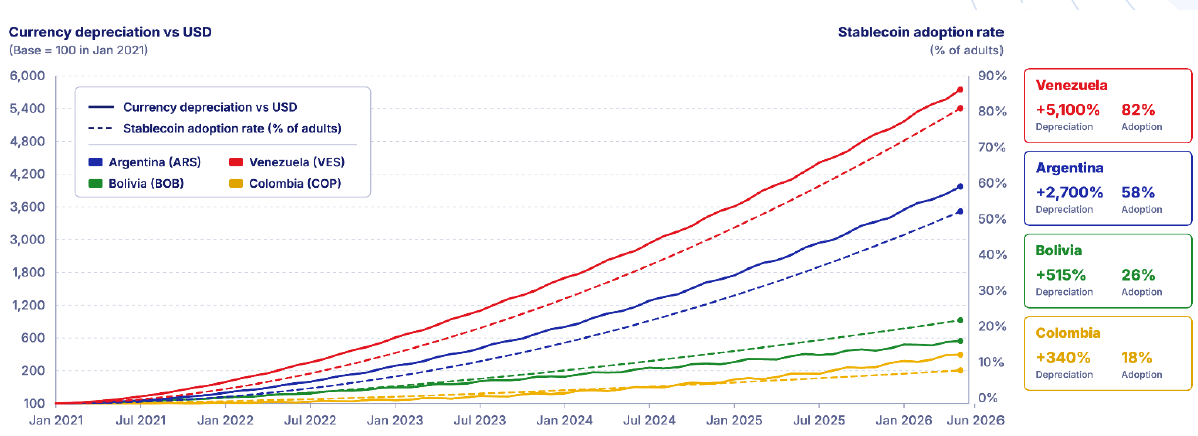
Stablecoins are playing a bigger role in Latin America’s crypto economy. According to a Chainalysis report published in September, by June 2026 stablecoins accounted for 32.1% of cross-border crypto value in the region, 22.1% of domestic peer-to-peer activity, and 17.6% of personal wallet balances.
The report also said the countries with the greatest monetary instability showed the fastest growth in stablecoin adoption. The chart cited in the article was sourced to Varys Capital and Verda Ventures.
The pressure point is conversion back into local currency
Chu said the most immediate problem would emerge at the exit point if a key provider were disrupted. In that case, users might still hold stablecoins but face higher costs or delays when converting them into local currency.
「The problem would be at the exits. Spreads would widen, cash-outs to local bank accounts would slow or pause, and funds in transit with the failed desk could be stuck,」 he said.
The report does not quantify concentration
The report does not establish how concentrated liquidity itself is. Chu said Stablescape does not track transaction volumes and does not provide market share data. Exchanges and payment companies classified elsewhere in the database also supply liquidity, though he said Verda believes some of them may ultimately depend on the same underlying desks.
Licensing and local-currency stablecoins seen as possible fixes
Chu said licensing is the biggest lever for reducing concentration because clearer rules would make it easier for banks to serve liquidity providers.
He also pointed to local-currency stablecoins, which could let more market makers settle transactions onchain. At the same time, global trading firms are beginning to quote Latin American currency pairs.
Few specialists do not automatically mean a broken market
Chu also cautioned against treating a small number of specialists as proof of a structural failure.
「Mature FX markets also have far fewer dealers than customer-facing firms. What matters is redundancy and capital,」 he said.
He added: 「Each major currency should have several independent, well-capitalized desks with separate banking relationships, and each wallet should be able to route between multiple players.」
LATAM still stands out as a growth opportunity
The report still described Latin America as a growth opportunity, especially for businesses focused on cross-border payments. It argued that fragmented banking systems and costly transfers create demand for services that help people and companies move money between countries.