
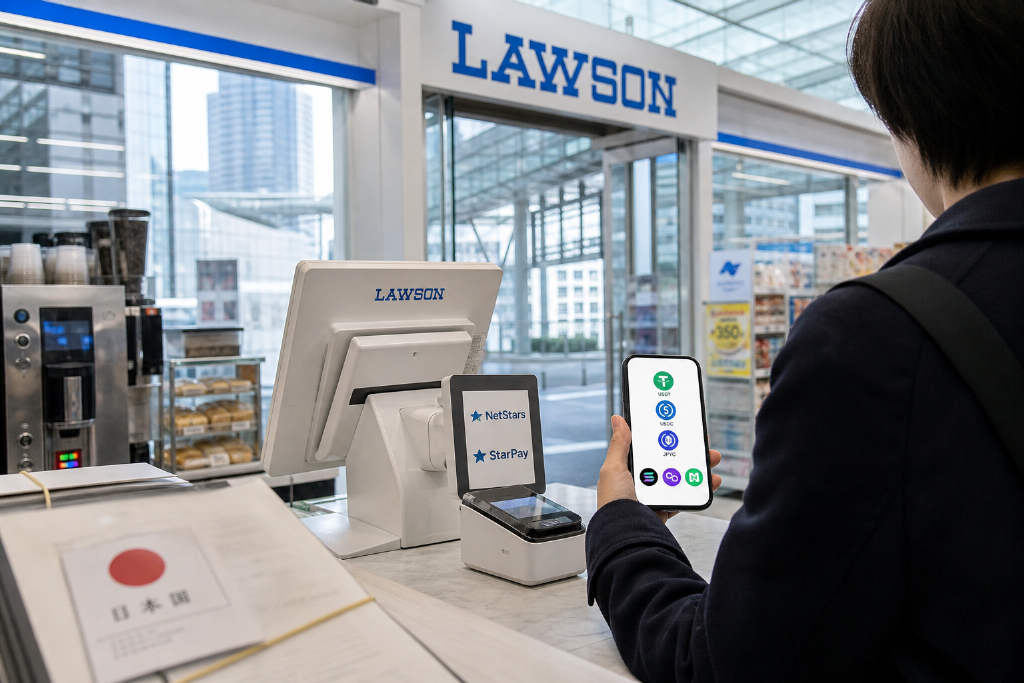
Lawson and NetStars carried out a stablecoin payment trial at Lawson Gate City Osaki Atrium Store on Aug. 17, testing whether in-store checkout could support USDC, USDT and JPYC without disrupting existing operations. The experiment linked Lawson’s current POS system with NetStars’ merchant-facing stablecoin payment service, Stablecoin Pay, and examined payment processing, speed, ease of use and store-side operational impact across several token and blockchain combinations.
A second-stage trial after Lawson’s Aug. 6 test
This was the second phase of a POS-linked stablecoin payment proof of concept that Lawson began on Aug. 6. The first phase was conducted by blockchain companies HashPort and KDDI together with Lawson at Lawson Takanawa Gateway City Store. That earlier test used the yen-denominated stablecoin JPYC on Polygon and HashPort Wallet.
The Aug. 17 trial was run by NetStars, the company behind the cashless payment platform StarPay, and was intended for related parties including NetStars and Lawson. The goal was to check whether stablecoin payments could be executed through Lawson’s existing store systems while keeping day-to-day store operations intact.
NetStars also tested a range of payment scenarios, including error cases, to see how the system would behave in actual checkout conditions.
Three stablecoins, three chains, MetaMask on the user side
The trial covered three stablecoins: dollar-denominated USDC and USDT, and yen-denominated JPYC.
- USDC was tested on Solana, Morph and Polygon.
- USDT was tested on Solana, Morph and Polygon.
- JPYC was tested on Polygon.
MetaMask was used as the wallet. Users accessed a NetStars-prepared website through MetaMask’s in-app browser, connected their wallet and then generated a payment code based on the selected stablecoin and blockchain. The report says this payment-code function is not a standard MetaMask feature and was built by NetStars specifically for the trial.
On the store side, Lawson did not add a new payment button to the POS register. Staff selected the existing barcode payment option and scanned the customer’s code. The POS system then identified the payment method automatically, sent the information to NetStars and received the result back after payment processing was completed.
NetStars says most observed payments finished within five seconds
NetStars said the trial confirmed that not only yen stablecoins but also globally circulated dollar stablecoins such as USDC and USDT could be used for in-store payments while preserving existing store operations.
The company said widespread stablecoin use in Japanese physical retail would require tight integration with POS systems that manage product information. It also said that verifying the practicality of multiple stablecoins and blockchains in a convenience store setting — where customer traffic is heavy — pointed not only to possible use by domestic customers but also to a potential new payment option for foreign visitors to Japan.
The Shin Keizai editorial team interviewed Taro Tamura, head of marketing strategy and an executive at Lawson Financial, and Hisahiro Chofuku, director, COO and head of business operations at NetStars, at the trial store. Chofuku said the team was testing whether multiple stablecoins on multiple chains could be used at the POS. Payments confirmed during the interview were generally completed within five seconds. He said speed was a major result, especially during crowded periods such as lunchtime.

Lawson calls it a preparatory experiment
Tamura said the purpose of the trial was to verify whether stablecoins, which are gradually beginning to be used, could work for in-store payments and to make technical preparations in advance for broader use.
He said Lawson’s franchisees have not yet asked to introduce stablecoin payments and described the current effort as a preparatory experiment. The point, he said, is to sort out whether the model could withstand commercial use and what issues remain.
These trials are positioned as part of Lawson Financial’s effort to prepare for new types of payment. Lawson had already asked multiple companies this spring about interest in participating in proofs of concept and placed weight on user numbers and marketability when choosing companies.
Tamura also said Lawson plans to run another experiment related to digital funds on Aug. 20 with two companies whose names have not been disclosed. He did not name them, but said he had heard they would announce themselves within three days.
Customers pay in stablecoins, stores receive yen
Settlement between the store and NetStars was handled in yen. Customers paid using different stablecoins, while the store received yen in a way similar to ordinary barcode payments. Direct stablecoin receipt by Lawson itself was not included in this test.
The gas-fee design was also part of the setup. Users did not need to separately hold native chain tokens such as SOL or POL for payment. NetStars fronted the gas fees and then charged users through a processing fee.
When a dollar stablecoin was used, the processing fee included both gas fees and exchange rate-related costs. With yen-denominated JPYC, there was no exchange rate-related cost. Users were shown the total amount — the product price plus the fee — and then confirmed the payment.
The report adds that some wallets may also be able to handle required conversion and gas processing, so the fee may vary depending on the wallet and the user’s situation. That user-facing fee is different from NetStars’ published merchant payment fee of 0.98%.
USDT remains the toughest regulatory question
One of the biggest differences from previous trials was the use of USDT for store payments. The report states that USDT does not appear on the latest registered list published by Japan’s Financial Services Agency for assets that electronic payment instrument service providers in Japan may handle.

On the legal treatment of USDT for payments at stores in Japan, Chofuku said the structure used in the trial involves a user paying for goods with USDT held in a self-custodied wallet.
He said NetStars does not hold user assets as a financial institution under this model. On the fact that the method does not assume customer identity verification, or KYC, in advance, he said the thinking is similar to a customer using cash to buy goods in a store.
Still, NetStars is consulting with the Financial Services Agency on the legal handling of receiving USDT from users as payment for goods and on how the company should treat the assets while holding them. Separately, the details of how received USDT would be converted safely into yen have yet to be finalized with the regulator.
It has not been decided whether that conversion would involve overseas institutions or domestic Japanese counterparties. Chofuku said the specific method for converting USDT and USDC into yen will be designed later.
User experience and commercialization are still open questions
On usability, first-time users had to open the payment URL through MetaMask’s built-in browser. After visiting once, however, they would not need to enter the URL every time.
Chofuku said MetaMask was chosen because its mechanism is relatively open and easy to build on. Going forward, the company plans to improve the user experience by working with wallet providers, including letting users launch Stablecoin Pay directly from a wallet home screen.
Tamura said that if support for multiple stablecoins and multiple blockchains could be unified in some form, that would be the easiest way to respond. He added that blockchain remains highly specialized from a retailer’s perspective and that work with wallet providers and others will be needed.
Lawson has not set a timeline for commercialization. Tamura said the decision will depend on confirmed demand from the market, users and stores, while fee levels and other economic conditions will also matter.