
WuBlockchain’s project roundup for Aug. 23 through Aug. 29 covered a wide set of updates across market infrastructure, token governance, exchange-traded products and licensing.
LayerZero plans institutional blockchain exchange for this fall
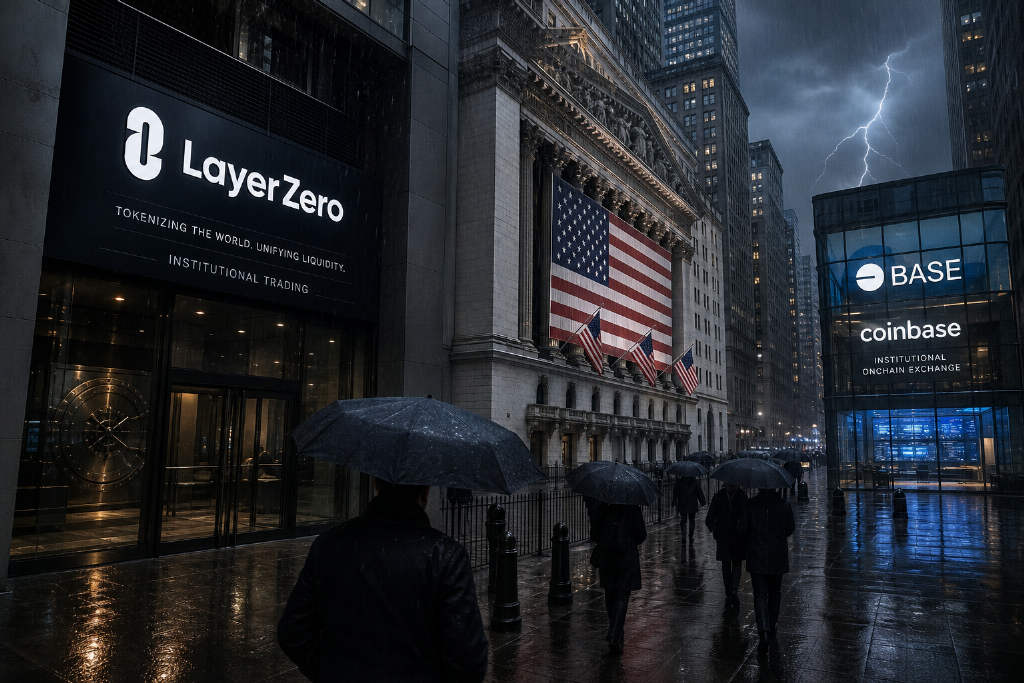
LayerZero plans to launch a blockchain-based exchange aimed primarily at financial institutions this fall. The company had already said its new Layer 1 blockchain, Zero, is also scheduled to go live this fall, with partners including Citadel Securities, the Depository Trust & Clearing Corporation, or DTCC, and Intercontinental Exchange, the parent company of the New York Stock Exchange.
LayerZero previously said Zero is designed for use cases including 24/7 capital markets, institutional clearing and stablecoin payments, and that it will include a dedicated trading environment.
Grayscale launches first U.S. Zcash ETF
Grayscale launched the Zcash ETF, ticker ZCSH, on Aug. 25 and listed it on NYSE Arca. The product was converted from the Grayscale Zcash Trust and is the first U.S. exchange-traded product focused on ZEC.
According to Grayscale, ZCSH had about $314 million in assets under management as of Aug. 24, held about 387,200 ZEC and charges a 2.5% management fee. Grayscale said fee revenue from ZCSH will be used to support Zcash ecosystem development and product marketing for up to 12 months after the registration statement becomes effective. Data from The Block showed ZEC rose about 45% over the past several days.
Ethena Foundation sets out four ecosystem updates
The Ethena Foundation announced four major ecosystem updates. First, it said it had completed the repurchase of all remaining locked tokens held by certain major seed-round investment firms that had sold any ENA during the past nine months.
Second, the foundation said it reached a master framework agreement with development entity Ethena Labs under which protocol IP and all value accrual will belong exclusively to the foundation and be governed by token holders. Equity investors in Ethena Labs will no longer receive any protocol cash-flow benefits.
Third, Ethena opened voting on a fee-switch governance proposal intended to use net revenue generated by all Ethena business lines to programmatically buy back ENA on the secondary market.
Fourth, it said it had reached agreement with lead investors to release unvested tokens in order to fully remove future monthly unlock sell pressure from VC firms, while team tokens will continue to follow the original vesting schedule.
Lido revises EarnETH vault fee structure
Lido said it is changing the fee model for the EarnETH Vault by cutting the fixed management fee and increasing the share tied to actual vault performance. EarnETH previously used a fixed structure of 1% AUM management fee plus a 10% performance fee.
Under the update, the model becomes variable and more performance-weighted, with a cap of 0.5% AUM plus a 20% performance fee. The initial setting will be 0.2% AUM management fee plus a 15% performance fee. Lido said reducing the base AUM fee from 1% to 0.2% lowers the fixed cost of holding EarnETH during lower-yield periods, while the higher performance fee better aligns protocol revenue with users’ realized returns.
Flop Labs releases draft FLOP tokenomics
Flop Labs published a draft tokenomics plan for FLOP, saying there is no VC allocation and no presale. Airdrops are intended for network participants including miners, validators, agents and early community members.
Based on the draft chart, total FLOP supply in year 10 is projected at 17.2 billion, with a terminal annual inflation rate of 0.6%. In the supply breakdown, miners account for 51.2%, or 8.8 billion tokens. Airdrops account for 20.4%, or 3.5 billion, including 1.2 billion for miners, 310 million for validators, 1.2 billion for agents, and 790 million for reserves and incentives. Team and foundation receive 11.4%, or 2 billion. Validators receive 6.8%, or 1.2 billion. Brokers and agents receive 6.8%, or 1.2 billion. Staking rewards account for 3.4%, or 600 million.
In a video interview on the Altcoin Daily podcast, BitMEX co-founder Arthur Hayes introduced the new project Flop Network and said the bet is that FLOP can become the native currency used by AI agents to buy compute, store memory and conduct economic activity. He described it as another “binary bet” after perpetual futures.
Base adds Coinbase-issued tokenized stocks
Base said tokenized stocks issued by Coinbase are now live natively on the network under the B20 standard. The tokens represent real shares held 1:1 by a regulated custodian. Eligible users can hold tokenized stocks of companies such as Apple and NVIDIA through self-custody wallets, then trade, lend and use them in other DeFi applications within the Base ecosystem.
Base said tokenized equities add a new asset class to onchain finance, with 24/7 trading, collateral use and composability with decentralized protocols. The assets are managed by Alpaca as the regulated broker and custodian, and more Coinbase tokenized stocks are expected to be added later.
World Liberty wins conditional OCC approval for national trust bank
World Liberty Financial, tied to the Trump family, has received conditional approval from the Office of the Comptroller of the Currency, or OCC, to establish a national trust bank. One of its main goals is to expand the use of USD1 and place reserve assets backing the stablecoin within its own banking structure to reduce costs and strengthen compliance and market credibility.
The data cited in the roundup showed that in the first 19 months of Trump’s second term, the OCC approved 22 bank charter applications, more than the total from the previous five years, with many of those applications coming from fintech and digital asset companies. World Liberty’s approval process took about 220 days, above the roughly 126-day median during the current administration. Before final approval, the company still has to meet conditions including external audit and capital adequacy requirements.
Lisk proposes DAO shutdown and 100 million LSK burn
The Lisk team submitted a governance proposal to wind down the Lisk DAO, stop the DAO and related governance infrastructure, and burn 100 million LSK that had been scheduled to vest to the DAO Treasury between 2027 and 2033. That would reduce total supply from 400 million LSK to 300 million LSK.
The proposal would also transfer about 47 million LSK that had vested or become available by 2026 to Lisk Ltd. It would let stakers exit through an emergency unlock after a three-day wait with no penalty. Lisk had previously announced that Lisk Chain will shut down on Oct. 31. The latest measures still require governance approval before they take effect.
The Sandbox offers 1:1 reimbursement after bridge attack
The Sandbox said it will reimburse affected SAND holders on a 1:1 basis following a bridge attack. The company said the attacker exploited contract configuration flaws on Base and BNB Chain on Aug. 21 and moved about 14.744 million SAND from an Ethereum vault, worth about $700,000.
According to the project, users who were legitimately holding bridged SAND on Base or BNB Smart Chain before the attack will receive the same amount of Ethereum-based SAND from the project treasury. No new tokens will be minted, and claims are expected to open within two weeks. The Sandbox also said unbacked SAND minted during the attack has been isolated and cannot be bridged or redeemed, and the affected bridge contracts will be permanently disabled.
USDe tops $320 million on Robinhood Chain in eight weeks
Ethena’s USDe surpassed $320 million eight weeks after launching on Robinhood Chain and now accounts for 42% of the chain’s stablecoin supply. That makes it the network’s largest external dollar asset, behind only Robinhood Chain’s native USDG.
Analyst Mesh said the growth stemmed from infrastructure design choices, including Steakhouse Financial selecting Ethena as the main collateral issuer for the launch of Robinhood Earn, and 62% to 65% of liquidity allocated by the Steakhouse USDG Vault flowing into the USDe/USDG Mprho market. Borrowers deposited USDe into that market because it represented the deepest collateral slot in the vault.