
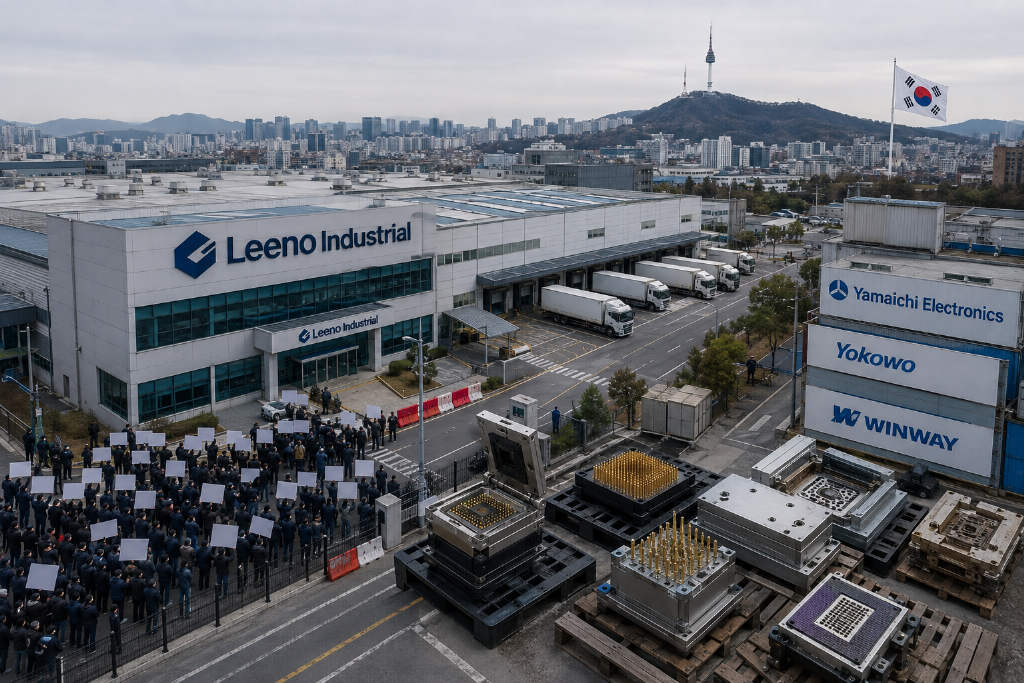
Leeno Industrial, a leading South Korean supplier of semiconductor test components, has been dealing with an indefinite strike for more than 34 days. The company has estimated daily losses at as much as 2 billion won, or about $1.475 million, and has notified major customers including Nvidia, Qualcomm and Broadcom that they may need to look for alternate suppliers for some items that cannot be delivered on schedule. The report said market attention has turned to Japan’s Yamaichi Electronics and Yokowo, as well as Taiwan-listed WinWay Technology (6515), as potential recipients of diverted orders.
Strike started on the 20th of last month and escalated three days later
According to South Korean media outlet THE ELEC, the labor action began on the 20th of last month in a rotating format across departments. On the 23rd, it escalated into a full indefinite strike. Leeno has 665 employees eligible to participate, and 340 of them joined the strike, leaving the production lines short of staff.
To keep operations going, the company activated an emergency response plan and reassigned 100 of its 150 administrative employees to production lines.
Leeno said publicly that the estimated daily loss of about 2 billion won was calculated from expected revenue under normal production conditions, minus the volume that could not be shipped because of the work stoppage. The company has also stopped accepting new orders, saying even delivery commitments for existing orders are now at risk.
Customers were told to review alternate suppliers, with three companies named
Leeno’s core products are metal test pins and test sockets used in semiconductor testing. These components are widely used in chip verification before products leave the factory. Global fabless chip designers such as Nvidia, Qualcomm and Broadcom are among its long-term customers.
As the strike has dragged on, Leeno has contacted some customers to explain the production disruption and told them to review alternative suppliers for items that may not be delivered on time, in an attempt to avoid further delays to development and mass-production schedules.
- Yamaichi Electronics of Japan: a long-established Japanese leader in the test socket market
- Yokowo of Japan: a Japanese manufacturer focused on semiconductor test connectors
- WinWay Technology of Taiwan (6515): a direct competitor to Leeno in the test socket segment
The report estimated that orders are moving toward these three companies, with WinWay specifically named as a possible beneficiary.
Record second-quarter performance now followed by pressure in the second half
Earlier this year, in the second quarter, Leeno posted its best quarterly performance on record. Revenue reached 143.2 billion won, up 27.3% year over year, while operating profit came in at 73.5 billion won, up 37.6%. Both figures were quarterly highs, and the market had expected Leeno to deliver its best full-year performance this year.
That picture changed after the strike. Existing customers have continued to shift away, while new orders have come to a stop. The report quoted an industry source as saying, 「If the labor dispute cannot be resolved quickly, the impact could extend from the second half of this year into all of 2026, and the earnings outlook may face a substantial downward revision.」
Long-term risk centers on market share and supplier qualification
The report said Leeno’s problem is not limited to a direct financial hit of 2 billion won per day. A deeper concern is the possible permanent loss of brand credibility and long-term market share.
A company insider said, 「Once customers come to see this company as having strike risk and switch suppliers, the scale of the loss will be hard to measure in monetary terms.」
One reason is that test pins and test sockets are highly customized products, and customer purchasing decisions often require a lengthy qualification process. Once an alternate supplier completes qualification and is adopted, the cost of switching again later drops, and the incentive to return also falls. In the report’s view, Yamaichi Electronics, Yokowo and WinWay may now have a chance to take on stickier long-term customers.