

Lido is pushing through a validator migration tied to more than 8 million ETH, or about $16 billion, according to the article by imToken. The funds are not being moved out of Lido or into a different protocol. What is changing is the validator setup underneath stETH, as hundreds of thousands of legacy validators are gradually shifted into the new validator architecture introduced after Ethereum’s Pectra upgrade.
Under Lido’s plan, more than 265,000 validators using the older 0x01 withdrawal credential are set to be consolidated into a smaller number of higher-balance 0x02 validators. Once the migration is complete, the article says Ethereum’s total validator count could drop from about 880,000 to roughly 628,000, a decline of nearly one-third. The number of attestation messages that need to be propagated in each epoch may also fall by about 29%.
That shift is not expected to directly lower gas fees for regular users, nor is it supposed to suddenly speed up transaction confirmations. Lido estimates that the temporary reward loss caused by the migration would be equal to about 0.28% of the protocol’s annual staking rewards. Even so, the article’s central argument is that the change matters because Pectra has opened the door to a broader reset in validator structure, capital efficiency and staking service design.
What Lido is actually moving
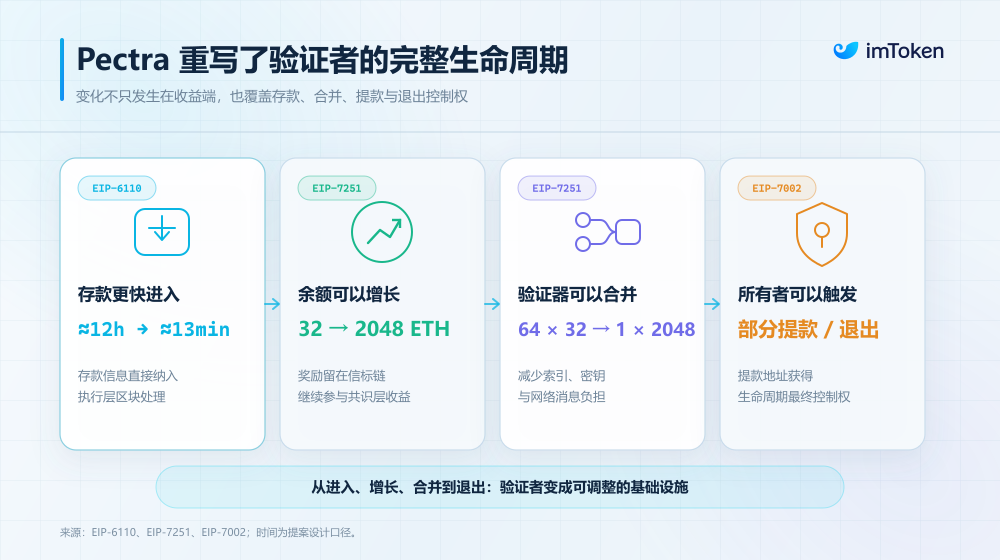
Pectra went live on Ethereum mainnet on May 7, 2025. One of its changes, EIP-7251, raised the maximum effective balance for a single validator from 32 ETH to 2,048 ETH and introduced withdrawal credentials beginning with 0x02. Validators using the new credential can keep consensus-layer rewards inside the beacon-chain balance, allowing effective balance to grow over time and earn additional rewards. That is why they are often described as compounding validators.
On the surface, this looks like protocol-level auto-compounding. The deeper shift is structural. Ethereum’s validator model had long been organized around a fixed 32 ETH unit, and Pectra loosened that constraint.
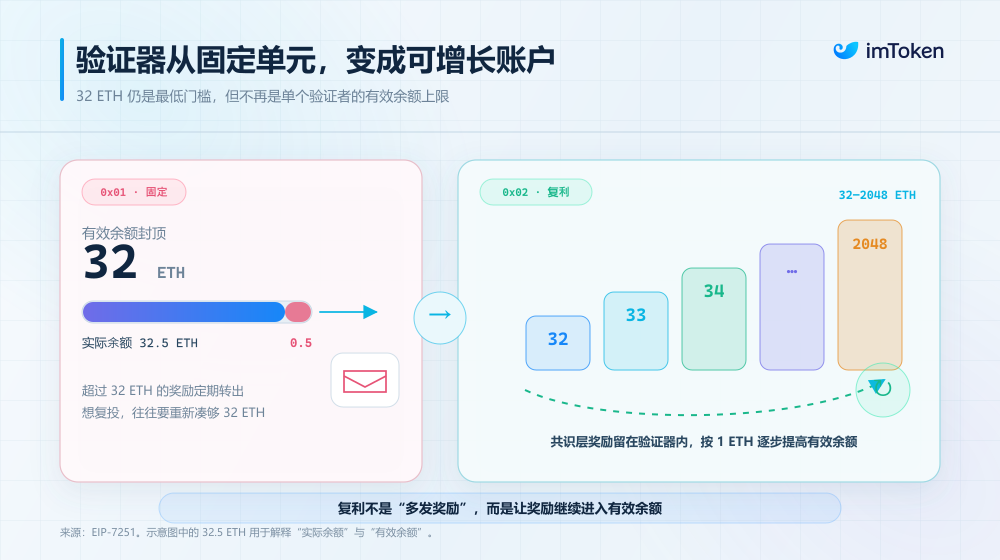
Before this change, a validator’s effective balance was capped at 32 ETH. Even if the validator balance rose above that level, the amount used in consensus reward calculations stayed at 32 ETH. The excess did not add more validator weight and was instead periodically swept to the execution-layer withdrawal address.
For solo stakers or users running only a small number of validators, that setup made native reinvestment cumbersome. Rewards spread across validators had to be gathered back into 32 ETH chunks before they could be restaked, and balances below 32 ETH often sat outside the staking system.
Large staking providers, exchanges and professional operators were in a different position. They could aggregate fragmented rewards from many users and reach new 32 ETH thresholds faster, but each additional 32 ETH usually meant creating and maintaining another validator. As Ethereum staking grew, validator counts kept climbing, and so did the operational burden tied to indexing, key management, signatures and attestation traffic.
EIP-7251 was introduced to change that setup.
In the 0x02 model, the minimum to start a validator is still 32 ETH, but the maximum effective balance rises to 2,048 ETH. Rewards no longer have to be pushed out automatically. They can remain inside the validator, increase effective balance and continue generating returns.
Legacy validators can also be merged. The article gives a simple example: 2,048 ETH that was previously spread across 64 validators can be consolidated into one higher-balance validator. Total staking weight stays the same, but the number of validators, keys and network messages that need to be handled drops sharply.
The ETH is still staked on Ethereum. The network’s economic security is not reduced. The main difference is that the operating load becomes much lighter. That is the process Lido is trying to capture through this migration.
Seen from that angle, “compounding” explains only part of the value behind the new validator type. The other part is that validators no longer need to remain fragmented into large numbers of standardized 32 ETH units. They can be reorganized into a leaner structure built for scale.
The yield lift is real, but uneven
The article makes clear that the yield benefit from 0x02 validators is not evenly distributed. In theory, both smaller stakers and large institutions can reduce idle balances and put rewards back to work more quickly. In practice, the marginal gain depends on how efficiently each participant could already manage and aggregate funds before the upgrade.
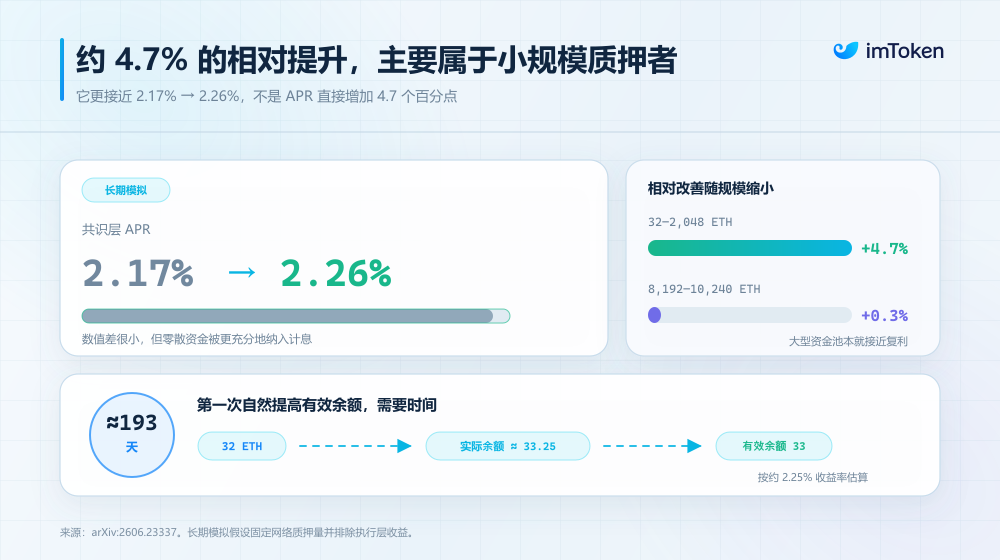
A June 2026 paper titled When Staking Rewards Compound: Measuring the Impact of Ethereum's Pectra Upgrade compared the performance of 0x01 and 0x02 validators. Its simulations showed that in the 32 ETH to 2,048 ETH balance range, consensus-layer APR averaged about 2.17% for 0x01 validators and about 2.26% for 0x02 validators. That translates into a relative improvement of about 4.7% for the latter. But when staking size reaches 8,192 ETH to 10,240 ETH, the relative gap narrows to about 0.3%.
The article stresses an important point here: the roughly 4.7% figure is not a 4.7 percentage-point increase in APR. It is a relative improvement on top of an existing consensus-layer APR in the neighborhood of 2% to 3%.
Smaller stakers benefit more because they historically had a harder time compounding. If a user runs a single 32 ETH validator, rewards swept to the withdrawal address may take a long time to build back up to another 32 ETH, unless they are combined with other funds. Balances below that threshold can remain scattered across addresses, making reinvestment less likely.
With a 0x02 validator, those funds can remain inside the same validator and keep increasing effective balance. That cuts down on idle ETH trapped below the 32 ETH threshold. In other words, smaller stakers were missing not just the desire to reinvest, but often the practical ability to redeploy fragmented ETH back into native staking.
Large staking services also gain from native compounding, but they already had stronger fund aggregation capabilities. They could assemble fresh 32 ETH deposits and launch new validators quickly, which meant that from the perspective of the full pool, capital allocation was already close to compounding. As staking size rises, scattered balances make up a smaller share of total capital, so the marginal gain from 0x02 becomes smaller.
That does not mean 0x02 matters less for large institutions. The article argues the opposite. Their central problem is shifting away from how to keep rewards earning yield and toward how to manage more ETH with fewer validators.
For those operators, 0x02 has two main advantages:
- Rewards can stay inside validators and keep compounding, reducing the need for repeated aggregation, redepositing and validator creation.
- Large fleets of 32 ETH validators can be merged, cutting the management cost of nodes, keys and consensus-layer messaging.
There are trade-offs. Traditional 0x01 validators automatically send rewards above 32 ETH to the withdrawal address, with no active onchain action required. In the 0x02 model, rewards stay inside the validator by default. If a large provider needs to handle user redemptions or manage liquidity, it must actively initiate partial withdrawals and redesign accounting, reward distribution and liquidity buffer frameworks.
That leaves smaller stakers and institutions benefiting from the same mechanism for different reasons. For smaller participants, the clearest gain is lower reinvestment friction and less idle ETH. For larger operators, the improvement in yield may be smaller, but validator consolidation and infrastructure efficiency become more important.
A reset in staking services, not just APR
If APR is the only metric, the article says Lido’s migration is not an especially compelling trade by itself. Yield improvement for large providers may be below 1%, the migration creates a temporary reward drag, and accounting, withdrawal and liquidity systems all need to be adjusted.
Even so, Lido has decided to pursue what the article describes as its biggest core architecture upgrade since V2 in 2023. The reason is scale. Once the protocol is managing more than 8 million ETH, validator count itself starts to become a cost center.
After Pectra, a single 2,048 ETH validator can carry the same staking weight as 64 traditional validators. That means the same capital base can be run through a much smaller validator set.
The changes do not stop at validator consolidation. After migrating to Curated Module v2, Lido’s professional node operators will, for the first time, need to lock ETH as bond collateral. If there is downtime, slashing, reward misallocation or another attributable issue, that bond can be used to cover losses.
Previously, Lido’s curated node operators were trusted mainly on the basis of track record and reputation. Under the new model, that reputation layer remains, but it is supplemented by capital at risk. The article says all 34 existing curated node operators are expected to migrate to CMv2, with none opting out because of the bond requirement.
The piece argues that this change may deserve even more attention than compounding itself. In its view, Pectra is shifting the basis of competition in staking. Differences between providers may increasingly show up in how they improve effective capital usage, manage withdrawals and liquidity, distribute validator risk, and balance asset control, operational complexity and yield.
For wallet interfaces and other user entry points, the implication is also broader than showing a return figure. They need to surface the capital path and risk structure behind each staking option. The article uses imToken Stake as an example:

- Users can enter staking directly from the ETH asset page and choose services based on capital size and demand. Users with smaller amounts can use staking services integrated into the wallet.
- Users holding more than 32 ETH who want to retain control of assets can choose a non-custodial validator option and join native Ethereum staking without maintaining nodes themselves.
As compounding validators become more common, these interfaces may need to show more details, including whether rewards are automatically compounded, when rewards can be withdrawn, which withdrawal credential a validator uses, who controls the funds, and what technical or liquidity risks come with each setup.
In that sense, the wallet is no longer connecting users to a single staking yield page. It is connecting them to a growing set of differentiated validator services.
How Pectra changes the staking playbook
The article closes by placing Pectra in Ethereum’s broader staking timeline. The Merge made validators central to network security. The Shanghai upgrade addressed how staked funds could exit. Pectra starts refining how capital enters staking, accumulates and gets reorganized.
Compounding validators will not deliver the same degree of yield improvement to every participant. For smaller stakers, the main effect is to reduce idle balances and let long-term ETH holdings participate more fully in consensus. For large institutions, the more important value may be lower validator count and lower operating burden rather than higher APR.
That is why the migration to 0x02 validators is likely to be gradual. Participants with different capital sizes, liquidity needs and operating structures may choose to keep legacy validators for longer, or move step by step toward the compounding model.
Still, the way Ethereum organizes staked capital is changing. As validators stop being hard-bound to 32 ETH units, staking is starting to move away from a standardized yield product and toward a more segmented contest over capital management and infrastructure design.
The original article also includes a disclaimer stating that markets carry risk, users should be cautious, and the content does not constitute investment advice.