XRP Ledger
Nov 5, 2026

XRP Ledger fixes bug that let approved token burners mint new tokens

XRP Ledger has closed a bug that allowed approved token burners to create new tokens, according to CoinDesk. The fix went live on Wednesday after validator support reset the activation clock in October. CoinDesk said XRP itself was not affected by the issue. The update addresses the specific flaw on the ledger while leaving the native token untouched. The report did not provide additional technical details in the summary, but it identified the timing of the rollout and the validator-related reset as the key points tied to the fix.

550

XRP Ledger fixes bug that let approved token burners mint new tokens
Sei
Nov 3, 2026

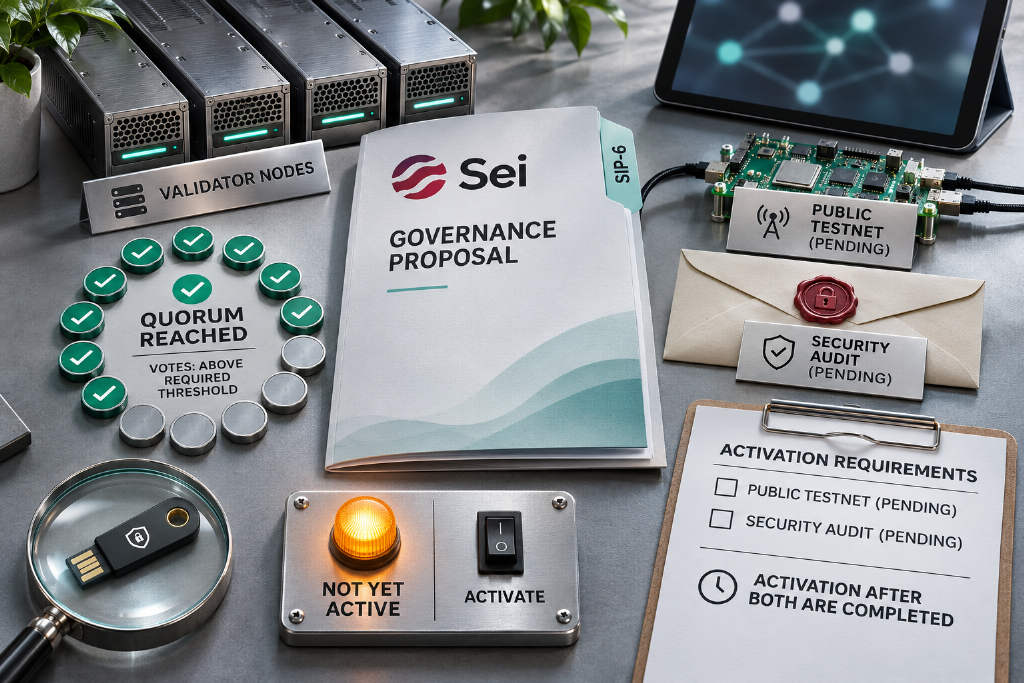
Sei’s SIP-6 Autobahn consensus vote reaches quorum

Sei’s governance vote on SIP-6 has reached quorum, clearing an early procedural hurdle for the proposed Autobahn consensus change. The proposal would allow validators to propose transactions simultaneously, altering how the network’s consensus process works. Still, the change is not set to go live yet. According to TheDefiant, activation must wait until a public testnet rollout and security audits are completed. That leaves the proposal in a passed-quorum stage rather than immediate implementation, with additional testing and review still required before the feature can be turned on.

800
Sei’s SIP-6 Autobahn consensus vote reaches quorum
NEAR Protocol
Nov 3, 2026

NEAR holders back plan to cut annual issuance cap to 1.6%, pending validator adoption

NEAR Protocol’s onchain governance body, the House of Stake, has voted to support a proposal to lower the network’s annual issuance ceiling from 2.5% to 1.6%, with the reduction phased in over 24 months. The vote does not change issuance by itself. NEAR said the result still needs review and ratification by the House of Stake Security Council, followed by an approximately 90-day grace period, and the change becomes binding only if validators adopt it through a protocol upgrade. The proposal, HSP-029, was written by Sal Ternullo, CEO of Nasdaq-listed SVRN, and says the cap would decline by roughly 3.75 basis points per month, recalculated every epoch, until reaching 1.6% in month 24. Token distribution would remain unchanged, with 90% of new issuance going to stakers and 10% to the NEAR treasury. The proposal also disclosed that SVRN holds about 55 million NEAR, with more than 90% staked, and intended to vote in favor. It estimated lower issuance would reduce gross staking yield from about 5.27% to 3.37% at current participation levels and could leave 24 validator pools unable to cover costs at the token price measured in September.

570
NEAR holders back plan to cut annual issuance cap to 1.6%, pending validator adoption
Aztec
Nov 3, 2026

Aztec rolls out Tierra upgrade, fixes security flaws and doubles private proof speed

Aztec Foundation has released the Tierra (Alpha V6) upgrade for Aztec, an Ethereum privacy-focused Layer 2 network. The update addresses security issues found in earlier versions, including a critical flaw identified in V5, and adds an AI-based security testing system. It also improves performance: private transaction proof generation is now twice as fast and takes about one second on a local device, while the time for Ethereum messages to reach the Aztec network has been reduced from an average of about two minutes to as little as 12 seconds. Aztec said the network’s decentralized design means critical vulnerabilities cannot be patched by a single centralized operator and instead require a network-wide upgrade. The team added that the network currently has more than 3,000 validators and does not rely on a centralized sequencer or privileged viewing keys, according to The Block.

720
Aztec rolls out Tierra upgrade, fixes security flaws and doubles private proof speed
ETHGas
Nov 3, 2026

ETHGas develops institutional blockspace for validator selection on Ethereum

ETHGas is developing an "Institutional Blockspace" feature that would let banks and trading firms choose which validators handle their Ethereum transactions, according to CoinDesk. The setup is designed to let participants screen counterparties for sanctions compliance and reserve space in upcoming blocks. Even with those controls, the transactions would still settle on Ethereum's public network. The report frames the product as a way to give institutional users more choice over transaction handling without moving settlement off the public chain. CoinDesk identified banks and trading companies as the intended users of the feature.

600
ETHGas develops institutional blockspace for validator selection on Ethereum
Solflare
Nov 3, 2026

Solflare enters security mode, tightens access to code and infrastructure

Solflare, a wallet built for the Solana ecosystem, has moved into a security mode after a series of security incidents across the industry. The wallet said access to infrastructure and code has been restricted, all changes now require multiple layers of approval, and new modifications have been paused for the time being. The move follows an earlier incident involving one of Solflare’s third-party staking providers. According to the wallet team, the event affected Solana validator keys and temporarily prevented some users from receiving staking rewards, though user funds were not stolen. Solflare also extended the validator migration deadline to Nov. 30 UTC and said it will compensate users for missed staking rewards accrued between Oct. 26 and Nov. 1 UTC. The update was cited by Techub News, which referenced Crypto.news.

740
Solflare enters security mode, tightens access to code and infrastructure
NEAR
Nov 2, 2026

NEAR Governance Backs Plan to Cut Issuance Cap to 1.6%

NEAR governance has approved a proposal to reduce the network’s issuance cap to 1.6% over a 24-month period, according to TheDefiant. The change would lower staking rewards if it takes effect. The vote, however, does not make the proposal active right away. Two steps still remain before implementation: ratification by the Security Council and adoption of the required protocol upgrade by validators. The report frames the decision as a governance milestone, but one that still depends on follow-through at the protocol and validator levels. The article was published by TheDefiant on Nov. 2, 2026.

710
NEAR Governance Backs Plan to Cut Issuance Cap to 1.6%
Jito
Nov 2, 2026

Jito names first outside BAM node operators, with broader mainnet validator access targeted for early Q1 2027

Jito has identified the first outside operators for its BAM nodes, naming Triton One, Bitwise, and SOL Strategies. The three firms are starting with testnet onboarding, according to The Defiant. Jito also set a longer-term access target for the broader validator set: any mainnet validator is expected to be able to access the system in early Q1 2027. The update points to a phased rollout, with external participation beginning in testnet before wider availability on mainnet. The announcement centers on Solana infrastructure and validator access rather than token price or market activity. No additional technical details, performance figures, or deployment milestones were disclosed in the source material beyond the operator names, the testnet onboarding stage, and the early Q1 2027 target for broader mainnet validator access.

910
Jito names first outside BAM node operators, with broader mainnet validator access targeted for early Q1 2027
Total 224 items
Go topage