
Decentralized perpetuals DEX Lighter has been one of the stronger performers in the sector in recent weeks. According to OKX market data, LIT traded at 2.65 USDT as of 14:30 on July 6, up 19.4% over the previous 24 hours. Measured from its early-April low of 0.78 USDT, the token has now rebounded by more than 3x in roughly three months.
Recent developments suggest the move is not being driven by a single headline. Instead, the rally appears to reflect a combination of regulatory progress, new distribution through a major wallet channel, and a tokenomic redesign centered on buybacks and permanent burns. Market structure has also played a role, with prior holder rotation and short covering amplifying the upside once price momentum returned.
A clearer U.S. compliance path is strengthening Lighter’s domestic regulatory narrative
The first major pillar behind Lighter’s recent strength is its accelerating compliance story. In contrast to Hyperliquid, the category leader in on-chain perpetuals that is often viewed through the lens of offshore regulatory risk, Lighter has increasingly positioned itself as infrastructure embedded within the U.S. regulatory framework. That distinction matters more as derivatives oversight tightens and market participants assign higher value to projects seen as better aligned with future rules.
During its Q1 investor call in early April, Lighter founder and CEO Vladimir Novakovski said the company had already started the process of applying for an on-chain derivatives trading license in the United States. He framed the effort in practical terms, noting that serving traditional financial institutions such as Citadel would be unrealistic without proper licensing. For investors, that comment signaled a strategy aimed not only at crypto-native traders but also at building a bridge to larger institutional flows.
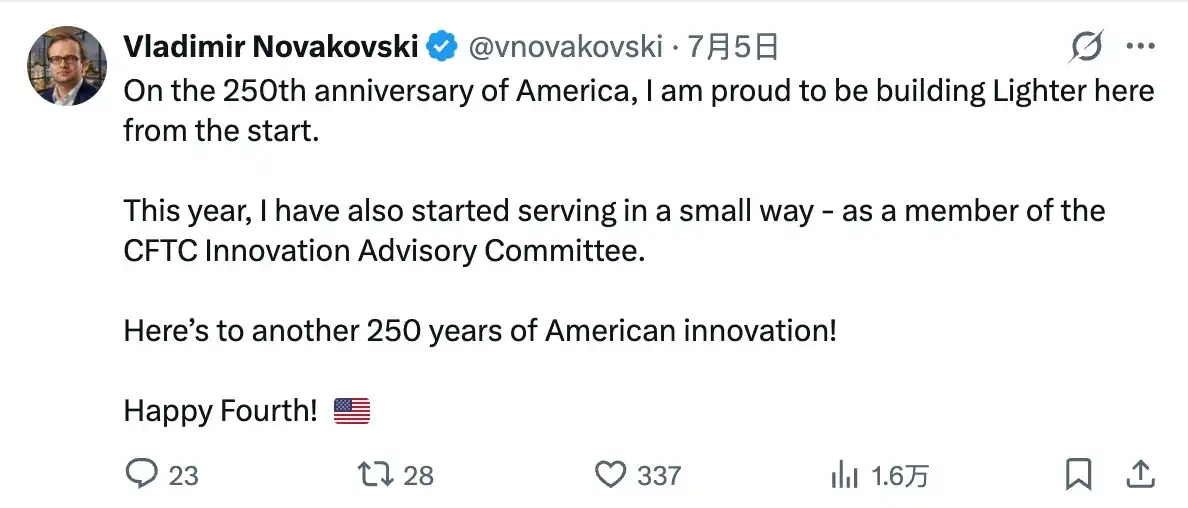
Another closely watched update came when Novakovski said on X that he had become a member of the U.S. Commodity Futures Trading Commission’s Innovation Advisory Committee. The significance, in market terms, goes beyond the title itself. The committee serves as a policy interface between regulators and industry participants, providing input on issues that span technology, law, and finance. In this context, the appointment is being interpreted as a sign that Lighter is not merely reacting to regulation, but may gain earlier visibility into how future rules are discussed and shaped.
The article also noted that incoming Federal Reserve Chair Warsh disclosed holding a certain amount of LIT in pre-appointment financial filings. That does not imply any policy action tied to the token, and no such claim has been made. Still, traders often price in perceived network effects around policy circles, and the disclosure has added to speculation that Lighter may enjoy stronger regulatory credibility than many of its peers.
Robinhood Wallet integration expands distribution and shifts Lighter’s role
The second major catalyst is distribution. Last week, Robinhood and Lighter jointly announced that Robinhood Wallet now supports a native perpetuals trading entry powered by Lighter. Through the wallet, users can directly trade perpetual contracts and tokenized stock assets, with USDG used as the quoted asset.

Robinhood had already been an investor in Lighter, so further collaboration had long been expected by parts of the market. At the same time, some users had worried that Robinhood might choose to build its own perpetuals product in-house, eventually competing with Lighter. The latest announcement suggests Robinhood instead opted to plug into Lighter’s trading infrastructure rather than create a separate on-chain perpetuals stack from scratch.
That matters because it changes how Lighter can be valued. Rather than functioning solely as an independent DEX, the protocol now looks increasingly like a default execution and liquidity layer inside the Robinhood Wallet ecosystem. The strategic value is not limited to brand association. More importantly, Robinhood brings a large existing user base, which could materially lower the friction for users entering on-chain perpetuals trading through a familiar interface.
From a sentiment perspective, the partnership also drew strong reactions from market participants. Trader Ansem, who recently attracted attention due to meme-token gains, described the Robinhood-Lighter collaboration as something that “looks like it could be big.” While that is not fundamental evidence on its own, it reflects growing market conviction that the partnership may have meaningful volume and adoption implications.
Revenue-funded buybacks and permanent burns reinforce LIT’s cash-flow narrative
The third major driver is tokenomics. On July 1, Lighter announced an update to the LIT model that directs all protocol revenue to LIT buybacks, with purchased tokens permanently burned. That change has strengthened the market view of LIT as an asset tied more directly to protocol cash flow rather than solely to speculative trading demand.
At the time of the announcement, Lighter said it had already repurchased about 15.5 million LIT, representing roughly 6.26% of circulating supply, and that the first on-chain burn would be executed after the end of Q2. Compared with a previous framework of programmatic buying, permanent destruction of repurchased tokens has a more direct effect on reducing effective supply, which is one reason traders have been willing to assign a higher valuation multiple.
Lighter also redesigned staking. After initially subsidizing rewards using pre-TGE revenue, the team said it will gradually introduce ecosystem tokens as the source of staking yield, targeting an annualized return of about 6%. Based on a current staking base of around 125 million LIT, that would imply annual distributions of approximately 7.5 million tokens. In practice, the model now has two visible legs: protocol revenue that buys back and burns LIT to reduce circulating supply, and staking rewards that aim to compensate longer-term holders.
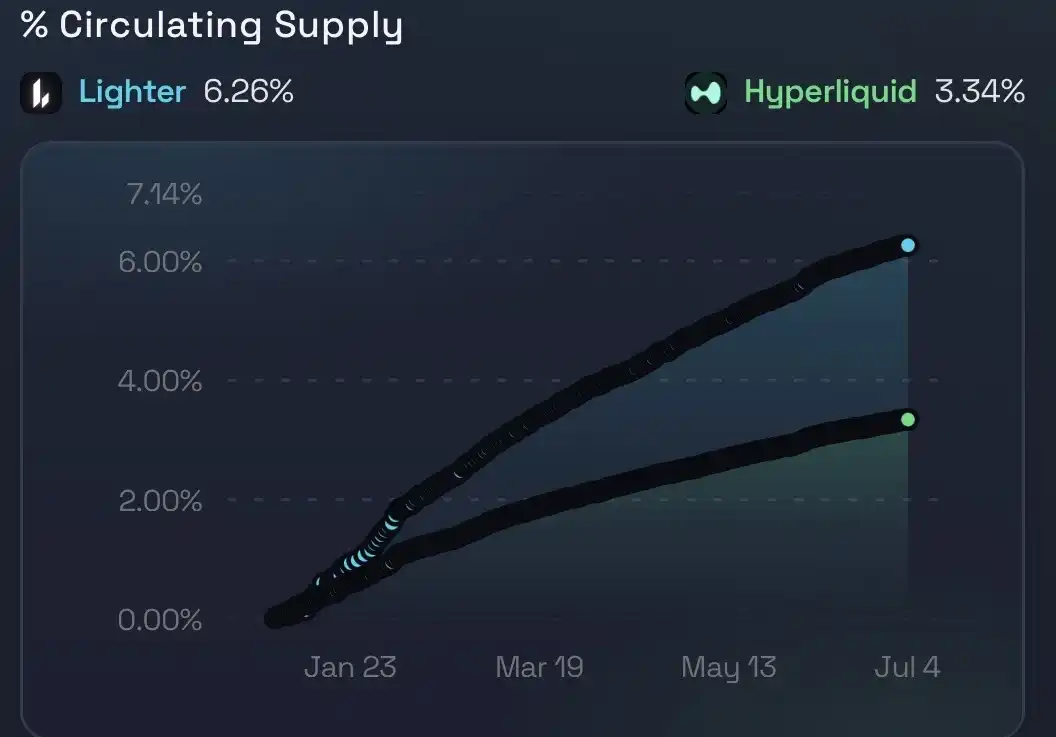
Data comparisons with Hyperliquid have further supported the bullish case. According to the figures cited in the article, Lighter’s cumulative buybacks amount to around 6.26% of circulating supply, versus roughly 3.34% for HYPE. Using a buyback-to-market-cap metric, Lighter was cited at about 4%, compared with around 1.8% for Hyperliquid. Those comparisons have helped frame LIT as unusually aggressive on capital return and supply contraction relative to peers in the perpetuals DEX segment.
Holder rotation and short covering magnified the repricing move
Viewed together, the compliance story, Robinhood integration, and tokenomic overhaul suggest that LIT’s rally is better understood as a delayed repricing than as a sudden improvement out of nowhere. A key precondition for that repricing was the token’s prior market structure. During the long drawdown after TGE, a substantial amount of weak-hand supply appears to have been flushed out.
Since launch, LIT had faced several overlapping pressures: a soft broader crypto market, intense competition across the perpetuals DEX sector, and persistent selling from early airdrop recipients. At the same time, market makers and longer-term capital reportedly accumulated at lower levels, shifting the ownership structure from loose and broadly distributed toward more concentrated hands. As fundamentals improved, the market dynamic gradually moved away from being dominated by overhang sellers and toward one driven by fresh incremental buyers.
Short positioning likely added another layer to the move. With the token spending a long period either range-bound or drifting lower, bearish positioning had time to build. Once price broke through key levels, upside liquidity became more asymmetric: overhead sell pressure was limited, while short covering created an additional source of demand. That combination can sharply increase price elasticity during breakouts.
In that sense, LIT has not necessarily “suddenly become strong.” Rather, the market appears to be revaluing the token as several previously uncertain drivers become more concrete and more measurable. The recent move reflects not just improving fundamentals, but also a structural shift in who holds the token and how marginal flows are setting price.