
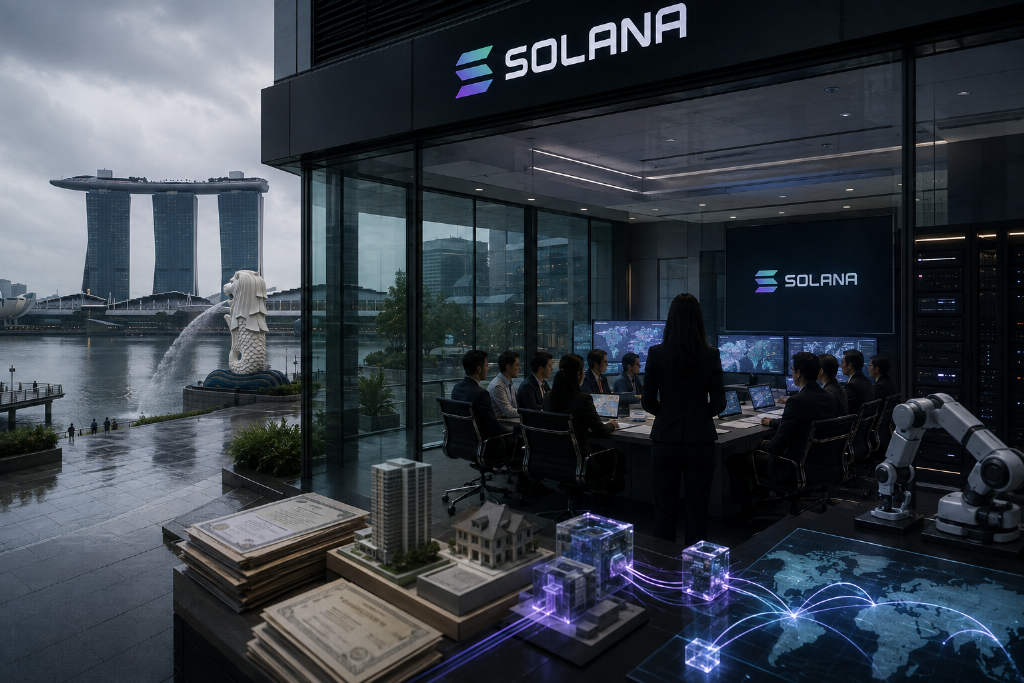
Lily Liu, chair of the Solana Foundation, said value is becoming programmable and argued that the tokenization supercycle is not just another market upswing. She described it as a long transition in which money, assets, and ownership move onto always-on internet infrastructure. The internet capital markets that emerge from that process, she wrote, will ultimately become the largest capital markets in the world.
Tokenization changes issuance, investment access, and distribution at the same time
Liu framed the shift as a supercycle. She pointed to the early 21st century, when China’s rapid industrialization drove a multiyear structural rally in commodities. Economists used the term “supercycle” for periods in which supply, demand, and capital allocation change over a longer span than a normal business cycle. She noted that the United States in the late 19th century, as well as postwar Europe and Japan, went through comparable periods.
In earlier cycles, shocks usually appeared at one end of the market and then spread outward. Tokenization is different, she said. It changes three parts of the market at once: who issues assets, who can invest, and how assets reach investors.
Liu listed four forces that are now converging:
- Stablecoins have shown that money can move on-chain at global scale.
- Financial institutions are bringing assets on-chain.
- Blockchain infrastructure can now meet real-economy requirements for speed and cost.
- AI is creating a new class of economic participants, and those participants need programmable money to function.
Each force, on its own, could define a technology cycle. Combined, she argued, they amount to more than a technical upgrade. In the future, anything with value could be tokenized and tied to clear ownership rights. Those assets could then be financed and traded in markets that never close.
Distribution power may become part of valuation
Liu wrote that the traditional financial system was built in a period when sharing information and moving value were both difficult and expensive. Those constraints have eased, but the market structure created under them still remains.
Liquidity is still fragmented, she said. A market may contain strong assets without reaching the capital willing to hold them, because that capital is separated by regulatory systems and investment thresholds.
Tokenization widens those channels. Geography stops being the key barrier, in her telling, because an asset issued anywhere can potentially reach global investors at any time. Minimum ticket size also becomes less restrictive, allowing markets that once catered only to institutional pools of capital to open to smaller investors at much lower cost.
She used American depositary receipts, or ADRs, as a historical example. The structure converted foreign shares into a form that U.S. investors could buy. Issuers used it for one simple reason, she wrote: access to a deeper pool of capital often gave the same cash flow a higher valuation. The logic has already been proven, but the mechanism was costly, narrow in scope, and dependent on depositary banks and sponsors.
Scaling that mechanism up is now mainly a technology problem, Liu said, and tokenization addresses it. Different asset classes and jurisdictions can plug into the same framework. Over time, she argued, an asset’s distribution capability will become part of its valuation.
She said this is already starting to happen. Over the past year, real-world assets worth hundreds of billions of dollars were traded on Solana. Tokenized Treasuries, equities, private credit, and other assets are finding distribution and liquidity through on-chain markets. Liu described these as early signals that capital, like information, can become freely mobile and continuously available.
She added that traditional financial institutions are already exploring the area. The New York Stock Exchange, the Depository Trust & Clearing Corporation, and the London Stock Exchange are all studying what on-chain equity markets could look like.
Investors gain ownership access and financing capacity
The same infrastructure gives investors two things, Liu wrote: the ability to own assets and the ability to borrow against them.
Ownership opens markets that were previously closed off by geography, minimum investment size, or investor qualification rules. Financing gives existing assets a more active role. They can be used as collateral for borrowing or put to work as yield-generating investments. Large amounts of global wealth still sit in forms that are hard to finance and, in some cases, impossible to pledge. Tokenization can put that dormant wealth into motion, she argued.
She described the goal as “universal basic ownership,” meaning that anyone connected to the internet should have a chance to own part of the value created by economic activity and let that ownership generate further value.
Any application could become a super app
Liu said traditional capital markets were built around intermediaries. For assets to reach investors, they typically had to pass through licensed institutions, and each jurisdiction or asset class often came with its own intermediary stack. Those firms made money by sitting between counterparties and charging for access and service.
That structure lasted because asset distribution used to be hard. The barriers came not only from regulation but also from integration costs. Connecting to payment networks, custodians, and trading venues often took years.
Programmable money changes that math, she wrote, reducing integration costs to something closer to a single API call. A mobile or web application can add payments and trading on top of its existing functions. In that sense, any application can become a super app.
The deeper trend, in her account, is convergence. Payments, settlement, issuance, and market trading used to rely on separate financial systems. They are now starting to run on the same programmable infrastructure.
Liu said Solana’s low cost and shared liquidity make that convergence possible. Consumer payments, institutional settlement, and global markets can operate on one platform, allowing liquidity to accumulate across use cases instead of being split across isolated markets.
She cited examples that are already live: Visa uses Solana for USDC settlement; PayPal has brought PYUSD payments and payouts to the network; MoneyGram provides conversion rails between fiat and digital assets; and Western Union has launched the USDPT stablecoin on Solana. Over the past year, stablecoin transfer volume on the network exceeded $4.7 trillion.
Liu also described a reinforcing loop between issuers, investors, and application entry points. More issuers increase asset supply. More assets attract more investors. More investors deepen liquidity and improve price discovery, which then attracts additional issuers. Applications sit across the whole loop. Every new entry point expands reach on both the asset side and the capital side, while every new asset gives applications more products to integrate and distribute.
AI could accelerate the loop
AI, Liu argued, will speed the process up again. It introduces a type of economic participant that finance has not seen at scale before: software that can carry out economic activity on its own.
Using crypto assets, an AI agent can determine what it needs, find a service, pay for it, receive the result, and continue operating without a human initiating each transaction. Liu said that opens a new commercial model in which AI agents transact autonomously. AI creates new economic participants, while blockchains provide a programmable, always-on financial layer where those participants can operate.
She added that AI could amplify the same three-sided effects across issuers, investors, and entry points. Build-out in AI infrastructure will direct market attention toward new issuers because the physical capacity that supports AI needs financing, which brings new asset supply. AI agents will also increasingly act as autonomous investors, allocating capital without human involvement. At the same time, they will become new transaction entry points in their own right.
When ownership and intent can both be read by machines, asset allocation and settlement can run at machine speed, she wrote. Energy markets and payment systems would no longer need to remain segmented by geography, instead operating on shared infrastructure. Near-zero-cost payment networks would replace legacy systems that combine percentage-based fees with fixed charges, and around-the-clock markets would replace limited trading windows.
Institutions that understand that shift, she said, will finance the next wave of real-world capacity more efficiently than firms that still treat tokenization as a novelty. She identified that capacity as data centers, energy, and production facilities.
Still early by traditional market standards
Liu said on-chain volume remains small compared with traditional markets, and tokenized assets are still almost negligible in size relative to their conventional security counterparts. That description is accurate for the present, she wrote, but it does not predict the future.
She compared the moment to the early internet, which drove the cost of producing and distributing information close to zero. What followed was not a simple digital version of newspapers but entirely new markets and business models. Tokenized Treasuries, in her view, represent the “newspapers online” stage: useful as a demonstration, but not the endpoint.
She also noted that 5.5 billion people are already connected to the internet. A financial infrastructure that works at any time, for anyone, and for any asset would put the world’s largest market, the market around capital itself, within reach. Once global liquidity moves online, she wrote, its pull will be hard to resist.
Markets without hard borders
Up to now, every capital market has had clear access boundaries. Exchange seats, brokerage channels, jurisdictional lines, and trading hours have all helped determine who gets in. Internet capital markets are beginning to loosen those boundaries.
The system that carries this transition, Liu wrote, will not simply be an upgraded version of the old one. It will be a new system built step by step, one token at a time.