
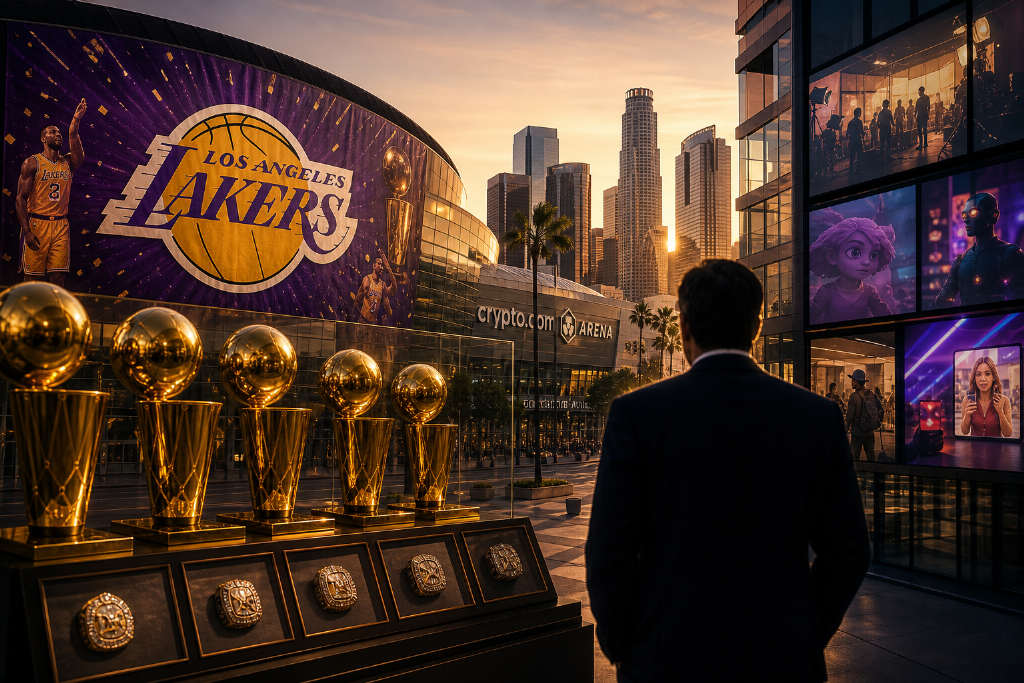
Lawyer Lin Shanglun argued in a BlockTempo commentary that the Los Angeles Lakers’ soaring valuation says as much about the limits of AI as it does about sports finance.
Lin wrote that the Lakers were sold for $10 billion in 2025, setting a new record for a U.S. professional sports franchise, and then changed hands again a year later for $12.5 billion in a deal involving former Disney chief executive Bob Iger. The gap between the two transactions was $2.5 billion in one year.
He said that price jump first struck him as absurd. Why would the same team fetch another record so quickly? Lin wrote that he only started to make sense of it after repeatedly seeing AI-produced short dramas in taxis and restaurants.
AI can fill in old regrets, but that erodes scarcity
Lin wrote that films, comics, novels, and even a team playing through a full season once shared a similar trait: each required real effort, repeated attempts, and meaningful cost. In filmmaking, he noted, lighting, locations, actors, and post-production all had to come together before a few usable minutes could appear on screen. Because the process was difficult, unfinished projects and unrealized scenes stayed in people’s minds.
That has changed, in his view. Visual entertainment can now be produced much more easily with AI, and the more consequential shift is that AI can also fill in what original works left unfinished. Lin pointed to long-imagined scenes from animation, films, and other works that were never officially made or never completed by their creators. He said AI can now turn those once-unreachable ideas into watchable images for viewers.
For Lin, the issue is not only that AI can help create films. It is that AI can repair the regrets attached to older works as well. Once something people had wanted for years, and considered very difficult to make, can be generated at a much lower cost, scarcity disappears first. Emotional value then falls with it, he wrote.
Sports history comes from games that were actually played
Lin drew a clear line between sports and AI-generated visual content. He wrote that athletic competition is different because a player’s development cannot be accelerated into existence by AI, and a team’s history is built game by game through events that actually happened.
That, he argued, is why the Lakers command their current price. The franchise’s value rests on accumulated honors over time. Lin cited Magic Johnson’s Showtime era, Kobe Bryant’s Mamba spirit, and LeBron James’ title in the NBA bubble. Those nights, those moments, and the people no longer on the court cannot be recreated afterward by AI. Even if fans want to watch them again, AI cannot reproduce championship moments that were truly lived.
Lin sees Bob Iger buying what AI cannot generate
Lin described the Lakers’ $2.5 billion one-year price increase as a precise assessment by Bob Iger. He wrote that Iger brought ESPN, Marvel, and Pixar into Disney and helped push the company’s market value to a peak, making him part of a group that understands asset valuation at the highest level.
In Lin’s telling, anything that can be generated on demand will eventually become abundant. Assets that AI cannot generate will grow rarer by comparison. Films can be remade. Novels can be rewritten. But the NBA will not have a second Lakers franchise, he argued. Lin wrote that “Magic has aged, Mamba is gone, and LeBron is in Philadelphia,” and said the next championship in Los Angeles is destined to belong to a different chapter, not the old heroes.
Capital is moving into both AI and anti-AI assets
Lin closed by framing the Lakers deal as part of a wider investment split. He wrote that Taiwan is making money from AI on a global scale and that stocks and capital are heavily tilted toward AI buildout. At the same time, he said, U.S. sports investing shows another path: putting serious money into assets that are most resistant to AI replication.
His conclusion was that both trades can exist at once. In the same era, some investors are heavily positioned in AI, while others are heavily positioned in assets that resist AI. In Lin’s view, both sides have smart money behind them.