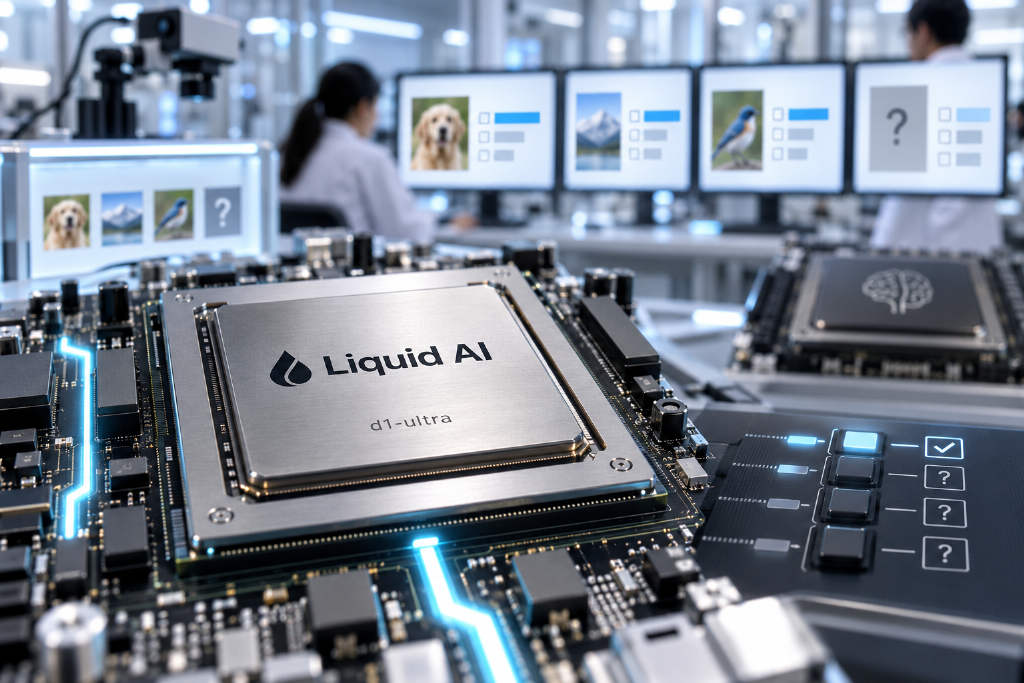
Liquid AI has released d1-ultra, a multimodal decision model that scored 65 on Artificial Analysis’ Decision Index v1.0, beating Jev 1.14 at 57 and taking the top spot. The model is built for decision tasks rather than chat or article generation, reading text and images to judge which option is more likely to be correct and assign probabilities. Use cases cited in the source include spotting defects on circuit boards, checking whether product images match descriptions, and reviewing customer-submitted insurance claim photos.
The lead on the benchmark came with a tradeoff. In Artificial Analysis’ 500-question knowledge test, d1-ultra answered only about 32% correctly, down from 41% for the previous-generation d1. Its strength was a sharper pullback from guessing: among questions it did not answer correctly, the rate of selecting “I don’t know” rose from 2% to 85%. Artificial Analysis gives 12.5% weight each to knowledge accuracy and avoiding incorrect answers, with the rest coming from complex reasoning, tool-use judgment, and safety classification. Liquid AI said its own 112 evaluations showed d1-ultra ahead of Jev 1.14 across all eight task categories. The model is available through Liquid API and Vercel, while weights remain closed.
Liquid AI has launched d1-ultra, a multimodal decision model that scored 65 on Artificial Analysis’ Decision Index v1.0, ahead of Jev 1.14 at 57 to rank first.
Decision models are not designed for chat or article generation. Instead, they read text and images, judge which option is more likely to be correct, and assign a probability. Examples cited in the source include checking circuit boards for defects, matching product images with descriptions, and reviewing customer-uploaded claim photos.
A benchmark lead with a tradeoff
The top ranking came with a notable contrast. In Artificial Analysis’ 500-question knowledge test, d1-ultra answered only about 32% correctly, below the previous-generation d1 at 41%.
Its edge came from cutting down on wrong guesses. Among questions it did not answer correctly, the share of “I don’t know” responses climbed from 2% to 85%. When it was uncertain, the model was more willing to say it did not know instead of risking a wrong answer. That helps explain why its overall ranking improved so sharply.
How the index is weighted
Artificial Analysis assigns 12.5% weight each to knowledge accuracy and the ability to avoid incorrect answers. The rest of the score comes from complex reasoning, tool-use judgment, and safety classification.
In Liquid AI’s own 112 evaluations, d1-ultra outperformed Jev 1.14 across all eight task categories.
d1-ultra is now available through Liquid API and Vercel, while model weights have not been released. Pricing is set at $0.042 per million input tokens, 2.1 times the price of the earlier d1, with no output charge. If the same image is used to answer multiple questions, the image input cost is counted again for each question.
This article was originally published by Bit.Fan. For more cryptocurrency news and market insights, visit www.bit.fan. Disclaimer:
The market information, project data, and third-party content displayed on this platform are for industry information sharing only and do not constitute any form of investment advice or return commitment.
Cryptocurrency trading carries high risks. Users should fully assess their risk tolerance and make independent decisions. All profits, losses, and legal responsibilities are borne by the users themselves.