
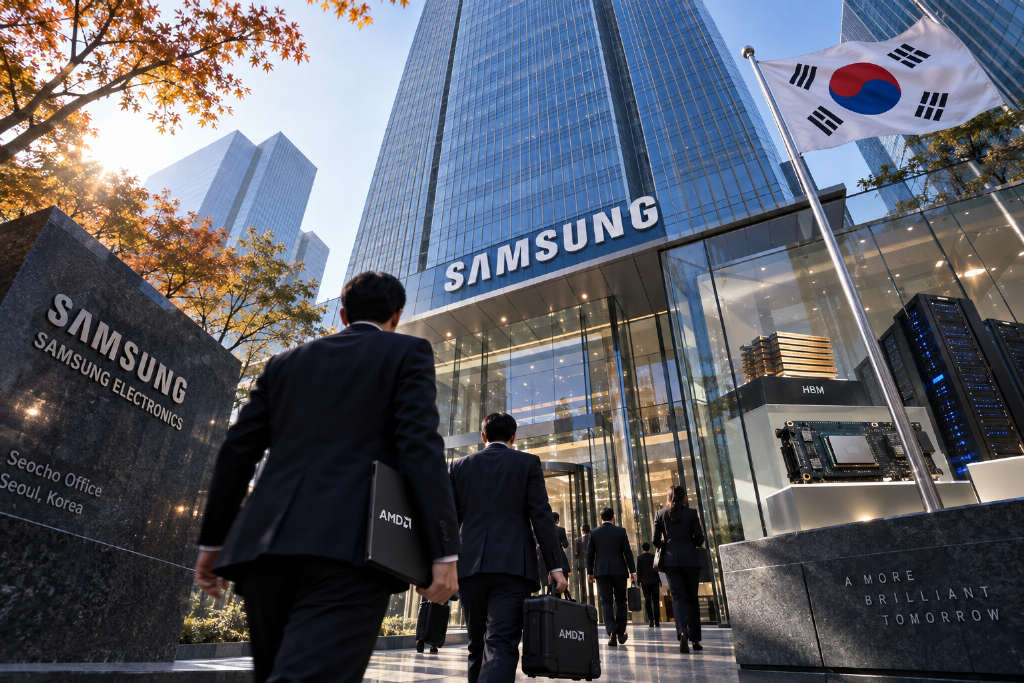
AMD Chair and CEO Lisa Su arrived at Samsung Electronics’ Seocho office building in Seoul at about 4:44 p.m. on Oct. 7 and met Jun Young-hyun, vice chairman and head of the Device Solutions division, according to ChainCatcher. The trip came about seven months after her previous visit to South Korea.
She was accompanied by Jack Huynh, head of AMD’s Computing and Graphics Group, and AMD Vice President Joseph Macri.
Broader partnership on the agenda
Su said the two companies would discuss a broader partnership. She also said Samsung has many partners. Asked whether she would meet Lee Jae-yong, she said she could not disclose that.
AMD points to long-term supply planning
Before visiting Samsung, Su attended AMD Player Day in Seoul. There, she described Samsung and SK hynix as core supply-chain partners and said AMD is planning its long-term supply chain as demand tied to artificial intelligence rises.
She said AMD’s next-generation MI455 and Helios systems have started shipping and both use HBM4, with support from the two memory suppliers. Su added that cooperation on HBM would not stop at one generation.
MI455X memory capacity rises 50% from the prior model
A report cited in the item said the Instinct MI455X is equipped with 432GB of HBM4, a 50% increase from the 288GB of HBM3E in the previous MI355X.
Su said memory supply is very tight. AMD is working with customers to optimize usage and is asking partners to expand production.
TrendForce said on the 29th of last month that HBM and conventional DRAM share limited advanced-process capacity, and the supply shortage may continue into next year.
March memorandum covered HBM4 and next-generation DDR5
The report said AMD and Samsung signed a memorandum of understanding in March this year centered on HBM4 and next-generation DDR5 supply. Samsung was designated the main supplier of HBM4 for the MI455X, and the two sides also discussed having Samsung Foundry manufacture AMD’s next-generation products.
At the time, Jun said Samsung could provide memory, foundry, and packaging services at the same time.