

Jeff Huang, known in crypto markets as Machi Big Brother, has once again seen his Hyperliquid trading account pushed toward liquidation.
An Odaily report republished by MarsBit said Machi’s positions were hit by another broad liquidation on Oct. 15, sending his account from $12.25 million back to about $21,800. Over the prior four months, he had turned $56,000 of principal into more than $12 million, only to see a long-heavy trading style drag the account back to the edge of a wipeout.
At least four major liquidation events from June to October
The report said Machi went through at least four large liquidation episodes between June and October.
- In early June, he was liquidated seven times in two days, yet still kept a 25x long on 400 ETH.
- On June 18, his positions were liquidated during a market decline, producing a one-day loss of $320,000.
- On July 31, another sharp market drop led to three liquidations, leaving his account balance below $100,000.
- On Oct. 8, he again neared liquidation, cut 4,700 ETH at a loss, realized a $570,000 loss, and saw a $4 million unrealized gain turn into a $3 million unrealized loss.
The article framed those trades as a pattern of repeated liquidations followed by more leveraged longs.
Trading style centers on longs, usually at 25x leverage
Odaily summarized Machi’s Hyperliquid activity with three recurring traits, starting with an overwhelming preference for long positions and heavy leverage.
The report linked that habit to a profitable stretch in July of last year, when he made more than $22 million by going long ETH, HYPE, and PUMP. Since then, most of his activity has remained long-biased. It said he sometimes opened short positions as hedges, but in most cases stayed committed to longs, usually at 25x leverage, with some 5x positions mixed in.
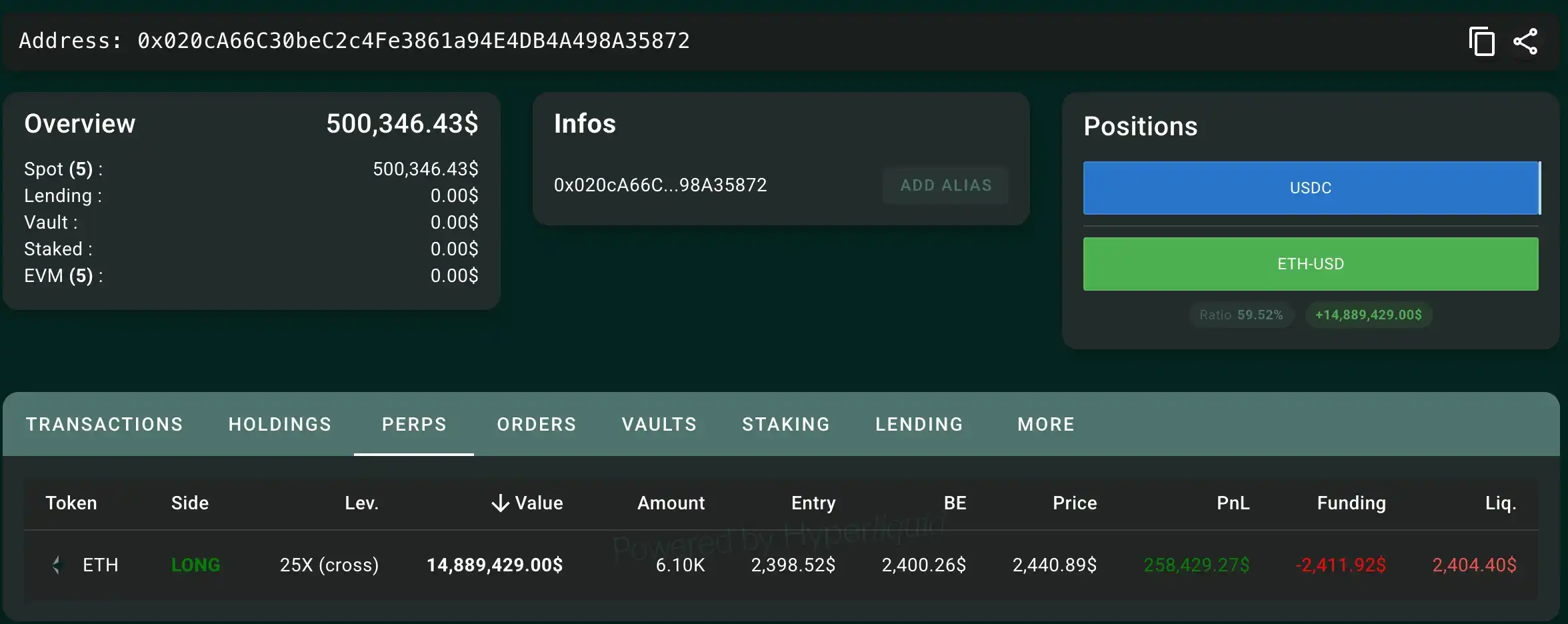
Based on on-chain data cited in the article, Machi still held a 25x long on 6,100 ETH as of writing, showing about $260,000 in unrealized profit.
ETH remains his main trading asset
While Machi has opened perpetual positions in BTC, HYPE, PUMP, UNI, and more recently ENA and PONS since July of last year, the report said ETH remains his most frequent trade, his largest position, and the asset with the highest trading volume in his book.
In September last year, he opened a long on 30,000 ETH at $4,399, a position worth more than $120 million that at one point showed nearly $10 million in unrealized losses.
In November and December last year, Machi transferred funds into Hyperliquid six times to support his ETH longs, but the market drop on Dec. 17 still pushed him from profit to loss. At that point, the report said his cumulative losses had already exceeded $23 million.
The same pattern continued this year. In February, after reaching a profit of $3.5 million in January with a win rate above 84%, he was hit by another sharp reversal and lost more than $27 million within just 20 days. His Hyperliquid account balance briefly fell to around $90,000.
The article used that sequence to highlight his unusually high tolerance for risk.
Repeatedly raised funds to keep trading
The report also said Machi did not leave the market after repeated near-liquidations and full liquidations. Instead, he kept raising money and returning to Hyperliquid for new positions.
In February, when the value of his Hyperliquid holdings fell below $1 million, he even used funds that had been deposited into the PleasrDAO treasury five years earlier to add margin to his longs.
In June, while facing another liquidation cycle on his long positions, he sold 34 BAYC NFTs and effectively ended that part of his NFT holdings with losses of more than $6.3 million.
In July, he launched a meme coin named Machi to raise more trading capital.
Later, at the end of August, he floated the idea of a "$1 million CTO Friend.tech" move. The report said the FT token jumped more than 30x on that news, and that he made another seven-figure profit.
Odaily argued that frequent trading made many observers think Machi had unlimited capital, while his asset sales, transfers, and fresh fundraising attempts showed how much effort went into keeping the trades alive.
Stayed long from above $4,000 ETH to around $1,800
According to the article, Machi kept opening and maintaining positions even as losses mounted. It said he traded ETH longs from levels above $4,000, through the drop to around $1,800, and into the rebound toward roughly $2,400.
Data cited for early June showed his cumulative losses had already grown to around $80 million.
By the end of August, his account balance had risen 200x again, and the value of his BTC and ETH long positions once more exceeded $100 million.
In early September, he reportedly compounded his capital from $150,000 to $11 million. Later that month, his long book showed as much as $6.7 million in unrealized profit. After he called for ETH to hit $3,000, the price gradually weakened and he was forced to cut positions on Oct. 8.
October slide deepened as he promoted Papertrade
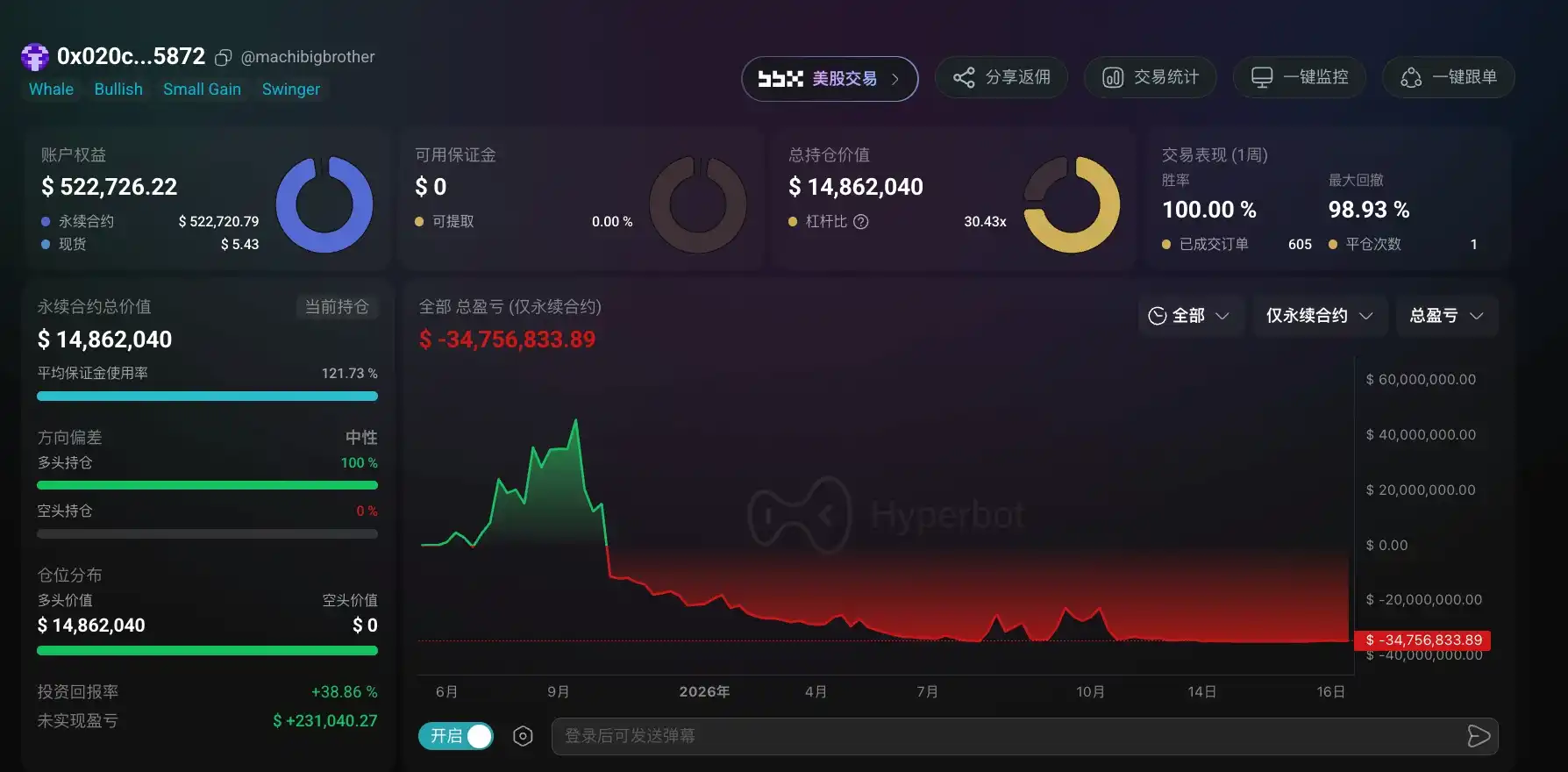
As of writing, Hyperbot data cited in the report showed Machi’s cumulative PnL on Hyperliquid had fallen to a loss of nearly $34.8 million. Earlier, the account had shown more than $44 million in unrealized profit. Its maximum drawdown reached 98.93%.
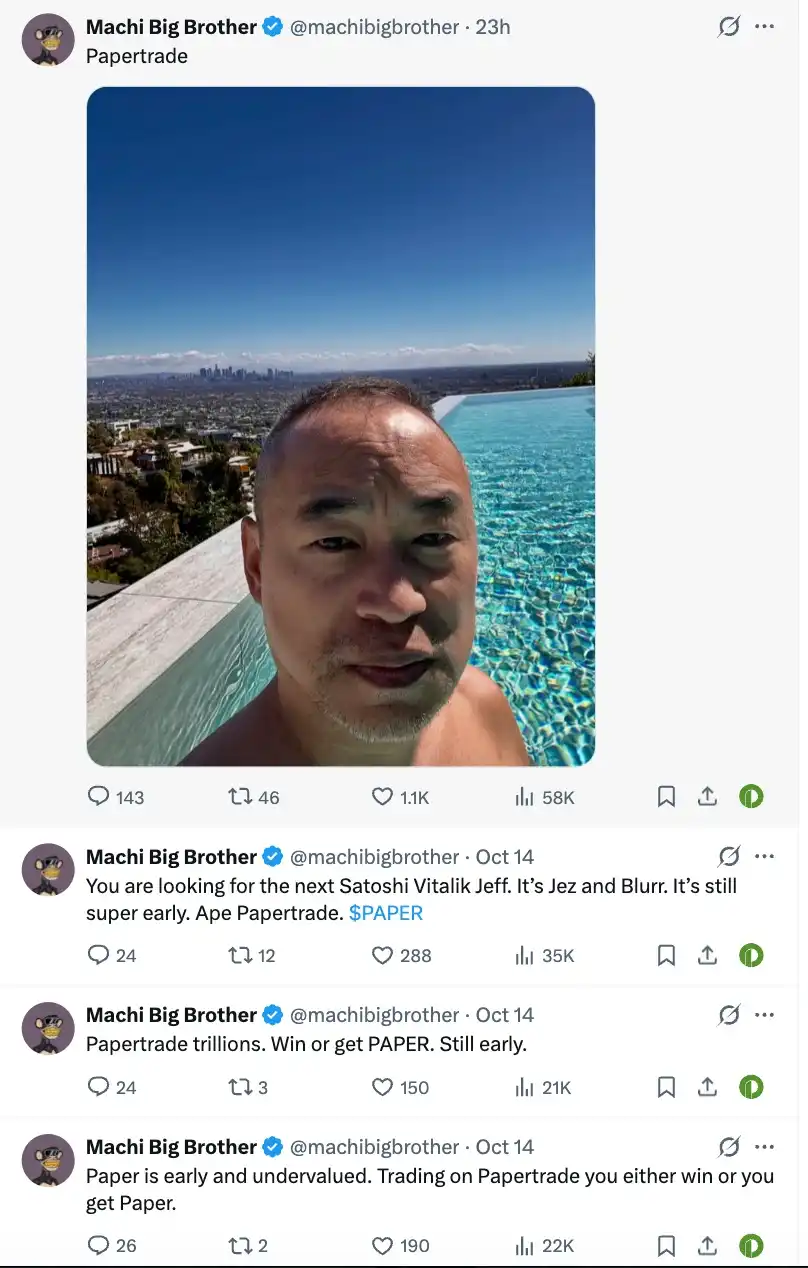
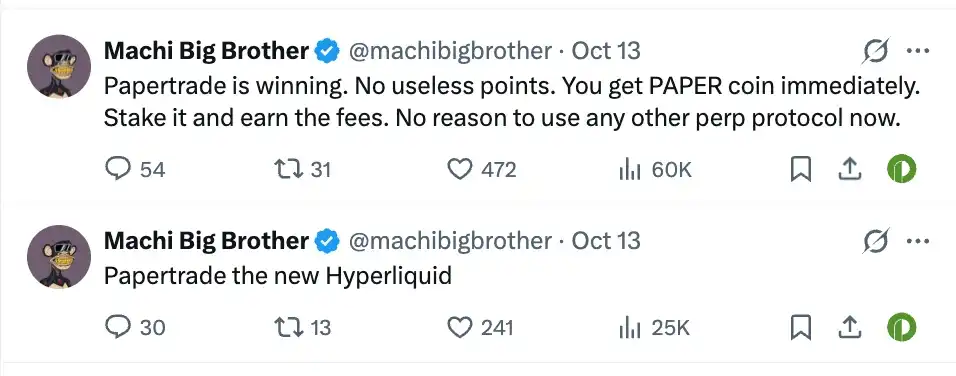
At the same time, his public posts shifted toward backing the trading protocol Papertrade. The article said he had previously declared that "Papertrade is the new Hyperliquid" and that there was "no reason to use other perp protocols." In his latest post, he also shared a selfie while continuing to endorse Papertrade.
The change in his account over October was just as sharp. On Oct. 5, he was still up nearly $5.5 million. About a week later, his account balance had dropped to around $560,000, meaning losses of more than $11.2 million in seven days. By Oct. 15, the report said, his positions were again close to zero after another liquidation.
From the ICO era to on-chain perpetuals, Machi has remained active in crypto trading. In this account of his Hyperliquid history, the defining pattern is straightforward: liquidation, recapitalization, and another return to leveraged ETH longs.