
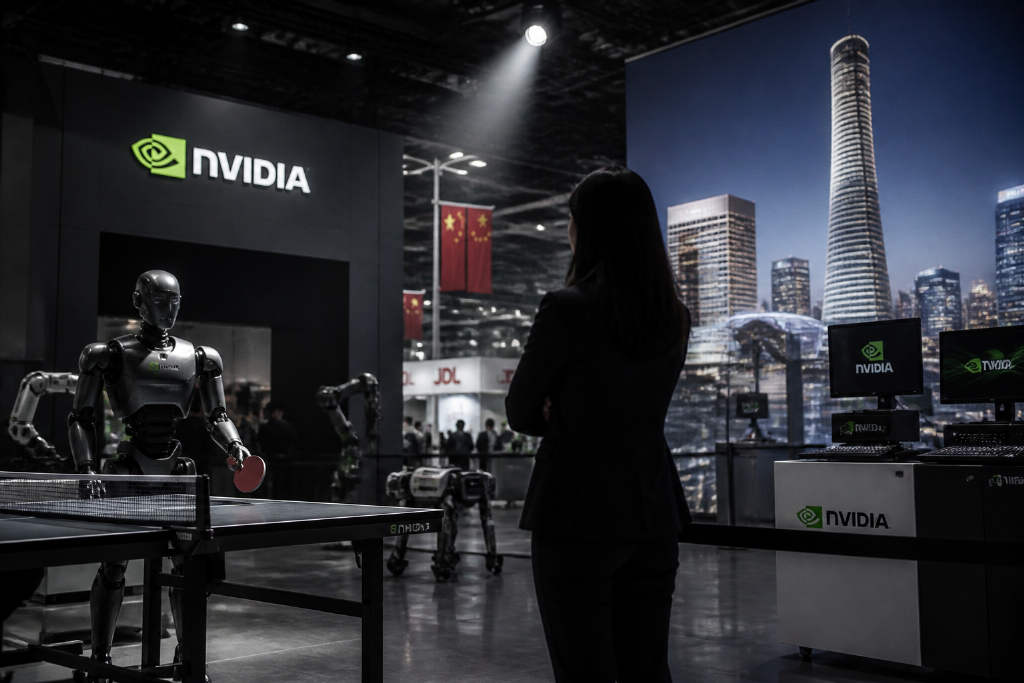
Madison Huang, the daughter of Nvidia founder Jensen Huang, appeared at the 2026 World Robot Conference in Beijing’s Yizhuang on the day the event opened, making a rare public appearance while visiting a range of Chinese robotics companies.
Huang, who is in her 30s, now serves as senior director of product and technical marketing for Nvidia’s physical AI platform. Her Beijing schedule centered on robotics, matching the business areas she currently oversees at the company.
Visits across multiple robotics booths in Beijing
On Aug. 19, the 2026 World Robot Conference opened in Yizhuang, Beijing. Huang moved through several booths on the exhibition floor, including those of Dobot Robotics, Lunewheel Intelligence, UBTECH, Huazhijian, Kepler Robotics and JD’s exhibition area.
At Dobot, she watched demonstrations of an embodied intelligence platform described as 「one brain, multiple bodies」 as well as a robot playing table tennis. At Lunewheel Intelligence, she focused on the company’s progress in human data collection, physical simulation, large-scale evaluation and feedback from real-world deployment. Members of the Nvidia delegation also tried the simulation equipment in person and discussed scene generation and parameter calibration with the team.
She later stopped by UBTECH and other booths. At UBTECH, the company’s commercial service humanoid robot Walker C1 presented her with flowers and shook her hand. She then spent time trying out the highly biomimetic humanoid robot U1. At the Kepler Robotics booth, Huang experienced the heavy-duty Qilin series quadruped robot. In JD’s exhibition area, she looked into robot operations in real-world settings and the company’s data training system, while watching action demonstrations in specific scenarios. The report said she exclaimed 「Amazing」 several times.
According to the report, many people at the venue recognized her, with some taking photos and others asking for pictures together. Unlike Jensen Huang, who has appeared in China frequently, Madison Huang has rarely been seen in public before.
Her recent itinerary has stayed focused on robotics
The day before arriving in Beijing, Huang led a visit to LG’s robot data factory in Seoul, South Korea, according to the report. Her recent travel has consistently revolved around robotics, which lines up with her role inside Nvidia.
She is currently responsible for product and technical marketing tied to Nvidia’s physical AI platform, covering Omniverse, Cosmos, Isaac and the humanoid robot foundation model GR00T. The article said these businesses have taken on increasing weight inside Nvidia in recent years and are part of what Jensen Huang has repeatedly described as the next wave: physical AI.
As framed in the report, large language models taught AI to understand and generate text, while physical AI aims to let machines understand the real world and act in it. Robots sit at the center of that push. Against that backdrop, Huang’s Beijing trip carried added significance because the companies she visited represent some of the most active players in China’s robotics scene, an ecosystem Nvidia cannot avoid as it builds out its physical AI strategy.
From culinary training to an internship at Nvidia
More than a decade ago, Huang’s path looked far removed from chips, AI and robotics. The report said that when Nvidia was founded, she was only one or two years old. Raised in an engineer’s family, she once considered applying for electrical engineering after high school.
Instead, Jensen Huang was the one who persuaded her to change direction. According to the article, he believed she was not especially passionate about engineering and that cooking was what she genuinely liked. Huang then withdrew her earlier application and enrolled at the Culinary Institute of America.
After graduating in 2012, she worked in restaurants in New York and San Francisco, went to Paris to study pastry, and later continued wine studies at Le Cordon Bleu in London. After leaving the food industry, she joined LVMH and began working in marketing and brand management.
The report linked those experiences through a common thread. In kitchens, timing, heat and detail matter. Luxury goods also place weight on product and experience. Huang came to see that what drew her in was the repeated refinement of a product until it was good enough, along with an intense focus on detail.
She returned to tech in 2019 and joined Nvidia in 2020
The turning point came in 2019, when Huang and her brother Spencer took an artificial intelligence course at the Massachusetts Institute of Technology. She then went on to pursue an MBA at London Business School.
The following year, while still studying, she joined Nvidia as an intern. The report said she struggled at first with the technical vocabulary used in meetings. She later shared that she created a document to write down every term she did not understand, then studied them one by one after meetings. Over time, the number of unfamiliar words in that document fell, and the work became easier to handle.
Over the next few years, she rose from intern to senior director. In a recent speech cited by the article, Huang said the AI era does not require a straight-line life path and that detours can eventually become part of one’s accumulation.
Her brother also ended up at Nvidia
The article said her brother Spencer followed a similarly indirect route. After college, he opened a cocktail bar with friends. The bar had no fixed menu; customers described the flavors they wanted and bartenders created drinks on the spot. It was at one point ranked among Asia’s 50 Best Bars.
Madison Huang joined Nvidia first. Spencer later shut down the bar, returned to school, completed an MBA and joined Nvidia as an intern in 2022. He now works mainly on robot software and simulation products, including robot learning simulation and synthetic data generation.
According to Nvidia disclosures cited in the report, Madison Huang’s total compensation for fiscal 2026 was about $1.232 million, or roughly RMB 8.3 million. Spencer’s total compensation was about $1.32 million.
The report also brought up the question of nepotism. At an Nvidia all-hands meeting in 2025, Jensen Huang did not avoid the issue, saying the company had indeed hired many employees’ children, but parents usually would not recommend children who would embarrass them. He also joked that some second-generation Nvidia employees had outperformed their parents.
China’s robotics sector draws more attention
Madison Huang’s trip came during a period of growing heat in China’s robotics industry. The article said this year’s World Robot Conference featured nearly 400 companies, more than 3,000 exhibits and over 300 newly released products.
Beyond showpieces such as dancing, boxing and table tennis, more robots are now being used to move materials, sort goods and operate equipment, with deployments showing up in auto manufacturing, logistics and commercial services.
The report described China’s humanoid robotics sector as having moved quickly from zero to one over the past few years. Startups have appeared in dense numbers, full-machine iteration has accelerated, core component supply chains have gradually taken shape, and both financing records and valuations have kept rising.
Unitree lists as more robotics firms advance IPO plans
On the same day the conference opened, Unitree officially listed on Shanghai’s STAR Market. Its stock at one point rose more than 600% on the first day of trading.
More robotics companies are now moving through the capital markets pipeline. The report said AgiBot had announced plans to start a Hong Kong listing process, DEEP Robotics had its STAR Market IPO application accepted, and Leju Robotics, Zhifang, Variable Robot, LimX Dynamics, Zhongqing Robotics, Stardust Intelligence and Galbot were also pushing ahead with capitalization plans.
By incomplete count, the article said, more than 50 robotics-related companies were already waiting in line at the Hong Kong Stock Exchange. It added that listing is not the finish line: capital markets can assign valuations, but industry still has to provide the answer in the end.
The contest is shifting from bodies to brains
In the first half of this year, China’s humanoid robot shipments exceeded 40,000 units, according to the report. As volumes rise, a more important question is emerging: whether robots can adapt to more tasks and still understand instructions and complete actions in unfamiliar environments.
The article argued that the real competition in robotics is moving from the body to the brain.
At the World Robot Conference, Wang Xingxing said the real 「ChatGPT moment」 for robots would come when they could enter an environment they had never seen before and complete most tasks based only on voice or text instructions. He said that point may still be two to 10 years away.
The report also said China already has one of the world’s most complete manufacturing systems. A robot can move from components to the full machine through R&D, production and iteration at high speed. Just as important, large industrial settings across autos, consumer electronics, logistics and retail give robots a valuable testing ground. As global technology giants turn their attention to China’s robotics industry, what they are seeing is not only a dense field of startups but also a broader industrial competition now under way.
This article was sourced from the WeChat public account Touzijie and written by Wang Lu, as cited in the original report.