
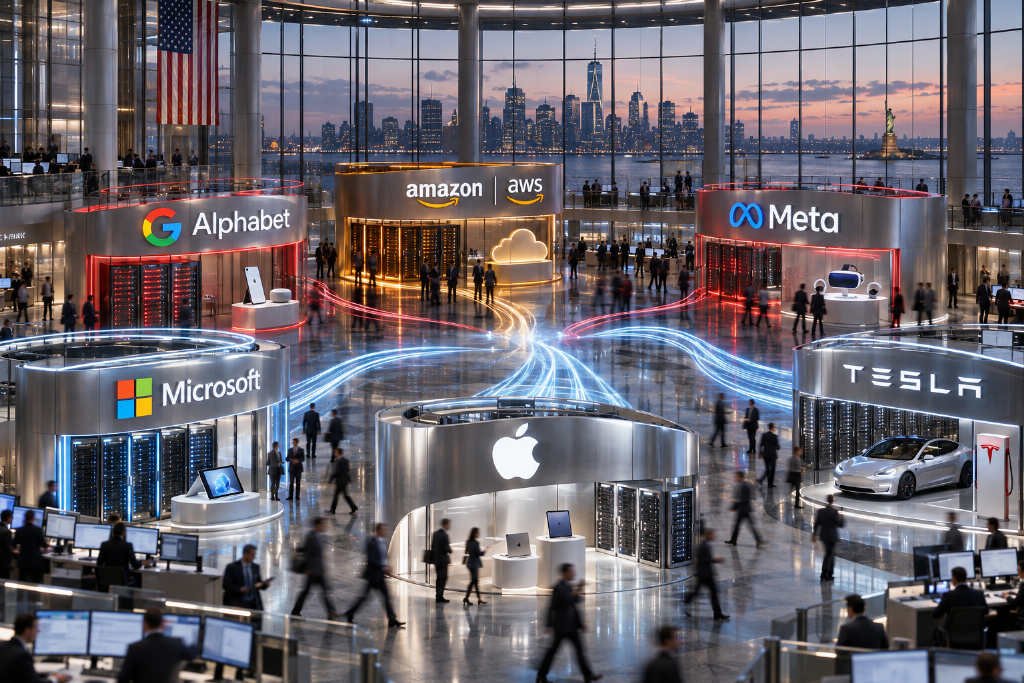
By Nov. 2, six of the seven U.S. tech giants grouped as the “Magnificent Seven” had released their latest earnings. Nvidia was the exception. Revenue growth was strong across most of the group, but the market response was anything but uniform.

The steepest selloff hit the company with the fastest growth. On Oct. 28 U.S. Eastern Time, Alphabet reported third-quarter results showing Google Cloud revenue of $30.7 billion, up 103% year over year. A day later, the stock dropped 12.64%, the biggest single-day decline since the company went public. Twenty-four hours later, Amazon saw a similar reaction. AWS growth reached 39.3%, its fastest pace in nearly five years, yet the stock fell more than 7% in after-hours trading. A week earlier, Meta had posted 26% revenue growth, but its shares also fell 7%.
The other three names were more stable. Microsoft’s Azure grew 48%, and the stock slipped just 0.2% the next day. Tesla’s operating profit fell 56% and its operating margin narrowed to 2.6%, but the shares held up after the company said it would cut full-year capital expenditures from $25 billion to $20 billion. Apple, which has spent little on AI infrastructure compared with peers, was up about 26.7% this year, the best performance in the group.
The “Magnificent Seven” refers to Apple, Microsoft, Nvidia, Amazon, Alphabet, Meta and Tesla. Nvidia’s reporting schedule does not line up with the other six, and its third-quarter earnings are due in November, so the analysis centers on the six companies that have already reported while still discussing the broader seven-stock group when addressing share performance and the supply chain.
For the past few years, the seven stocks had largely moved together. This year, that pattern broke down. As of Oct. 30, Apple was up 26.7% for the year, Nvidia had gained 9.7%, while Alphabet and Tesla were down 10.5% and 11%, respectively. Together, the seven accounted for about one-third of the S&P 500 by weight, yet their weighted gain for the year was only 6.2%, trailing the broader index. According to the report, this is the first time the group has collectively underperformed since the “Magnificent Seven” label emerged in 2023.
On the surface, the market appears worried about an AI bubble and whether massive spending can be recouped. In the last quarter alone, the six companies spent more than $200 billion in capital expenditures combined, with a large share of that ultimately flowing to Nvidia. Nvidia itself spent only about $6.1 billion in capital expenditures in its last fiscal year. But if fear of a bubble were the whole story, the report asks, why did Microsoft remain relatively unscathed while Alphabet, which posted the fastest growth, suffered the sharpest decline?
Who is earning today, and who is still betting on tomorrow
All six companies are tied to the AI trade, but the logic supporting their valuations is not the same.
Microsoft and Amazon sell computing power. Meta sells advertising. Apple sells hardware and services. Tesla is valued largely on autonomous driving. Alphabet is more complicated because it has both cloud and advertising. Once investors started measuring AI returns in cash terms rather than narrative terms, the strengths and weaknesses of each model became easier to see.
Selling compute is the most stable business right now. As long as the industry keeps scrambling for capacity, Microsoft, Amazon and Google should have a fairly visible revenue base for the next two to three years.
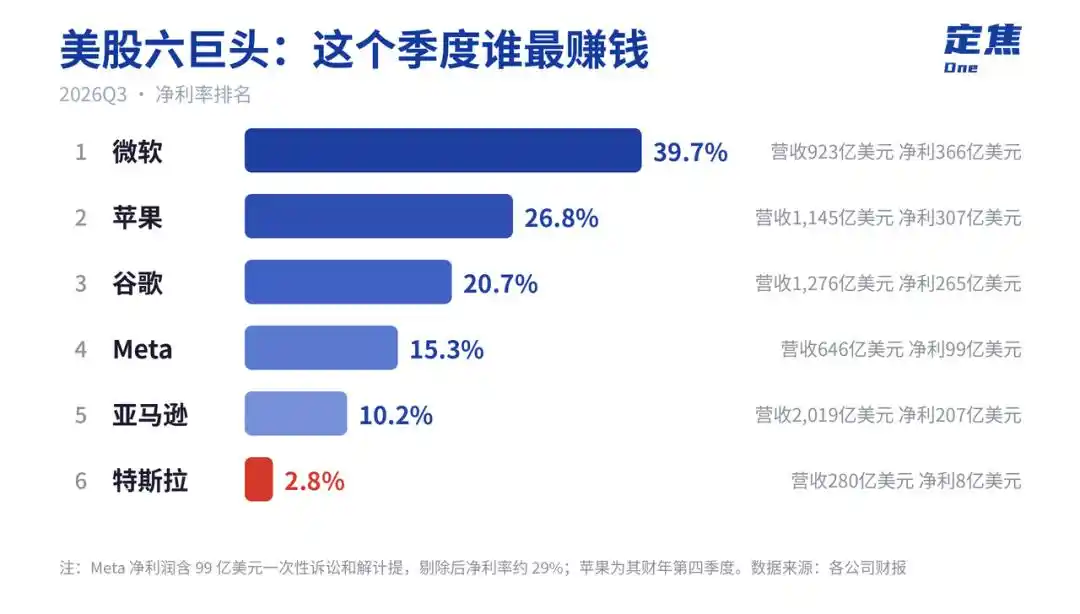
Microsoft Azure generated $33.17 billion in quarterly revenue, up 48%. AWS brought in $46 billion, up 39.3%, which annualizes to $184 billion and marks its fastest growth in nearly five years. Google Cloud reached $30.7 billion, more than doubling from a year earlier.
Whether that pace can continue depends on backlog. Microsoft’s unfulfilled commercial contracts stood at $677 billion, up 73% from a year earlier. Google Cloud had a backlog of $561 billion, and management said more than half of that would be recognized as revenue over the next two years. Amazon’s backlog was $578 billion. On the earnings call, CEO Andy Jassy said OpenAI and Anthropic had each added long-term procurement contracts worth more than $100 billion.
That means a large share of cloud revenue for the next few years has already been booked in effect. The immediate constraint is supply. Amazon is now installing one AI chip into its data centers every 14 seconds on average, and capacity is still not enough.
Meta is following a different path: using AI to make advertising more valuable.
The company posted quarterly revenue of $64.6 billion, up 26%. Ad impressions rose 10%, and average price per ad increased 14%. Management attributed the growth on the earnings call to improvements in AI recommendation systems.
But advertising has a ceiling. Total advertiser budgets are finite. AI can make ads more precise, more expensive, or keep users engaged with ads for longer, but it cannot remove that limit. With ad pricing already up 14% this quarter, investors are asking how much further it can go. Daily active users across Meta’s products have surpassed 3.6 billion. The report asks how much room is left for growth, and whether ad revenue can keep outpacing spending once the marginal return on AI investment starts to decline.
Apple has barely joined this infrastructure race.
Quarterly revenue reached a record $114.5 billion, up 12%. Full-year revenue was $478.8 billion, the best in the company’s history. Full-year capital expenditures were $9 billion, down 29% year over year. For the past two years, the market had criticized Apple for lagging in AI while peers spent aggressively. After this quarter, the tone shifted. When everyone else is wrestling with giant outlays and tighter cash flow, not spending became a virtue. The report says Apple led the seven giants in 2026 with a gain of 27%.
Tesla represents a fourth model: a valuation built largely on autonomous driving that has not yet fully paid off.
Quarterly revenue was $28 billion, flat from a year earlier, while operating profit fell 56%. The car business is generating less profit, and the market is still assigning Tesla a premium based on autonomous driving and robotics. Paid FSD subscriptions reached 1.74 million, up 67%. More than 75% of newly delivered vehicles in North America included FSD. Robotaxi has also started carrying passengers in Austin, and unsupervised mileage increased eightfold in a single quarter.
Even so, those businesses are still far from producing major profits. A potential merger under evaluation between Tesla and SpaceX adds another layer of uncertainty to capital allocation.
Alphabet fell the most because both of its core businesses came under pressure at the same time.
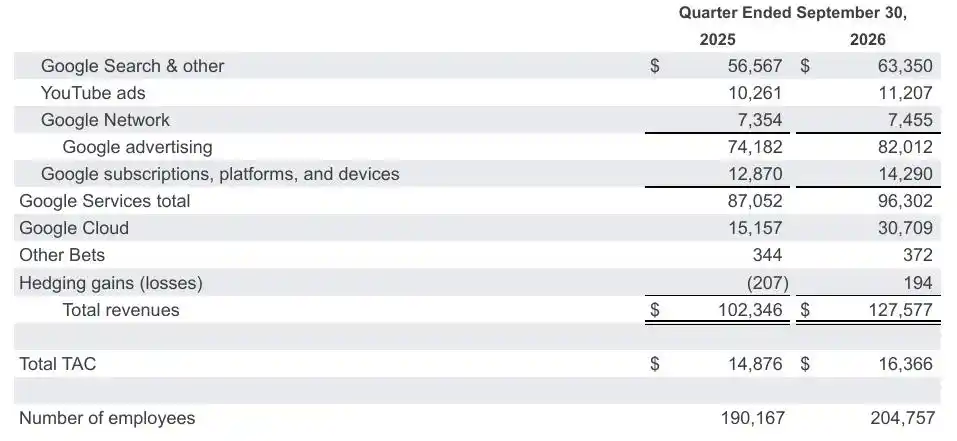
Search advertising revenue rose 12%, below market expectations of about 15%, and AI search monetization was less efficient than traditional search. Cloud revenue doubled, but the cost was quarterly capital spending of $51.4 billion, pushing free cash flow to negative $9.1 billion. Losses on equity investments including SpaceX also weighed on results, and net profit fell 24%. The report says the earnings release came in below expectations across the board, and investors responded by selling the stock.
Roy, an investor who follows U.S. equities, told Dingjiao One that treating all six companies as one single “AI concept” was flawed from the start. Some AI investments can pay back within the same year, while others may take years. Some companies are building infrastructure with customer money, while others are using their own profits to bet on the future.
Negative free cash flow is making investors uneasy
This quarter, stock performance tracked free cash flow closely. Free cash flow is what remains after a company subtracts spending on factories, equipment and chips from the cash it generates.
The three companies with negative free cash flow — Alphabet, Meta and Amazon — all saw their shares fall in October. The other three — Microsoft, Tesla and Apple — kept their footing.
Roy said that over the past two years, investors were willing to back companies that were bold enough to spend. Now, companies that spend heavily have to prove they can afford it.
The shift reflects the sheer size of this AI buildout. Microsoft, Amazon, Google and Meta spent a combined $202.9 billion in capital expenditures this quarter, a record for a single quarter. Their full-year plans add up to more than $700 billion, up 75% from last year. Industry estimates cited in the report put next year’s figure at $1.3 trillion.
At that scale, investors naturally want to know when the money comes back. Goldman Sachs summarized the change in a first-quarter industry review this year: the focus in AI has moved from who is spending the most to how far those dollars are from turning back into cash.
The three companies with negative free cash flow are not in the same position.
Alphabet and Amazon are spending on data centers, chips and networking equipment. The report argues that this money will probably come back, but not quickly. Alphabet’s capital expenditures reached $51.4 billion this quarter, more than doubling from a year earlier. Management pointed to a $561 billion backlog, with more than half expected to become revenue within two years. Amazon’s case is similar. AWS has a $578 billion backlog, and OpenAI and Anthropic each expanded long-term purchases by more than $100 billion.
Microsoft also doubled capital spending this quarter, to $39.4 billion. But because it generated $58 billion in operating cash flow, it still had $18.6 billion left after those outlays.
Meta is different. It is also spending on data centers, with quarterly capital expenditures of $34.9 billion and a full-year plan of $135 billion to $145 billion, roughly on the same scale as the cloud providers. The difference is that cloud providers build data centers for customers who pay once the capacity is delivered. Meta is building for itself. Whether that investment pays off still depends on how much more money advertising can generate.
In 2022, Meta made a major metaverse bet and the stock fell 75% within a year. It recovered only after layoffs and budget cuts. Advertising is more profitable now than it was four years ago, but the size of this new wager is several times larger than the old one.
Another point drawing attention is Meta’s funding shift. The company is moving from financing the AI race with its own profits to raising money in capital markets. Long-term debt rose from $58.7 billion to $80.9 billion in one year, and Meta also said it would create non-voting Class C shares. S&P recently revised Meta’s outlook to negative from stable, citing major uncertainty around capital spending and free operating cash flow.
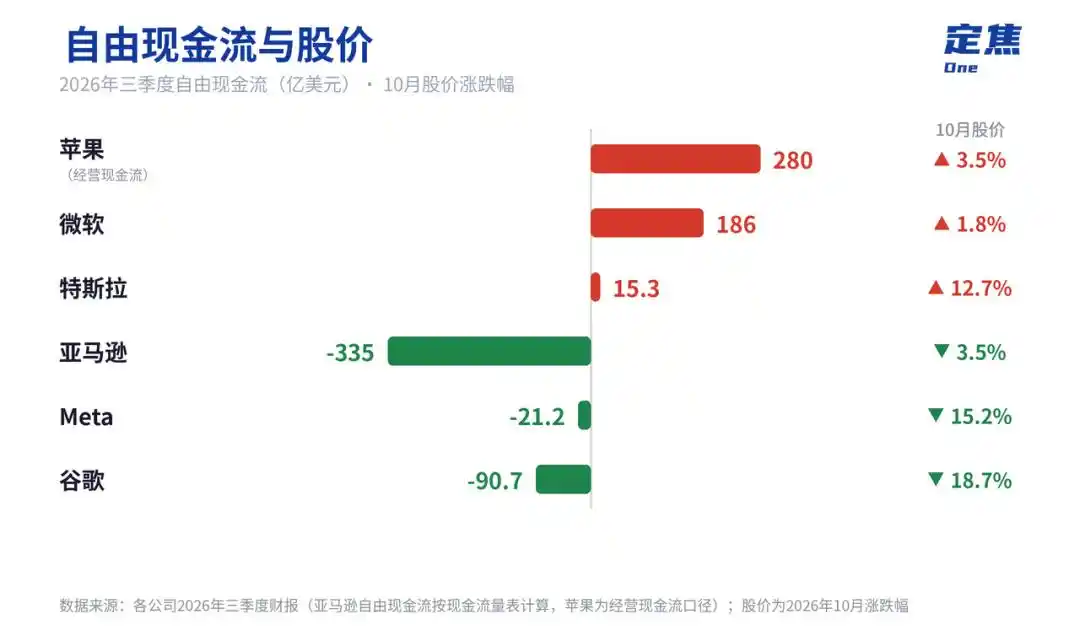
The other two companies took a different route. Tesla is pulling back by choice, while Apple has barely spent at all.
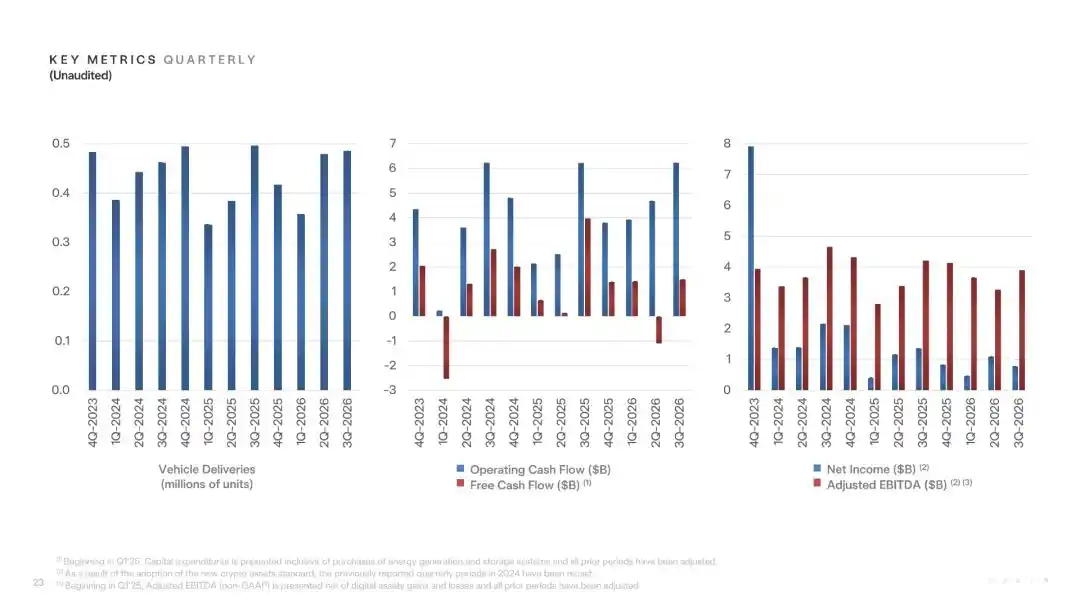
Tesla is still directing most of its resources to Robotaxi and robotics, but the scale is smaller than earlier plans. Full-year capital expenditures were cut from above $25 billion to $20 billion. Free cash flow returned to positive territory at $1.53 billion, and the company still has $30 billion in credit lines available.
Apple has largely stayed out of this spending wave. It is not building large data centers. Its AI spending is focused on gradual integration into existing products and services rather than large in-house training clusters. Full-year capital expenditures were $9 billion, down 29%, while quarterly operating cash flow reached $28 billion.
That does not mean Apple escapes the cost entirely. Its in-house AI effort has struggled. In January this year, the company said it would spend about $1 billion a year to buy Google’s Gemini model to rebuild Siri. The supply chain has also been affected. AI servers have absorbed a large share of high-bandwidth memory capacity, pushing up the cost of standard memory chips, and the Mac mini has already been priced $200 higher.
The market response, the report says, is straightforward. Investors are still willing to wait when the path to repayment is clear. Pressure is greatest where that path is uncertain. Companies that stayed conservative, or have already started to rein in spending, have become relative safe havens.
The pecking order has changed, and the reshuffle is not over
Over a longer horizon, the AI wave has already reordered the Magnificent Seven, and the process is still unfolding.
Go back to the start of this cycle. ChatGPT launched on Nov. 30, 2022. By the end of that year, the market-cap ranking was Apple at $2 trillion, Microsoft at $1.8 trillion, Google at $1.1 trillion, Amazon at more than $850 billion, Tesla at less than $400 billion, Nvidia at more than $360 billion, and Meta at just over $300 billion. Nvidia ranked sixth.
In May 2023, Nvidia’s market capitalization first touched $1 trillion intraday. Two and a half years later, it briefly became the world’s most valuable company.
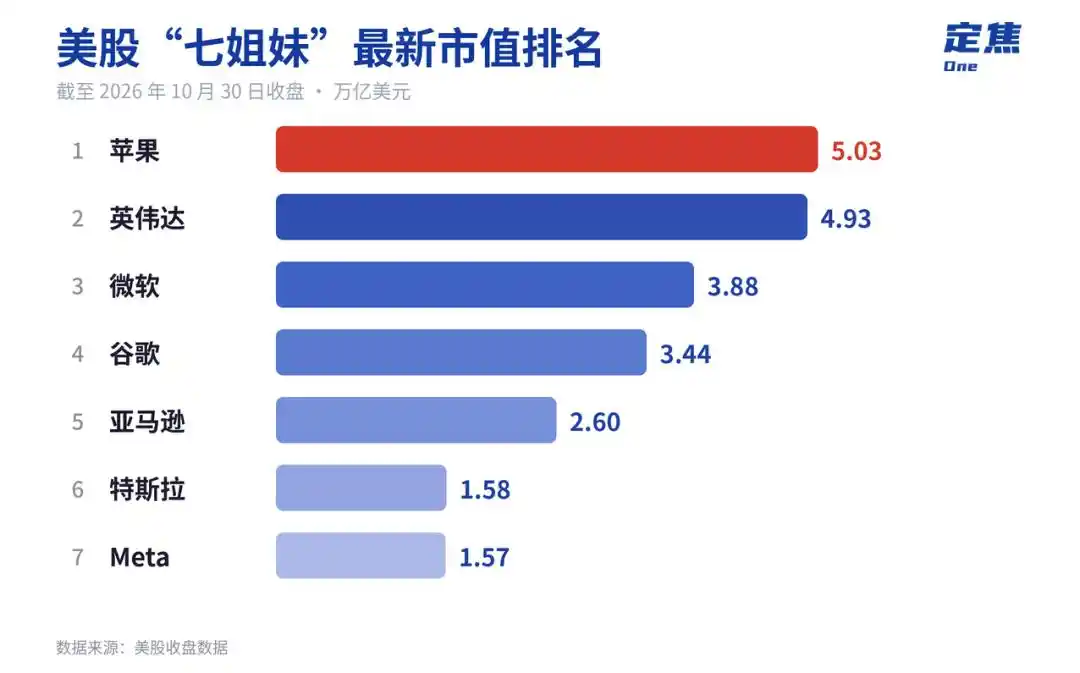
As of Oct. 30 this year, the new ranking was Apple at $5.03 trillion, Nvidia at $4.93 trillion, Microsoft at $3.88 trillion, Google at $3.44 trillion, Amazon at $2.6 trillion, Tesla at $1.58 trillion and Meta at $1.57 trillion. Combined, the seven expanded from $7 trillion to $23 trillion in market value, and their weight in the S&P 500 rose from 22% to 33%.
Nvidia, the chip seller at the center of the AI boom, rose 13-fold and moved from sixth place to the top. At one point, its market value exceeded Tesla’s by more than three times. Three years ago, the two were worth roughly the same. Meta rose nearly fivefold but still ranked last, and Tesla at one stage also fell to the bottom of the group.
Roy said this earnings season reveals three lines of change that are rewriting the rules.
First: who is collecting cash, and who is borrowing it
A large share of the six tech giants’ spending is flowing to Nvidia. Nvidia itself is not building massive infrastructure. Its capital expenditures in the last fiscal year were only about $6.1 billion. As long as the industry keeps buying compute, its revenue is protected. But the reverse is also true. Its position rests on the spending of others, and if downstream customers start to pull back, Nvidia would feel the pressure quickly.
At the same time, some cloud providers that once built server farms out of profits are now issuing debt, selling stock and borrowing to fund expansion. This quarter, Alphabet raised a net $28.7 billion through debt and also planned a stock issuance of $84.75 billion. Amazon issued $48.1 billion of debt in a single quarter.
Reuters provided a broader data point. Microsoft, Alphabet, Amazon, Meta and Oracle generated a record $542.9 billion in operating cash flow in the first nine months of 2026, but capital expenditures doubled to $556.9 billion, leaving them short for the first time. Combined free cash flow for the five swung from a surplus of $143.5 billion a year earlier to a deficit of $14 billion.
Roy said the market has started to notice the risk of circular financing: chipmakers and cloud providers use their own credit to offer loans or guarantees to downstream customers, and that money then flows back into chip and compute purchases, creating the appearance of stronger demand.
Second: the depreciation burden is only beginning
Spending on facilities and chips does not hit only once. Once equipment is purchased, depreciation begins and is spread through the income statement quarter by quarter. Microsoft’s quarterly depreciation and amortization rose 44% year over year, and the report says that pace will only accelerate. Amazon’s depreciation and amortization over the past 12 months reached $79.3 billion, more than its net profit of $76.5 billion in the comparable period a year earlier. In other words, its assets are aging and losing value faster than the company is earning money. JPMorgan has gone so far as to forecast that Amazon’s free cash flow could fall to negative $128 billion in 2027.
The reason is the speed of AI hardware turnover. A high-end GPU purchase that might once have been depreciated over 10 years could face impairment risk in five years, or even three, if performance falls behind too quickly.
Investor Michael Burry recently accused the tech giants of intentionally extending the depreciation lives of AI chips. By his estimate, that could overstate profits by about $176 billion in total from 2026 to 2028.
On this front, Apple, which invested the least, and Tesla, which has already tightened spending, are in a relatively easier position.
Third: stopping is harder than continuing
If AI monetization arrives more slowly than expected, companies that can slow down and adjust can protect profits. Those that cannot may be trapped by their own cost base. Nomura cross-asset strategists described the problem as a dilemma: keep accelerating and free cash flow comes under pressure; slow down and the AI demand story starts to weaken.
Cloud providers are tied to long-term contracts. Tesla cannot simply stop funding autonomous driving. Meta’s AI recommendation system underpins its advertising business, so that spending is also difficult to cut.
Apple is the only one with real room to wait. Its spending is small enough that it can hold back until the technology path and business model become clearer.
The next test will come with Nvidia’s earnings release in November. If data center revenue and guidance continue to accelerate, downstream customers are still spending more. If guidance is cut, that would suggest the pullback has begun.
The conclusion drawn in the report is that this earnings season marks the end of one phase. The AI infrastructure arms race is giving way to a period of financial reckoning. In the first half, the contest was about who was willing to bet bigger. In the next phase, the market will focus on balance-sheet strength and on which companies can show returns that hold up as depreciation starts eating into profit and debt costs remain high.
The article was originally published by the WeChat account Dingjiao (ID: dingjiaoone). It was written by the Dingjiao One team, with Jin Yufan credited as author and Wei Jia as editor.



