
Traditional finance is becoming one of the clearest expansion paths for centralized exchanges in this market cycle, and equities are moving to the center of that push. Since the start of 2026, more exchanges have added U.S. stocks, ETFs and even pre-IPO assets to their trading stacks. The product mix now ranges from plain price exposure to tokenized spot equities, transferable onchain assets, stock contracts, CFDs and direct brokerage-style access to traditional securities markets.

According to CoinGecko data cited in the report, monthly stock perpetual volume across the top 13 crypto trading platforms rose from about $831 million in July 2025 to roughly $34 billion in May 2026, an increase of nearly 40x in less than a year. In the first five months of 2026 alone, cumulative stock perpetual volume had already exceeded the total for all of 2025. Across broader TradFi and RWA perpetuals including stocks, commodities and indexes, May 2026 monthly volume reached $347.17 billion, while year-to-date volume topped $1.32 trillion.
On the spot and tokenized-equity side, xStocks offers one of the clearest examples. As of July 2026, the project said cumulative trading volume had surpassed $35 billion, with close to 200,000 holders globally, and the lineup was expanding beyond U.S. stocks and ETFs into Hong Kong, the U.K., Europe and South Korea.
That pace makes it difficult to describe crypto stocks as a fringe RWA experiment. Exchanges are now treating the segment as a serious competitive battleground for extending from crypto into TradFi. At the same time, CoinGecko data also shows crypto stock derivatives still account for less than 1% of traditional stock market trading activity, which points to an early-stage market with large room to grow.
Binance: brokerage access, bStocks, stock perpetuals and pre-IPO contracts
Binance has built a layered stock product stack rather than relying on a single tokenized-equity model. Its lineup now includes Binance Stocks, bStocks, TradFi Perps and Pre-IPO Perps, covering direct stock ownership, tokenized securities and leveraged derivatives.
The key idea is to split one equity into several tradable forms. A user can hold the stock directly, convert eligible holdings into an onchain token, or trade a perpetual contract tied to the same underlying.
Binance Stocks
Binance Stocks is not a tokenized stock product. It is offered by Nest Trading Limited, a broker-dealer in Binance's ADGM setup, and connects to external brokerage and clearing infrastructure. After a purchase, the user becomes the beneficial owner of the security. Shares are held with partner brokers, and eligible users can receive economic rights tied to dividends, stock splits and similar corporate actions.
At launch, Binance Stocks supported more than 7,000 U.S.-listed stocks and ETFs spanning large-cap tech, financials, consumer names, energy, semiconductors and a wide ETF range. The minimum investment starts at $5, and some names support fractional trading. Orders are primarily settled in USDC, though users can place them with BNB, USDT, USD1, U and other Binance account assets, with the platform converting those balances into USDC during execution.
The service supports regular U.S. trading hours as well as pre-market and after-hours sessions. Some securities also support overnight trading, allowing up to 24/5 access. Market orders are mainly executed during regular U.S. equity market hours, while limit orders can cover extended-hours and overnight sessions.
The product is built for crypto-native users who already keep assets inside Binance and want stock access without opening a separate brokerage account.
bStocks
bStocks are issued by BTech Holdings Limited, an affiliated Binance group entity, under the full name bStocks Tokenized Securities. Within the ADGM legal structure, they are classified as Certificates under FSMR Schedule 1 Paragraph 92. Each bStock is backed 1:1 by a corresponding U.S. stock held by a regulated custodian. Still, holders own a claim tied to the issuer's underlying securities rather than being directly registered as shareholders of the public company.
Binance links the direct stock account and the tokenized version. Eligible users can buy bStocks directly, or first buy a real stock through Binance Stocks and convert supported holdings into bStocks at a 1:1 ratio with zero conversion fees. The reverse conversion is also available.
Once converted, the asset becomes a BEP-20 token on BNB Smart Chain. Users can trade it 24/7 on Binance Spot, withdraw it to a BSC wallet and use it in supported DeFi venues. Dividends, splits and similar corporate actions are reflected through Binance's multiplier mechanism.
Binance also allows some bStocks to enter its Margin, Portfolio Margin and collateral frameworks.
Separately, Binance Wallet can connect users to onchain perpetuals offered by Aster for some blue-chip stocks, ETFs and commodities. Those trades happen on the third-party DEX rather than within Binance's own CEX execution and clearing setup, so the report treats that channel as supplemental.
TradFi Perps
TradFi Perps do not require users to hold or convert actual shares. They deliver stock price exposure through Binance's standard perpetual futures model. Contracts are settled in USDT, trade 24/7, apply funding every eight hours and typically carry a minimum notional of 5 USDT. Multi-Assets Mode is supported.
After May 2026, Binance added an Orderbook EWMA Index Mode for Equity TradFi Perps during underlying market closures, using the exchange's impact mid price and an EWMA mechanism to build a continuous index.
The lineup has expanded well beyond early names such as MSTR, AMZN, CRCL, COIN and PLTR. It now includes large-cap tech, semiconductors, ETFs and Asian assets. Besides POPMARTUSDT for Hong Kong-listed Pop Mart and ETF contracts like TMF, TBT and BITO, Binance has listed ZhongJi Innolight, Samsung Electro-Mechanics, HANMI Semiconductor, LG Electronics, NAVER and the KODEX 200 ETF. Some contracts offer up to 20x to 25x leverage.
Pre-IPO Perps
Binance formally launched Pre-IPO Perpetual Contracts in May 2026. These contracts can list companies before they are publicly traded. The first example, SPCXUSDT, was designed to let users trade market expectations for SpaceX's eventual public valuation through a USDT-margined perpetual before an IPO.
Once SpaceX lists, the contract can move from a pre-IPO perp into a standard TradFi perpetual, with its index shifting to public market pricing. At the same time, users can buy SPCX shares in Binance Stocks and obtain SPCXB through bStocks.
That creates a stacked product path: a company can trade as a pre-IPO perp before listing, then as a real stock after listing, then as a tokenized bStock, while a standard stock perp remains available as well.
Kraken: direct equities, xStocks and derivatives inside one system
Kraken has also assembled a broad equity stack, combining direct stock trading, xStocks tokenized equities, and derivatives built on top of xStocks, including stock perpetuals and pre-IPO perpetuals.

xStocks sit unusually deep in Kraken's infrastructure. The product began as a partnership between Kraken and Backed. At the end of 2025, Payward announced the acquisition of Backed Finance, the issuer behind xStocks, and completed the deal in January 2026. That brought more of the issuance, trading and settlement framework into the Payward and Kraken system.
Direct stock trading
Kraken's move into traditional brokerage began early. In April 2025, it officially launched U.S. stock and ETF trading. The U.S. offering now covers more than 11,000 stocks and ETFs across NYSE, Nasdaq and AMEX, and places those assets inside the same environment as crypto on Kraken App, Kraken Pro and Kraken Desktop.
Securities services are provided by Kraken Securities LLC, an SEC-registered broker-dealer and a member of FINRA and SIPC. Users are buying real shares, and Kraken explicitly says the stock belongs to the customer, with cash dividends paid into the account.
Trading hours still follow the traditional securities market. Regular U.S. equity hours run from 9:30 a.m. to 4:00 p.m. Eastern Time, Monday through Friday. Users can place orders outside those hours, but they wait for the next trading session. This is not the same as the 24/7 structure used for xStocks or stock perpetuals.
Kraken's help center update in July 2026 said the stock service was available across most of the U.S., excluding Maine and New York, and had opened to eligible users in Germany, the Netherlands and France across the European Economic Area.
The company has continued to add brokerage features as well, including ACATS transfers for stocks and ETFs from other brokerage accounts and a Stock Lending service that lets eligible users lend out shares they actually own.
xStocks
xStocks remain Kraken's most recognizable crypto stock product and are now integrated across multiple exchanges and onchain venues. The structure is straightforward in broad terms: real stocks or ETFs are purchased and held in custody, a 1:1 xStock token is issued against them, and the token then circulates on Kraken and onchain.
Each xStock is backed 1:1 by the corresponding stock or ETF. The underlying securities are held through conventional brokerage and custody infrastructure. Kraken works with firms including Alpaca on procurement and custody, while the xStocks issuance stack maps those securities into blockchain tokens.
Owning an xStock is still not the same as being directly registered as a shareholder. Users hold a token backed by real securities, not the underlying stock inside a brokerage account, which usually means no direct voting rights. When underlying shares pay cash dividends, the economic value is generally reflected by reinvesting and increasing the holder's xStock balance.
Kraken currently lists roughly 131 xStocks products, with updates still ongoing. That includes around 100 stocks, 27 ETFs and a small number of other assets. Major names include Apple, NVIDIA, Tesla, Microsoft, Amazon, Alphabet, Meta, Coinbase, Robinhood, Strategy, GameStop, SPY and QQQ.
The report also draws a distinction between the number of xStocks tradable on Kraken and the broader xStocks issuance universe. The overall system has expanded to more than 500 tokenized assets, though not all of them are listed on Kraken itself.
What separates xStocks from many internal synthetic stock products on CEXs is transferability. Users can buy xStocks on Kraken and withdraw them to external wallets. The assets are currently running on Solana, Ethereum, TON and Ink, giving them a place in DeFi. Most xStocks trade on a near-24/5 basis, while core names such as TSLAx, QQQx, SPYx, NVDAx, CRCLx, AAPLx, HOODx, MSTRx, GLDx and GOOGLx already trade 24/7 on Kraken Pro.
Kraken has also threaded xStocks into its broader crypto product framework. Some core xStocks support margin trading up to roughly 3x and qualify as collateral for Kraken Pro Futures and Margin. A user can keep holding AAPLx, NVDAx or SPYx and use those tokens as margin assets rather than selling into stablecoins first.
xStocks perpetuals and pre-IPO perpetuals
Kraken built xStocks Perpetual Futures on top of the spot token layer. Many exchanges create stock perp indexes directly from traditional market prices. Kraken instead puts more weight on a tokenized-equity benchmark, using xStocks pricing itself as a key reference before building the perpetual contract on top.
That matters because xStocks can keep discovering price on the exchange and onchain even when the underlying U.S. equity market is closed, allowing the associated perpetuals to keep trading 24/7.
The main live xStocks perps include AAPLx, CRCLx, GOOGLx, HOODx, MSTRx, NVDAx, TSLAx, SPYx, QQQx and GLDx. These contracts offer leverage up to about 20x. Users can trade them through Kraken's existing crypto perps margin accounts and collateral pool on both the long and short side.
That creates two very different forms for the same asset. NVIDIA offers a simple example: NVDAx is a tokenized stock backed 1:1 by real NVIDIA shares, while the NVDAx Perp is a leveraged perpetual contract built on top of the NVDAx and stock price framework.
Kraken has also taken the same derivative logic into pre-IPO markets with Pre-IPO Perpetual Futures, including products tied to OpenAI and Anthropic. Since those companies do not yet have publicly traded shares, Kraken uses a PreMarket Synthetic Index. The platform derives a price from the pre-IPO order book, then smooths it through index mechanisms to reduce the impact of single orders or short-term volatility, with mark price running around that synthetic index.
If a company later files for an IPO and its share count and offer price become clearer, Kraken can rebase the contract using the actual share count. Once the company is public, the pricing benchmark can shift to a listed stock or xStocks framework, turning the contract into a standard stock perpetual.
OKX: unified tokenized stocks, Ondo access and equity perpetuals
Compared with Binance, OKX leans more heavily toward a mix of tokenized stocks, equity perpetuals and Web3 or CeDeFi distribution. It uses several routes to give crypto users stock exposure.
Those routes break down into three main tracks: Unified Tokenized Stocks inside the CEX spot venue, currently based mainly on xStocks; Ondo tokenized stocks distributed through OKX's CeDeFi and DEX channels; and the larger stock or equity perpetuals business. In some regulated regions such as parts of the EEA, OKX also offers Equity X-Perps under a different contract structure.
Unified Tokenized Stocks
OKX launched Unified Tokenized Stocks, or UTS, in July 2026, plugging stock tokens directly into its existing spot market. Users do not need a traditional brokerage account or a fiat conversion step to trade tokenized versions of names such as Apple, NVIDIA, Tesla, Microsoft, SPY and QQQ with USDT inside their OKX accounts. The assets trade 24/7 and sit inside the same account system as crypto spot and equity perpetuals.

Like Binance's bStocks model in some respects, the underlying xStocks can be deposited and withdrawn via Solana and X Layer. That means a user can buy UTS on OKX, send the corresponding xStock to an onchain wallet, then move it back to OKX later.
UTS are not issued by OKX itself. Their current base comes mainly from the xStocks and Backed Assets framework, with third-party issuers creating the tokenized assets and holding or arranging the underlying securities. OKX acts as the trading platform and distribution layer, wrapping those instruments into a unified UTS interface.
That design is meant to prevent fragmentation if multiple issuers eventually mint different tokens against the same stock. Under OKX's framework, those could still be mapped into a single UTS instrument with one order book, one trading market and one corporate-action handling standard.
Corporate actions such as dividends and stock splits are also processed through the token structure. When the underlying company pays a cash dividend, the issuer handles the dividend first and, after applicable withholding tax, reflects the economic value in the user's UTS position through reinvestment or token-balance adjustments.
UTS currently spans 48 assets, including MU, SPCX, SNDK, SKHY, SPY, QQQ and NVDA. Coverage has widened from large-cap tech into semiconductors, crypto-linked names, consumer sectors, healthcare, energy, industrials and ETFs.
UTS are also being folded into OKX's structured product stack. Its dual-investment product now supports 11 tokenized stocks as underlyings, showing that UTS are moving beyond spot trading into OKX's broader trading, earn and structured products framework.
Ondo tokenized stocks
Before UTS arrived, OKX had already introduced another stock-token channel. In May 2026, it integrated Ondo Finance's tokenized stocks into its CeDeFi and DEX setup, allowing users to trade onchain stock-linked assets with stablecoins such as USDT and USDC from OKX accounts and wallets.
UTS live on the OKX CEX spot order book and are currently based mainly on xStocks. Ondo products, by contrast, operate inside OKX's CeDeFi, DEX and self-custody environment, with trading executed through onchain liquidity and related providers. In that setup, OKX Wallet serves more as an entry point, aggregator and interface.
One of the clearest differences is scale. When OKX launched the Ondo stock products in May, it opened more than 260 U.S.-listed stocks and ETFs in one go, including Apple, NVIDIA and Tesla. By pure coverage count, Ondo still sits far above the 48 current UTS assets.
Users can start from roughly $20 and access fractional stock exposure. Assets can remain in OKX Wallet or be transferred to other compatible wallets, which makes this layer more focused on self-custody and onchain portability.
Ondo products are not fully 24/7, however. Trading is organized around overnight, pre-market, regular market and post-market sessions tied to the U.S. securities market, making the schedule closer to 24/5. Trading usually stops from 23:59 UTC on Friday to 00:05 UTC on Monday, as well as during U.S. market holidays. In that sense, Ondo extends traditional equity hours toward 24/5, while UTS are built directly around crypto-style 24/7 access.
Ondo DEX currently relies mainly on market orders. User funds remain in their own wallet before execution, and trades can route through the OKX DEX Aggregator, Aggregator+ or third-party pathways, with network gas or interface service fees depending on the route.
Stock perpetuals and X-Perps
OKX's stock derivatives business uses two structures. Most international users trade USDT-margined stock perpetuals, while some regulated regions such as parts of the EEA use USD-margined X-Perps. Both routes provide stock price exposure, but they differ in contract design, margin currency and regional availability.
The international stock perpetuals closely follow the crypto perp model. OKX builds an index price from multiple traditional market quotes, tokenized-asset pricing and other related market data, then uses its own order book for execution. Contracts use USDT as margin and settlement collateral, trade 24/7 and rely on funding to keep prices anchored to the underlying stock reference.
These contracts are integrated directly into OKX's unified trading account, so users do not need a separate securities or TradFi derivatives account. Crypto balances in the same account can support spot, crypto perps and equity perps under one margin system.
That means OKX does not need to create a custody and token issuance framework for each stock one by one. It can feed stock indexes into infrastructure it already built for perpetuals, margin, liquidation and order books. From February 2026, OKX accelerated that expansion, adding names beyond early listings such as HOOD, TSLA, MSTR, NVIDIA, Micron, SanDisk, Alphabet, Microsoft, Apple, Meta, SPY and QQQ. The newer wave includes COIN, PLTR, QCOM, SNOW, APP, ZM, ETFs and leveraged ETFs such as SOXS and TMF, and South Korean assets including SK hynix, Samsung, Korean equity ETFs and the KR200 index.
In some regulated jurisdictions, X-Perps use a different legal and contract structure. They still provide stock price exposure but are structured as long-dated expiry futures margined in USD rather than the more common USDT stock perps on the international venue. Current X-Perps include AAPL, AMZN, GOOGL, META, MSFT, NVDA, TSLA, SPY, QQQ, SpaceX and SK hynix. Some products for eligible EEA users offer up to about 10x leverage and also trade 24/7.
Bitget: real stocks, rTokens, stock perps, options and pre-IPO markets
Bitget's crypto stock business falls into three broad parts: Stocks 2.0 built around Stock+ and rTokens, a derivatives stack led by stock perpetuals and U.S. equity options, and a pre-listing market that combines IPO Prime with Pre-IPO Perps. The platform also offers CFDs for equity and index exposure.
Stocks 2.0: Stock+ and rTokens
Bitget currently runs two separate spot-equity routes. Stock+ is for direct ownership of real shares. rTokens bring real stocks into the crypto trading environment as tokenized instruments.
Stock+ launched in June 2026 through licensed U.S. securities partners RQD Clearing and Atomic Vaults Securities. Orders can be routed to Nasdaq, NYSE and regulated market makers. Users end up with real U.S. stocks rather than a price-tracking token, which means they can receive cash dividends, stock dividends and voting rights.
The service covers more than 10,000 U.S.-listed stocks and ETFs, supports fractional trading down to 0.0001 share and includes pre-market, regular, after-hours and overnight sessions, giving it an overall 24/5 profile. Users can also transfer U.S. stocks from supported brokerages into Bitget without selling first.
From a funding perspective, Stock+ keeps the crypto-platform workflow. The stock account mainly uses USDC, and users can convert existing crypto or stablecoin balances inside Bitget before entering the stock market.
The parallel route is Reality rToken. Each rToken is issued by Reality, maps to one U.S. stock or ETF and is backed 1:1 by the underlying security. Those underlying shares are purchased and custodied through traditional financial infrastructure including Alpaca, while users can trade symbols such as rAAPL, rNVDA, rTSLA, rSPY and rQQQ on Bitget spot with USDT.
Bitget's official materials show rTokens now cover more than 500 stock and ETF assets. Not all of them trade around the clock, though. The platform has extended a group of popular names to full 24/7 trading, including NVIDIA, Apple, Amazon, Tesla, Microsoft, Meta, AMD, Broadcom, Micron, SpaceX, Circle, Robinhood, Strategy, QQQ, SPY, SOXL and ASML. Other assets still follow separate market rules.
Cash dividends on the underlying stock are converted into USDT and credited to the user. Stock dividends, splits and reverse splits are reflected through token-balance adjustments.
Bitget has also pushed rTokens deeper into platform composability. In its cross-asset unified account, 100 rTokens have been added to a shared margin pool. The first batch of eligible assets in that account totals more than 370, including those 100 U.S. stock rTokens. Users can keep holding rAAPL, rNVDA, rTSLA or rQQQ while using them as margin for derivatives and leverage trades or as collateral to borrow stablecoins.
Beyond that, rTokens have been integrated into Bitget's spot grid, strategy tools, copy trading and Earn products. Spot elite copy trading now supports rTokens as well, allowing traders to lead positions in names such as rTSLA and rNVDA.
The report also notes that Bitget initially integrated Ondo stock spot products. As Bitget's own approach matured, third-party structures began to exit. After July 2026, eligible Ondo stock tokens were automatically converted into Reality rTokens.
Stock derivatives and options
Alongside its two spot-equity routes, Bitget has built a larger stock derivatives business, with stock perpetuals at the center. These products use the standard crypto USDT perpetual model. Users do not own shares. They trade perpetual contracts that reference traditional equity prices.
Index pricing is sourced from traditional financial markets. Bitget explicitly says it uses four data providers: Pyth, dxFeed, Massive and Intrinio, adjusting the index source dynamically based on market activity and data stability. Contracts are quoted and settled in USDT, trade 24/7 and support isolated margin, cross margin and unified account mode. Maximum leverage varies by underlying, with some contracts going as high as 100x.
The lineup includes Apple, NVIDIA, Tesla, Microsoft and other major global equities, plus a large ETF set including SPY, QQQ, SOXL, SQQQ, TQQQ, EWY and EWJ, stock index contracts such as SP500USDT and NDX100USDT, and Hong Kong and South Korean names such as Tencent, Meituan, NetEase, Xiaomi, Pop Mart, SMIC, Gigadevice, Samsung, SK hynix and Hyundai.
In July, Bitget added Quanto Perpetual Futures for Hong Kong, Japanese and other non-USD-denominated stocks. The underlying still trades in local-currency terms, but margin, funding and final PnL are settled directly in USDT. The system does not actually convert HKD or JPY into USDT. Instead, it maps the local-currency price numerically into the USDT contract on a 1:1 basis.
If a Hong Kong stock rises from 200 HKD to 300 HKD, for example, the corresponding quanto contract moves from 200 to 300 as well, and profit or loss is calculated directly in USDT from that price change.
Bitget also lists U.S. stock options. Tradable contracts have expanded to more than 2,800 and cover S&P 500 and Nasdaq 100 constituents as well as many popular ETFs and single names. The options interface sits inside Stock+. Once users fund the stock account with USDC, they can view different expiries, strikes and call or put contracts on pages for names such as Tesla, NVIDIA, Apple and SPY, with pre-market trading supported.
Current functionality covers buying calls, buying puts and selling to close. Naked option selling is not yet available. Long calls and long puts require 100% premium payment with no margin financing, and settlement follows the U.S. securities market's T+1 cycle.
IPO Prime and pre-IPO perpetuals
Bitget uses two routes for pre-listing equity markets. The first is IPO Prime, launched in April 2026. It offers digital assets issued by compliant issuers and tied to the economic performance of private companies. Users subscribe with stablecoins. Examples include preSPAX, later renamed preSPCX, for SpaceX, and preOPAI for OpenAI. These tokens are issued by firms including Republic and are designed to map future post-listing economic performance under product terms, not to give direct ownership of SpaceX or OpenAI shares.
Users can subscribe with USDT, USDGO and other stablecoins, with the minimum investment floor going as low as roughly $100. Once subscription is completed, the assets can also trade in Bitget's Pre-IPO spot market.
The second route is Pre-IPO Perpetuals. These do not require users to buy a pre-listing token at all. Instead, Bitget uses its stock perpetual infrastructure to estimate a per-share reference price from company valuation and projected share count, then wraps that into a USDT perpetual contract.
For OPENAIUSDT, when the company was still private and had no public share price, Bitget used an estimated share count of 1 billion and divided company valuation by that projected number to produce the initial reference price. If future IPO documents reveal a different actual share count, the contract parameters can be adjusted under the product rules. These products settle in USDT, trade 24/7 and use funding.
Bitget has already launched pre-IPO perpetuals tied to OpenAI, Anthropic, Quantinuum, SpaceX and Moonshot AI. The report notes that some names such as SpaceX and SK hynix later moved into the regular stock spot and stock perpetual frameworks after listing.
Gate: real stocks, TokenStocks, perps, CFDs and IPO access
Gate's equity lineup spans direct stock trading, TokenStocks, stock derivatives and both Pre-IPO and IPO Access channels. In terms of breadth, the platform looks closer than most peers to a full bundle of crypto-distributed stock products inside one account system.
Gate Stocks
Gate officially launched Gate Stock in June 2026. The product connects directly to real securities markets through traditional brokerage infrastructure, allowing users to buy, hold and sell stocks and ETFs within Gate accounts.
For U.S. equities, the system works mainly through Alpaca. As the underlying brokerage and clearing partner, Alpaca handles order execution, clearing, settlement, custody, dividends and corporate actions. Gate focuses on user access, identity checks, order processing, the USDT funding link and account display.
The setup uses an omnibus-account model familiar in traditional brokerage. End-user securities are pooled into a single omnibus account at the clearing level, where only the net position is visible, while Gate records each user's holdings and economic rights in its internal account system. Users can receive cash dividends, stock dividends, splits and reverse splits, though they generally do not have registered shareholder rights such as shareholder meeting votes.
Gate Stocks now covers more than 12,500 stocks and ETFs, including more than 10,000 U.S. names and ETFs, 1,500-plus Hong Kong stocks and more than 1,000 South Korean stocks. Examples include Apple, NVIDIA, Tesla and Microsoft in the U.S., Tencent, Xiaomi and Meituan in Hong Kong, and Samsung Electronics, SK hynix, Hyundai and NAVER in South Korea.
All three markets sit under one Gate stock account, and users trade with USDT rather than converting separately into USD, HKD or KRW. The U.S. side covers NYSE, Nasdaq, NYSE Arca, NYSE American and BATS. Hong Kong and South Korea connect to HKEX and KRX, though the report notes Gate has not disclosed those non-U.S. brokerage and clearing partners to the same degree.
TokenStocks
Gate has built a unified TokenStocks section that currently includes gStocks, xStocks and Ondo Stocks. They all appear as stock tokens in the front end, but the issuance and asset structures differ underneath.
Gate's main in-house push is gStocks. These tokens use fully reserved 1:1 backing with real stocks. Each circulating gStock corresponds to an equivalent quantity of underlying stock or security assets. Users can trade them 24/7 on Gate's order books with USDT, invest fractionally and move them onchain.
The current asset set includes U.S. stocks such as Apple, Alphabet, Broadcom, JPMorgan, Berkshire Hathaway, Walmart, Visa and Eli Lilly, South Korean names such as Samsung and SK hynix, ETFs and leveraged ETFs such as TQQQ and KORU, and even products linked to private assets such as Quantinuum.
gStocks already feed into Gate's unified account, margin trading, collateralized borrowing, wealth products and stock-dividend handling. In other words, a user can hold a stock token and then use it as collateral to borrow USDT or bring it into Gate's broader margin and yield framework.
The same TokenStocks section also distributes xStocks and Ondo Stocks. As described earlier in the Kraken section, xStocks are onchain stock tokens issued through the Backed system and backed by real securities. Gate functions mainly as the trading and distribution layer. Ondo Stocks are closer to a total-return or economic-exposure structure, where users get an onchain asset tied to the economic performance of the underlying stock rather than direct registered share ownership.
That leaves Gate with a relatively unusual multi-issuer aggregation market: gStocks as Gate's own 1:1 reserve product, xStocks from the Backed tokenized-equity structure and Ondo as a separate stock-exposure framework.
Perpetuals, quanto products and CFDs
Gate's main stock derivative is the stock perpetual contract. The platform does not need to match every user position with real shares. Instead, it connects stock and ETF pricing into Gate's existing perpetual infrastructure, where users trade long or short with USDT as margin and settlement collateral.
Coverage is broad. Beyond Apple, NVIDIA and Tesla, Gate lists TSM, Walmart, Costco, Goldman Sachs, ServiceNow, Salesforce, Adobe, Palantir, SOFI, Toyota, MUFG, SK hynix, Samsung Electronics and Hyundai, plus a long ETF roster including SOXL, SOXS, SQQQ, XLK, XLF, EEM, KORU, TZA, IBIT and GDX. Most newly listed stock contracts offer up to 20x leverage.
For non-USD stocks such as Hong Kong equities, Gate has added quanto perpetuals on top of standard stock perps. The design is similar in broad terms to Bitget's quanto model. Tencent, for example, is quoted in Hong Kong dollars, but the user does not need to convert USDT into HKD. The contract displays the underlying HKD price, while margin, funding and final PnL remain settled in USDT.
If Tencent moves from 400 HKD to 500 HKD, the quanto contract also moves from 400 to 500. A user holding 10 long contracts would see the 100-point move multiplied by 10 and settled as 1,000 USDT in PnL, without separately layering in HKD/USDT FX changes. The first batch included TENCENTHKD, ZHIPUHKD, MINIMAXHKD and XIAOMIHKD, all with leverage up to 20x.
Gate also runs a separate CFD system. CFDs and stock perps both let users trade price changes without owning the underlying stock, but their mechanics differ. Gate's CFD setup is closer to traditional contracts-for-difference markets. Pricing mainly follows external real-market quotes, and fees come from spreads, commissions and overnight charges rather than the funding-rate structure used in crypto perpetuals. Users can go long or short after transferring funds into the relevant USDx setup through their Gate account.
The overall CFD market on Gate has reached more than 500 markets across stocks, forex, indexes, precious metals and commodities. Equity CFDs cover names such as Apple, Tesla, NVIDIA, Microsoft and Amazon, with stock CFD leverage usually capped at 5x.
Gate also supports pre-IPO perpetuals and has listed contracts tied to OpenAI, Anthropic, Anduril, Quantinuum, Neuralink, Moonshot AI and CXMT. Since those companies had no public share price when listed, Gate uses company valuation and estimated fully diluted share count to derive a unit price. For early OpenAI contracts, the estimate used 1 billion shares, which would imply a unit price of about $800 if the company valuation were $800 billion. Once actual IPO share numbers are known, contract size can be adjusted under the rules.
Pre-IPOs and IPO Access
Gate's Pre-IPOs product lets users subscribe to digital asset certificates with USDT or GUSD, after which those certificates can trade in a Pre-IPOs secondary market.
Its IPO Access product is different. Users are applying for actual IPO share allocations. They can submit an IPO subscription intent with USDT, and if Gate secures a real allocation and the user receives shares, the user ends up with real stock in the Gate Stocks account after listing and can continue trading it there.
Coinbase: direct stocks and stock derivatives are live, tokenized stocks are still being built
Coinbase's live equity products currently fall into two main buckets. One is direct stock trading through Coinbase Capital Markets. The other is a derivatives stack through venues such as Coinbase International Exchange, covering stock perpetuals, pre-IPO perpetuals and equity index futures. In parallel, Coinbase is still developing its own tokenized stocks framework and has not yet rolled it out to the market.
Direct stock business
Coinbase offers real-stock trading through Coinbase Capital Markets, or CCM. CCM is a securities brokerage entity within the FINRA and SIPC framework. Coinbase also works with Apex Fintech Solutions, which handles execution, clearing and custody through traditional securities infrastructure. Users are buying real stocks and ETFs rather than price-linked tokens.
Those assets can be managed inside Coinbase App and Coinbase Advanced alongside crypto holdings. Funding supports USD and USDC, stock trading commissions are zero, fractional orders can start from $1, and some securities support 24/5 trading.
Final securities settlement is still in USD. If a user enters with USDC, Coinbase converts it into USD during the trade. The stock itself continues to settle on the traditional T+1 securities cycle.
On Aug. 6, Coinbase expanded that direct stock business into the U.K. Eligible U.K. users can trade close to 4,000 U.S. stocks, again with 24/5 access, zero commissions and fractional trading, starting from as little as £1.
That leaves Coinbase in a familiar role seen at several peers: a unified crypto-plus-stocks front end and funding layer, while the actual securities order flow, clearing and custody remain in conventional market infrastructure.
Stock derivatives
The other major piece of Coinbase's stock business comes from derivatives, and the exact product depends on the region. For many typical crypto users, the closest fit is Coinbase International Exchange's Stock Perpetual Futures.
Coinbase formally launched stock perpetuals in March 2026 for eligible non-U.S. users. The products do not hold shares. They provide synthetic stock exposure through USDC-denominated perpetual contracts, support 24/7 long and short trading, and reuse Coinbase's existing funding, margin, liquidation and perpetuals infrastructure.
Another important feature is the shared collateral system. Users can manage both crypto and stock perpetual positions from the same pool of eligible collateral assets rather than opening a separate TradFi derivatives account.
During regular equity market hours, the stock index pricing mainly comes from real securities market data. At night, on weekends and during other closures, Coinbase uses internal pricing indexes together with tokenized-equity price data to keep building a reference price, allowing stock perpetuals to continue trading 24/7.
The first batch covered the Magnificent Seven: Apple, Microsoft, Alphabet, Amazon, NVIDIA, Meta and Tesla, along with the ETFs SPY and QQQ. The lineup later expanded to AMD, Intel, Micron, SanDisk, TSMC and SpaceX. Leverage varies by contract. Most single-stock products offer up to around 10x, while ETFs such as SPY and QQQ can reach around 20x. The minimum order is usually 10 USDC.
Coinbase also has a separate regulated product in the U.S.: Perpetual-Style Equity Index Futures. These are offered through Coinbase Derivatives within a CFTC-regulated futures framework and are not the same as the offshore stock perps. The first group includes four thematic indexes, AI10, China10, Defense10 and Tech100, providing basket exposure to artificial intelligence, China, defense and large-cap technology. The contracts use cash settlement and a funding-like mechanism to keep futures and underlying index pricing in line.
Tokenized stocks plan
Coinbase has publicly outlined its tokenized stocks plan, but it has not launched to market yet. In June, the company said it planned to offer non-U.S. users tokenized stocks backed 1:1 by underlying shares. The ambition differs from many offshore CEX stock tokens in one key respect: Coinbase says it wants eligible token holders to receive securities rights, including dividends and shareholder rights, while also allowing the assets to trade 24/7 and be used for onchain lending, collateral and transfers.
Coinbase recently obtained a Financial Services Permission from ADGM and FSRA, allowing it to establish an international tokenization hub in Abu Dhabi with permissions related to arranging securities transactions and providing custody. That creates a regulatory foundation for issuing tokenized securities. The relevant tokenized securities registered and issued in ADGM will be fully backed by the underlying shares. Verified holders who satisfy the applicable vesting conditions can receive voting, dividend and redemption rights under the product terms, while the asset itself exists in token form onchain.
Backpack: real securities plus 1:1 redeemable Solana stock tokens
Backpack does not have as many layers as Binance, Bitget or Gate, but its structure stands out. The core design has two parts. Backpack Securities offers direct access to real U.S. stocks and ETFs. Eligible securities can then be tokenized onto Solana, with 1:1 two-way conversion between the traditional securities entitlement and the onchain token.
Backpack Securities
Backpack officially launched Backpack Securities in June 2026. This is a real securities business, not merely a stock-price mapping product or CFD. When users buy U.S. stocks and ETFs, they hold a security entitlement protected under New York UCC Article 8, while the underlying assets remain in conventional U.S. securities infrastructure.
The custody and brokerage setup involves RQD Clearing and Atomic Vault Securities, both SEC-registered securities institutions inside the FINRA and SIPC framework. The model is close to an internet brokerage at the base layer: Backpack handles the unified account, trading interface and stablecoin funding link, while actual stock ownership, clearing and custody continue inside the U.S. securities system.
These real securities can receive cash dividends and participate in splits, reverse splits and related corporate actions. Users can buy with either USD or USDC, and the stock and crypto balances sit inside the same Backpack account.
Most stocks already cover overnight, pre-market, regular and after-hours sessions, making the overall schedule close to 24/5. Some names have gone further into true weekend and holiday trading. The report lists SpaceX (SPCX), Micron (MU), SanDisk (SNDK) and SK hynix (SKHY) among the real stocks already available 24/7.
Backpack notes, however, that these are not 24/7 stock perps. They are still real UCC Article 8 security entitlements under the platform's framework.
Tokenized securities
Backpack is also tokenizing those real securities, but in a way that differs noticeably from the standard CEX model of listing a third-party stock token. A user can first hold a real stock inside Backpack Securities. If that asset supports tokenization, it can be withdrawn onchain almost like a crypto asset. In the other direction, if the user already holds a Backpack-issued stock token in a Solana wallet, it can be deposited back into Backpack and converted into the corresponding traditional securities entitlement.
If a user holds INTC inside Backpack, for example, the position can be withdrawn and turned into $INTC on Solana. If that $INTC is later sent back from the Solana wallet into Backpack, it becomes an Intel securities entitlement again inside Backpack Securities. The conversion runs on a 1:1 basis.
Many stock tokens only offer some form of contractual claim on the issuer or underlying asset. Backpack's tokens are built with an explicit 1:1 redemption path back into a traditional securities account. The token is an onchain securities claim, and redemption restores it to the UCC Article 8 traditional securities framework.
Backpack's in-house tokenized securities mainly run on Solana today. They can be transferred between wallets 24/7 and used in Backpack Wallet as well as across Solana applications including Jupiter, Raydium, Kamino, Phantom, Solflare and other wallets, DEXs, aggregators and DeFi tools.
Dividend treatment depends on where the asset sits. If the security remains in Backpack Securities, cash dividends are processed like a normal brokerage account. If it has been tokenized onchain, dividends are automatically reinvested into additional tokenized shares, while stock splits and similar events are reflected by adjusting token balances to keep economic equivalence with the underlying.
Four product structures are emerging across the market
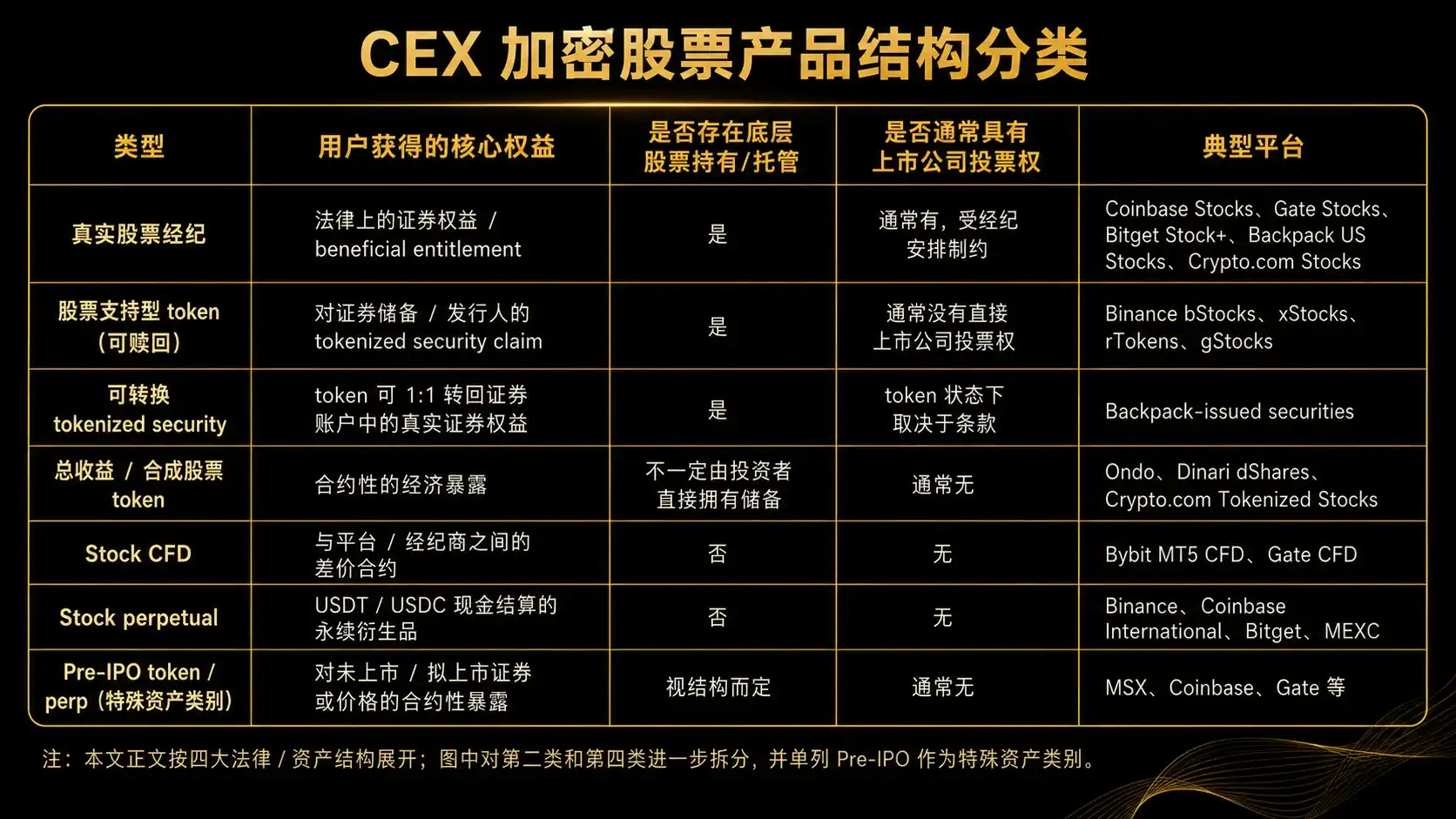
The report argues that the phrase "crypto stocks" hides several very different legal and technical structures. Even the same exchange may offer multiple stock products that fall into separate categories. Looking only at legal claims, custody, investor rights and risk allocation, the market has already split into at least four distinct product types.
1. Direct stock trading and brokerage services
These products embed traditional brokerage execution, clearing and custody inside a crypto platform. The user ends up with stock or ETF rights under the conventional securities system rather than just a token tracking a share price.
Binance Stocks, Coinbase's stock business, Gate Stocks, Bitget Stock+ and Backpack U.S. Stocks all fit here. Binance Stocks already offers more than 7,000 U.S.-listed stocks and ETFs. Coinbase provides brokerage services through Coinbase Capital Markets, with execution, clearing and custody handled through Apex clearing infrastructure, and covers thousands of U.S. listed securities with 24/5 trading for some names. Gate has connected to securities markets through traditional financial infrastructure including Alpaca and now spans U.S., Hong Kong and South Korean equities with more than 12,500 stocks and ETFs. Bitget Stock+ uses licensed partners such as RQD Clearing and Atomic Vaults Securities, covers more than 10,000 stocks and ETFs, and includes shareholder rights such as dividends and voting.
At a product-logic level, this route looks like a CEX extending itself toward an internet brokerage. The crypto account acts mainly as the unified entry point, funding bridge and front end, while securities trading itself remains tied to traditional market infrastructure.
2. Tokenized securities backed by real stocks
The second category is closer to stock tokenization in the usual sense. There is typically a reserve of real stocks or ETFs behind the product, and onchain tokens are issued against that reserve. Yet token holders usually do not become directly registered shareholders.
Binance bStocks, OKX Unified Tokenized Stocks, Kraken's xStocks, Bitget's Reality rTokens, Gate's gStocks and xStocks, and Backpack's own tokenized securities all fall into this bucket.
xStocks use 1:1 backing with the underlying security. OKX's UTS are currently based mainly on xStocks and support deposit and withdrawal over Solana and X Layer for some assets. Bitget's rTokens use the same broad 1:1 backing logic and already cover more than 500 assets. Gate distributes both its own gStocks and xStocks in parallel.
Still, matching on 1:1 backing does not mean identical investor rights. Binance bStocks represent a claim tied to the issuer's held securities rather than direct registered share ownership. xStocks holders also own a token rather than stock in a conventional brokerage account. OKX's UTS provide price exposure to the underlying stock or ETF but do not in themselves mean direct ownership of the company's shares or standard voting rights.
Backpack's tokenized securities differ somewhat because some of them can be converted 1:1 between the onchain token and the traditional securities entitlement. The report cites products such as MU, SNDK, HOOD and MSTR as using that type of structure.
3. Total-return or synthetic tokens built around economic exposure
The third category can look similar to the second from the front end. It may still involve real stocks as underlying or hedging assets, and it may still deliver near-1:1 price exposure. The difference lies in the legal claim and economic right received by the user.
These products are generally built to pass through the economic performance of the underlying stock, including price change and dividends, through contracts, total-return structures or other arrangements. The token itself is not the same as a traditional stock sitting in the holder's own securities account. In the report's framework, OKX's Ondo tokenized stocks fit more closely here.
Ondo Global Markets' stock tokens are supported by real securities held through licensed broker-dealers and regulated custodians, but investors hold an onchain equity-backed token that gives economic exposure rather than direct shareholder registration. That is why the report says 1:1 stock backing alone is not enough to classify a tokenized stock. Two products can both hold 1:1 underlying shares, yet one may grant a securities entitlement, another a claim against the issuer, and another a contractual stream linked to the stock's returns.
4. Stock perpetuals and CFDs without 1:1 stock reserves
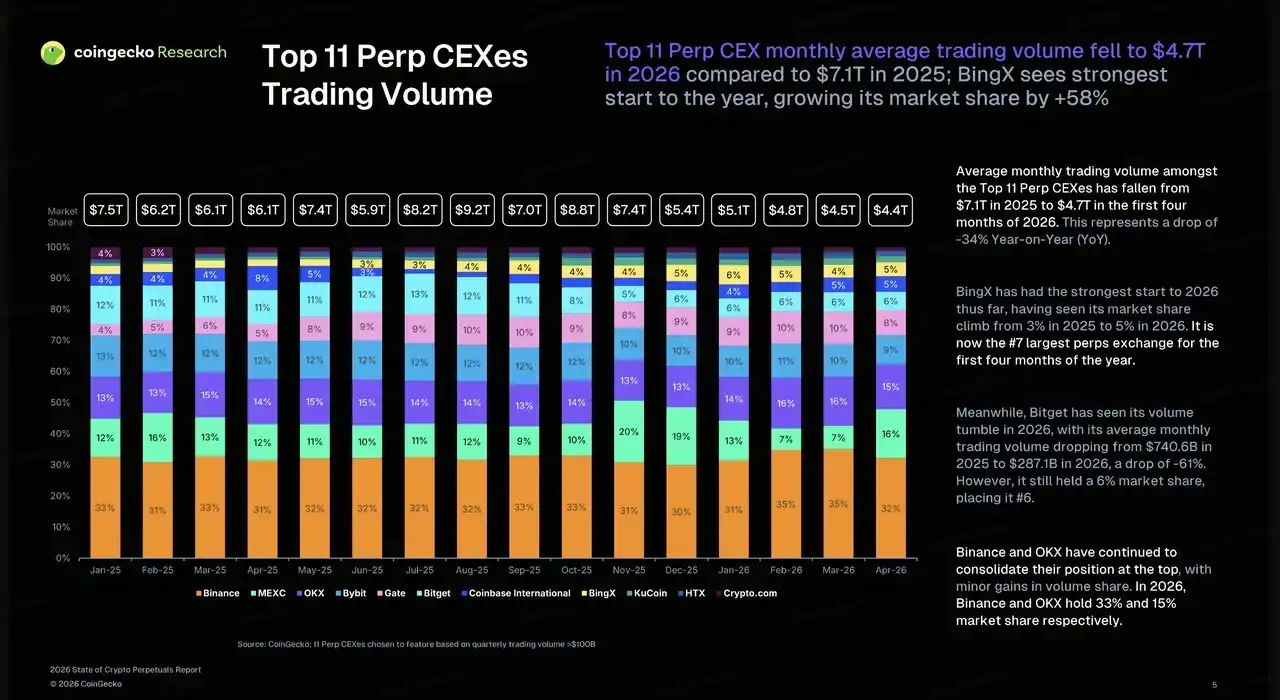
The fourth category is one of the largest by trading activity today: stock perpetual contracts and CFDs. Coinbase International's Stock Perpetual Futures, Binance TradFi Perps, OKX stock and equity perpetuals, Bitget's stock perps and Gate's stock CFDs all belong here.
Unlike the first three categories, these products do not require a one-to-one reserve of actual stock for each user position. They are much closer to the native crypto perpetual model, using indexes, spot references, oracles, funding, margin and liquidation rules to deliver long or short exposure to an underlying stock's price moves.
Coinbase International's stock perps, for example, let eligible non-U.S. users trade synthetic exposure to U.S. stocks 24/7, and Coinbase itself describes them as leveraged synthetic exposure rather than real shares. Binance, OKX and Bitget use the same broad approach, placing stocks, ETFs and even stock indexes into USDT- or USDC-based derivatives systems. Some Bitget stock perpetuals offer leverage up to 100x. Kraken extends the model by tying perpetuals to a tokenized-equity benchmark built around xStocks.
CFDs work along similar lines. The user is trading a contract on the price difference of the underlying stock with the platform or broker, not buying the stock itself.
By product nature, this category has the weakest direct link to "stocks onchain" but the strongest link to established crypto trading habits: stablecoin margin, long and short positioning, leverage and round-the-clock trading.
The segment is widening, and the entry barrier is rising
The report's broader conclusion is that crypto stocks are moving from isolated products into a full stack, and centralized exchanges are shifting from pure crypto trading venues toward more comprehensive financial marketplaces.
That shift also raises the competitive threshold. Real stocks, tokenized securities and stock perpetuals all require different mixes of securities licensing, brokerage and clearing access, custody arrangements, issuance structures and cross-jurisdiction compliance. Once a platform moves beyond simple stock derivatives into real securities and tokenized securities, it needs a complete bridge between traditional finance and onchain markets.
From the supply side, the report argues that only exchanges with enough compliance depth, capital and infrastructure are likely to stand out, which naturally keeps many smaller platforms out. On the demand side, a large share of early crypto-stock users are still crypto users first. That means the first phase of competition is not simply about taking traditional brokerage clients from scratch. It is also about how efficiently an exchange can move its existing crypto user base into stocks, ETFs and other TradFi products.
Under that logic, accumulated user scale, trading habits and account balances become strategic advantages. Platforms such as Binance, OKX, Bitget, Gate, Kraken and Coinbase begin with a stronger position because they already have large existing user bases. Crypto stocks may expand the addressable market for CEXs, but they may also reinforce the industry's existing hierarchy.