
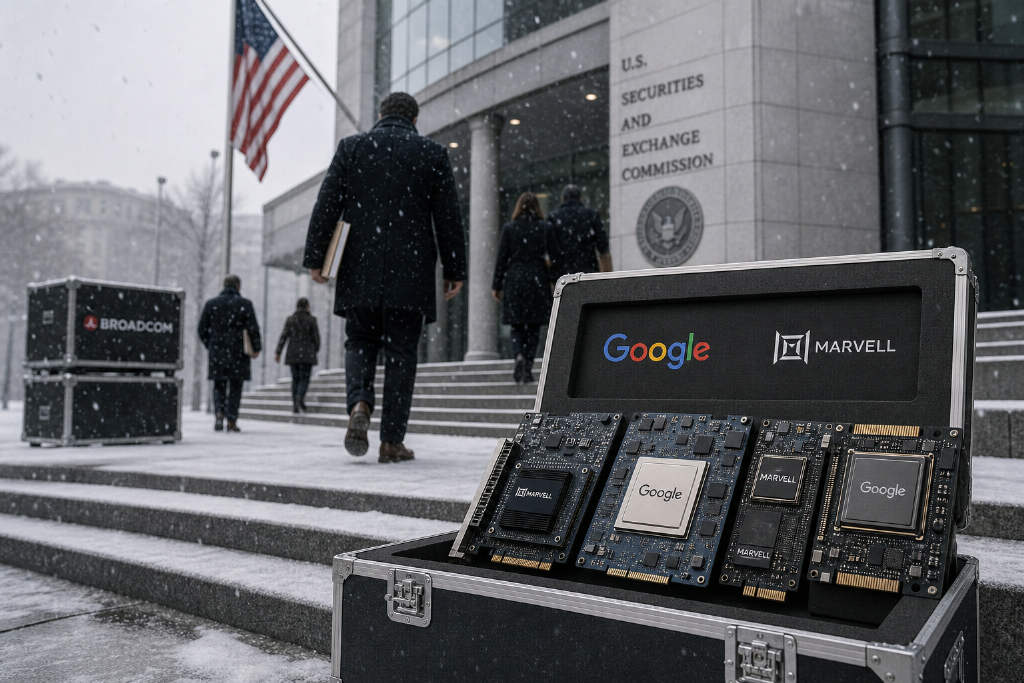
Marvell has confirmed in a filing with the U.S. Securities and Exchange Commission that it is expanding its chip partnership with Google. The companies will jointly develop customized semiconductor products for Google’s Tensor Processing Unit, or TPU, ecosystem. The disclosure lifted Marvell shares by nearly 10% at the close, while Broadcom, long seen as Google’s main TPU supplier, fell more than 5% on the same day.
Partnership centers on TPU ecosystem components
According to the Financial Times, Marvell (NASDAQ: MRVL) and Google confirmed that they will co-develop customized semiconductor products across the Google TPU ecosystem. The list includes AI inference accelerators, storage controllers, network interface controllers, memory interface controllers, and near-memory computing technologies.
As part of the agreement, Marvell granted Google warrants that allow it to buy up to 58,970,907 Marvell shares at $206.58 per share. The total value comes to about $12.2 billion. Based on the figures in the report, that stake equals about 7% of Marvell, which would make Google the company’s fifth-largest shareholder. The warrants remain valid through Aug. 18, 2033.
Most of the warrant shares vest in stages
The shares are not unlocked all at once. Roughly 1.36 million shares will vest evenly by quarter during the first year after the agreement takes effect.
The remaining more than 57.6 million shares are tied to revenue generated under the deal. Marvell unlocks one tranche for every $500 million in revenue, with 240 tranches in total. Full vesting would imply around $120 billion in cumulative revenue from the partnership.
Marvell jumps while Broadcom drops
After the news broke, Marvell shares rose as much as 9.85% in early trading and closed at $237. Broadcom (NASDAQ: AVGO) fell more than 5% that day.
The report said Broadcom had been Google’s main TPU supplier, but Marvell’s new role does not cover the TPU chip itself. The focus is on supporting chips around the TPU platform.
Google is broadening its TPU supply-chain setup
Google had already signed a long-term agreement with Broadcom in April this year. Under that deal, Broadcom is responsible for developing and supplying the next-generation TPU itself, along with other components needed for AI racks, with the contract running through 2031.
This new arrangement with Marvell targets a different slice of the stack: peripheral chips tied to TPUs rather than the TPU processor itself. As Google starts selling TPUs to external cloud customers, demand for supporting chips is also rising. The report cited analyst estimates that Google’s TPU-related infrastructure revenue could reach about $3 billion this year and as much as $25 billion in 2027.
Recent Marvell moves also include Nvidia and Celestial AI
Marvell has made other notable moves this year. Nvidia announced that it would spend $2 billion to take a stake in Marvell, and Marvell also completed its acquisition of Celestial AI.
That deal gave Marvell photonic interconnect technology that can link AI chips across large clusters. The report described it as an important building block for the computing infrastructure behind systems such as Google Gemini, Anthropic Claude, and OpenAI ChatGPT.