


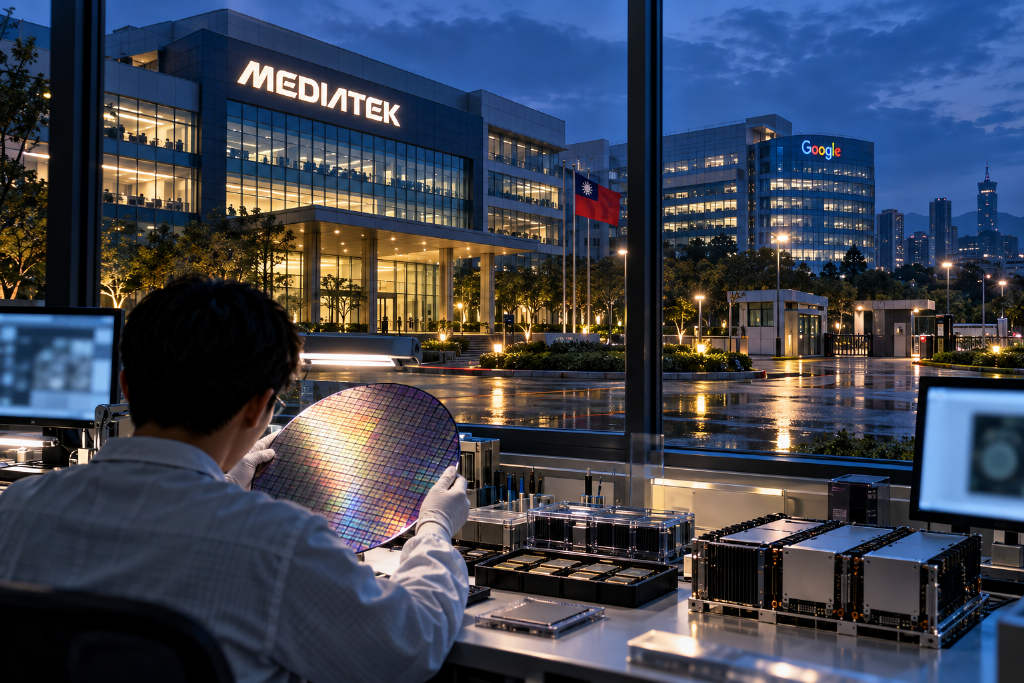
Google’s TPU v9 program, which includes MediaTek as a participant, is reportedly facing a schedule change that could push shipments into the first quarter of 2028. According to Commercial Times, citing institutional sources, Google revised the Core A design for TPU v9, delaying development by about three weeks. The first tape-out is now expected in January 2027.
The report said the Core A design carries the codename Humufish. Because MediaTek is responsible for Core B and I/O design work that must align with Core A, the change also affected MediaTek’s part of the project.
The target for sample delivery in November 2026 was said to remain unchanged. Even so, the first tape-out is now expected in January 2027, while the tape-out for the mass-production version is projected for the second quarter of 2027. Based on that timeline, institutional estimates cited in the report suggest TPU v9 shipments may move to Q1 2028. MediaTek is also expected to address the issue at its earnings call in late October.
EMIB-T packaging and substrate yield have become a focal point
Beyond the design revision, the chip’s advanced packaging route has drawn attention. TrendForce said TPU v9 is expected to use Intel’s EMIB-T packaging technology, and that substrate yield remains a key challenge affecting production scale and cost competitiveness.
DIGITIMES interpreted the production delay as a result of Google’s design adjustment. Its report said yield issues had appeared before during the packaging stage, and that Google may have taken that into account when revising the design. It also said v9 had originally been planned with Intel EMIB processing and advanced glass substrates to improve overall computing performance, while claiming MediaTek’s yield in that area was too low.
That explanation has been disputed. Zephyr, an analyst at Citrini, said TPU v9 packaging does not use glass substrates. He added that Broadcom would be the first company to introduce glass substrates, around 2029 to 2030, and that MediaTek currently has no related plan. On that basis, there is still no reliable evidence that poor glass-substrate yield is the reason behind the TPU v9 delay.
MediaTek is also expanding its ASIC customer base
Outside the Google project, MediaTek is pushing to broaden its ASIC business. Chain News previously reported that ByteDance, the parent company of TikTok, is considering buying MediaTek data-center chips. If a deal is signed, ByteDance would become MediaTek’s second-largest ASIC customer after Google.
According to the report, winning a large customer contract would help MediaTek reduce its dependence on smartphones and strengthen its competitive position in the data-center market against Qualcomm and Broadcom.
Taiwan ASIC design service firms have posted strong recent revenue
Recent revenue figures from Taiwan’s ASIC design service companies have also drawn market attention. Alchip-backed peer GUC, or Global Unichip, posted September revenue of NT$7.145 billion, a monthly record, up 97.8% from a year earlier, supported by cloud customer CPU and ASIC projects. Alchip Technologies reported September revenue of NT$9.979 billion, up 496% year over year, mainly due to higher shipments of 3 nm AI accelerators.
On the demand side, institutional estimates cited in the report project global AI ASIC accelerator shipments will reach 14.1 million units in 2027, up about 69% year over year, leaving room for continued growth for Taiwan’s ASIC design companies.