
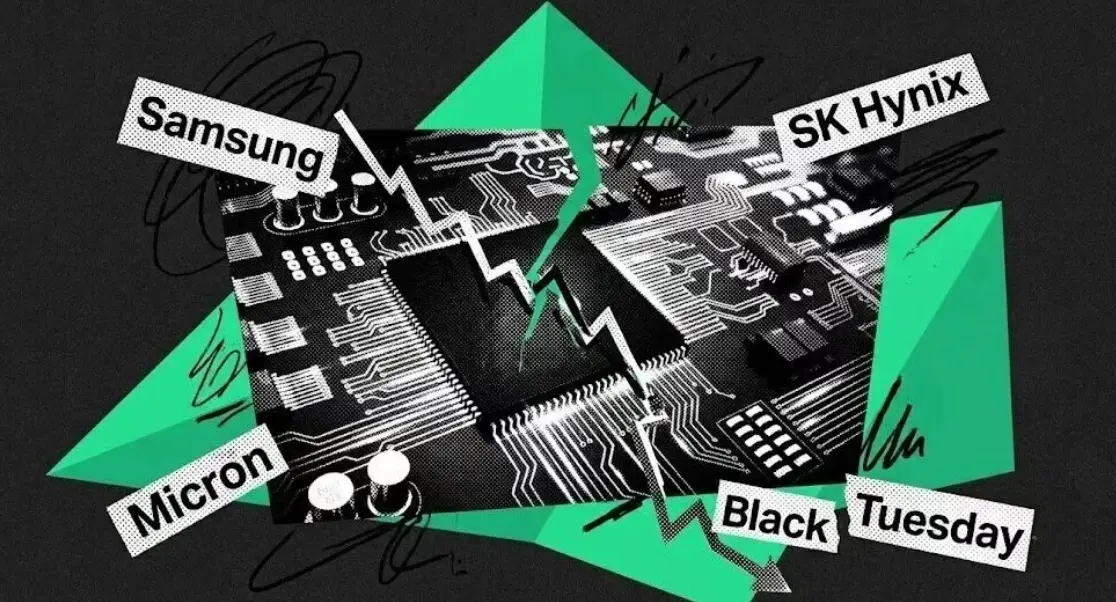
Memory stocks in South Korea and the U.S. sold off heavily around July 28, even as the industry was still posting some of its strongest results on record. In the latest trading session cited in the report, SK Hynix and Samsung Electronics each dropped more than 13%, wiping out about $28 billion in market value combined. In the U.S. on Tuesday, Micron fell 8.85%, SanDisk plunged 14.25%, Seagate lost 8.53%, and Western Digital fell more than 6.9%, for a combined loss of roughly $14.8 billion.
Using the figures in the source article, the one-day market value loss across the major Korean and U.S. names came to nearly $43 billion. Public data cited in the report also showed that SK Hynix had pulled back about 45% to 47% from its June peak, erasing close to $600 billion in market value. Micron had fallen more than 30% from its highs, while Japan’s Kioxia had nearly halved in one month.
Earnings were strong, but the stocks kept falling
The central market puzzle is that the selloff came right after blockbuster earnings. On July 7, Samsung Electronics released preliminary second-quarter results showing operating profit of KRW 89.4 trillion, up 18 times from a year earlier and higher than the company’s total profit for 2023 through 2025 combined. Even so, Samsung shares fell more than 10% intraday after the release, dragging the KOSPI down by nearly 5%.
SK Hynix reported second-quarter revenue of KRW 79.3 trillion on July 29, up 257% year over year, with operating profit at KRW 60.5 trillion, up 557%. Its operating margin climbed to 76%.
Micron said revenue for the fiscal period ending in May 2026 reached $41.5 billion, up 346% year over year. Gross margin rose to 84.6%, and free cash flow came in at $17.6 billion. The company’s management was quoted in the source as saying demand was far above supply capacity and that this situation would last until 2028.
That contrast between very strong fundamentals and falling share prices became the core issue for investors trying to explain the move.
ADR arbitrage and tighter ETF rules added near-term pressure
The report points first to cross-market arbitrage after SK Hynix launched an ADR in the U.S. The trade was described as long the U.S.-listed ADR and short the locally listed Korean shares. According to Bloomberg, citing a UBS note to clients, many global portfolio managers who previously did not include Korean-listed SK Hynix shares in their investment universe could now buy the new ADR instead.
UBS wrote in the note: “Buying the ADR from day one and selling the Korean common stock looks like a can’t-lose trade.”
A second trigger came from regulation in South Korea. On July 16, the Financial Services Commission tightened rules for single-stock leveraged ETFs. The minimum margin threshold was raised from KRW 10 million to KRW 30 million, and purchases were capped at 20 shares per person per trade.
JPMorgan analyst Nikolaos Panigirtzoglou said holdings in memory-chip leveraged ETFs had reached three times the ratio seen in regular stock ETFs relative to the market value of the related companies. As prices moved lower, mandatory end-of-day rebalancing in leveraged ETFs triggered automated selling and amplified the decline. On that day, SK Hynix fell more than 11% and Samsung dropped more than 8%, with the pressure then spreading into Europe and the U.S.
AI spending concerns spread to the HBM supply chain
On a broader timeline, the article says the retreat in memory names is also tied to concern about whether AI investment is producing returns quickly enough. On July 22, Google released second-quarter results and raised its full-year capital expenditure plan from $180 billion-$190 billion to $195 billion-$205 billion. Yet its shares fell in after-hours trading and again the next day. The report attributes that reaction to concern that relentless spending was weighing on free cash flow and that returns on AI investment remained uncertain.
Moody’s also issued a warning, saying an AI race worth nearly $1 trillion per year was pushing large companies such as Google and Microsoft to rely more heavily on debt and off-balance-sheet financing. The source says the combined direct debt of the six largest cloud providers had reached about $460 billion.
Under those conditions, even a slight miss in guidance from major technology companies can lead the market to reprice HBM-related names that are highly sensitive to AI demand expectations. Shinhan Securities analyst Kang Jin-hyuk said investor attention had shifted back to concerns over the sustainability of the AI investment cycle and the rising competitiveness of China’s memory industry, intensifying risk aversion.
Standard Chartered chief equity investment officer Sundeep Gantori said the selloff reflected broader deterioration in sentiment toward the semiconductor sector. Some institutions, according to the article, now expect memory prices to peak in 2027.
Michael Burry disclosed an aggressive short on memory
As fear spread through the market, Michael Burry, known as the inspiration for The Big Short, disclosed in his personal column that he was shorting the memory chip sector heavily and was still adding to the position.
The source traces his trade path in detail. On July 2, Burry opened an initial short in Micron at about $1,051.87. On July 25, he increased his short positions in Micron and NVIDIA, with the stock prices cited at $933.86 and $210.28 respectively, and also established a short against the SOXX semiconductor ETF.
The report says Burry’s bearish view rests on three main arguments. First, Micron’s valuation has stretched far above long-term trend levels. As the only pure-play DRAM name in the U.S. equity market, Micron has gone through 34 drawdowns of more than 30% in the past 42 years, according to the article. Its current distance from the 200-day moving average is said to be the widest since 1984, even beyond the 2000 internet bubble peak.
Second, capital returns have historically been weak. The source gives Micron a long-term median return on invested capital of 4% and median return on equity of 7%, adding that roughly one-third of its quarters historically were in capital-destructive territory.
Third, Burry argues end demand may be overstated. The article says he believes the strong demand linked to NVIDIA does not fully reflect real end consumption, but is partly driven by off-balance-sheet financing and capital recycling arrangements. It says he cited the Bank for International Settlements 2026 annual report in support of that view.
Burry also described recent capacity expansion plans from Korean manufacturers as a sign that the semiconductor cycle was turning from boom to slowdown, and said he expected a pullback of at least 30% across the sector.
That is not the only view in the market. Bulls argue Micron has just delivered the best quarterly report in its history, with record revenue, margins, and cash flow. A CoinCentral analysis cited in the source makes a narrower point: Burry may not be betting on an immediate collapse in end demand, but rather on memory makers losing capital spending discipline. The report says Micron’s own $27 billion capital expenditure plan could sow the seeds of the next downturn.
Large Korean expansion plans shifted focus to 2027 supply risk
Only weeks before the selloff, the global memory industry was still in the middle of an unprecedented wave of long-term supply agreements. At an AI summit in San Francisco on July 24 and 25, SK Group signed a long-term deal worth more than $500 billion with NVIDIA covering HBM supply and joint HBM4 development. Including its cooperation with Microsoft and Anthropic, the total scale cited in the article reached about $750 billion.
At the same time, Samsung Electronics signed a memorandum with Broadcom worth as much as $200 billion. Together, those Korean agreements totaled about $950 billion and were described by foreign media, according to the report, as the largest long-term semiconductor supply lock-ins on record.
During the same period, AMD acquired MEXT in a bid to use flash memory to imitate DRAM and lower memory costs, while Meta locked in multi-year NAND supply with SanDisk.
Those deals did not provide lasting support for memory stocks. For long-term capital, the bigger issue was a Korean government industrial plan introduced in late June. Under the plan described in the article, Samsung and SK Group will jointly invest KRW 800 trillion to build four new fabs in southwestern South Korea, with a goal of doubling memory chip capacity within five years.
Including a supporting KRW 550 trillion HBM packaging hub and data center construction program, the total investment would reach KRW 1,350 trillion, or about $880 billion, equal to 5% of South Korea’s 2024 GDP.
That scale matters because the industry’s supply discipline over the past two years had depended on limiting output and steering capacity toward higher-margin HBM products. The source says SK Hynix’s 2026 capital expenditure is expected to jump 43% to KRW 40 trillion, while Micron’s capex for fiscal 2026 is set to double year over year.
Morningstar analyst Jing Jie Yu warned that when this new capacity starts coming online in 2027 and 2028, the industry will face unavoidable price erosion. AInvest took a similar line, saying the expansion is no longer just an AI-demand victory story but could become a replay of the oversupply and price collapse cycle seen in 2022 and 2023.
Building a fab and bringing capacity online usually takes 18 to 24 months. The article notes that Samsung’s P5 fab is scheduled for mass production in the second half of 2027. TrendForce also said the current DRAM shortage would be difficult to reverse fundamentally before then. Even so, equity markets price expectations rather than current conditions.
The report’s conclusion is that South Korea’s latest expansion drive has broken the market’s confidence in sustainably high chip prices. The shock move in memory stocks was not caused by one event alone, but by the gap between powerful current fundamentals and weakening expectations for later years. In that sense, the market has already started pricing potential oversupply in 2027. Under Burry’s framework, the real test for the industry comes when the new Korean fabs begin concentrated mass production in the second half of 2027 and into 2028.