
Meta’s internal push to become an “AI native” company ran into operational trouble after security and technical incidents increased and management dropped a planned second round of restructuring, according to a Reuters report published on Aug. 26.

Reuters said CEO Mark Zuckerberg had introduced the initiative in January under the name Organization Transformation, or OT. The plan was designed to shift a large amount of day-to-day work from human employees to AI systems, while smaller and more concentrated teams would remain in place to supervise the process.
Internal planning documents showed that Meta executives had discussed scenarios in which staffing in multiple teams could be reduced by as much as 60%. Some employees would be reassigned to newly created units, while others could lose their jobs. The possible scale was described as comparable to, or even larger than, the roughly 25% of staff the company cut three years ago.
The restructuring was originally scheduled in two stages. The first was set for May, and the second had been planned for November. Beyond direct layoffs, Meta also intended to reduce headcount through hiring freezes and by removing underperforming employees.
Meta confirmed to Reuters that the OT plan did exist. The company described it as a one-year effort focused on cutting costs, reorganizing teams, and moving workers into priority areas including AI training data generation. Meta also said it had never planned to lay off 60% of its total workforce, and that the second phase was canceled before a specific number for further job cuts had been decided.
Employee backlash grew after the plan surfaced
After news of the layoffs emerged in March, employee morale fell sharply, the report said. Some managers were asked to play down the situation and only tell teams that their roles would “evolve” because of AI.
In April, reports circulated that Meta would cut about 10% of its workforce on May 20. Around the same time, the company was also said to have required U.S. employees to install monitoring software on their devices that recorded keyboard and mouse activity. The purpose was to train AI agents to imitate how humans operate computers.
That triggered strong internal criticism. Many employees feared they were effectively helping train AI systems that could replace them, and Meta’s Workplace platform was flooded with complaints.
More AI-written code, but fewer gains than expected
Internal data pointed to a mismatch between code output and real productivity gains. In a June internal post, Meta Chief Technology Officer Andrew Bosworth wrote that employee use of AI-generated code changes had risen 220% from a year earlier. New features or upgrades that actually reached users, however, increased only 36%.
Multiple internal posts said the wider use of AI in coding had created reliability concerns instead of relieving them. They referred to “large-scale, destructive AI agent behavior,” and said major technical and security incidents were up 40% from the same period last year. Time spent dealing with the aftermath of those failures rose 70%.
In June, hackers breached Meta’s newly launched AI customer service chatbot and used it to gain access to several high-profile Instagram accounts, including the deactivated official Obama White House account. That incident pushed the issue into clearer view.
Zuckerberg halted the second phase hours before the first cuts
Facing heavy internal pressure and weaker-than-expected technical results, Zuckerberg met again with senior executives on the evening of May 19, just hours before the first round of layoffs was due to begin. After that discussion, he decided to cancel the second restructuring wave that had been scheduled for November.
Meta still went ahead the next day with layoffs affecting about 10% of employees. Soon after, Zuckerberg wrote on Workplace that he did not expect any other company-wide layoffs this year and said he wanted to give staff more stability.
The company then tried to repair morale. Those steps included encouraging managers to deal directly with employee concerns, pausing the mouse-monitoring plan, allowing some workers moved into newly created AI engineering units to ask for a return to their former teams, and having Chief Financial Officer Susan Li strengthen employee benefits.
In early July, Zuckerberg made a rare appearance at an internal town hall. He acknowledged that the reorganization had been mishandled in terms of timing and said progress in AI agent technology had been slower than he had expected. He also said he expected to see more benefits from the technology over the next three to six months.
Public messaging shifted to talent while staff still worried about more cuts
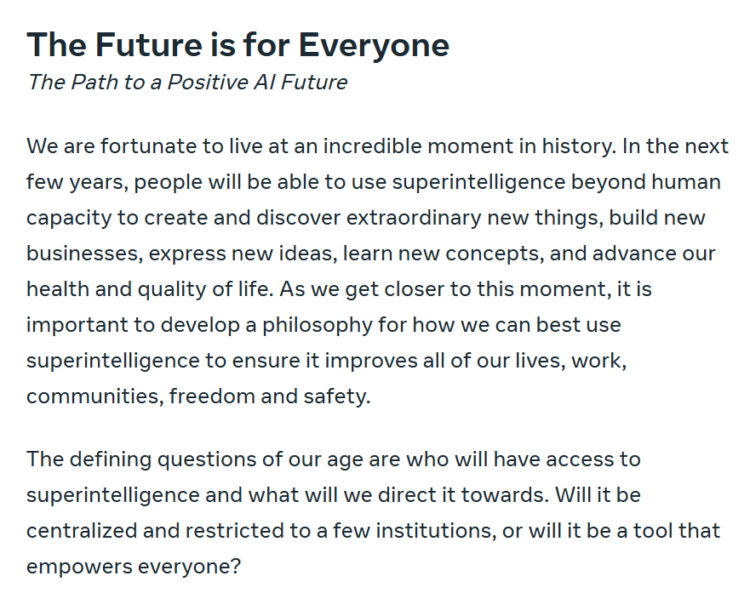
As Meta pulled back from some of the most controversial parts of its AI transition, Zuckerberg also started a public messaging campaign that stressed the company’s human side. That included an ad video built around the slogan of “betting on talent” and a 6,500-word essay laying out his long-term AI vision.
In that essay, Zuckerberg argued that the future could bring abundant job opportunities, while also saying some companies might shrink because of AI. He described a possible structure in which there are more companies overall, but fewer employees at each one.
Even so, Reuters said Zuckerberg remained careful in his wording with employees, repeatedly using terms such as “company-wide” and “this year.” Some employees took that to mean Meta could still continue reducing staff later through team-specific layoffs or performance-based attrition, or delay a broader workforce reduction until next year.
Meta is currently planning to spend at least $130 billion this year on AI chips and infrastructure. LSEG estimates that the outlay will consume the company’s full operating cash for 2026, keeping attention on what Meta does next with staffing.