
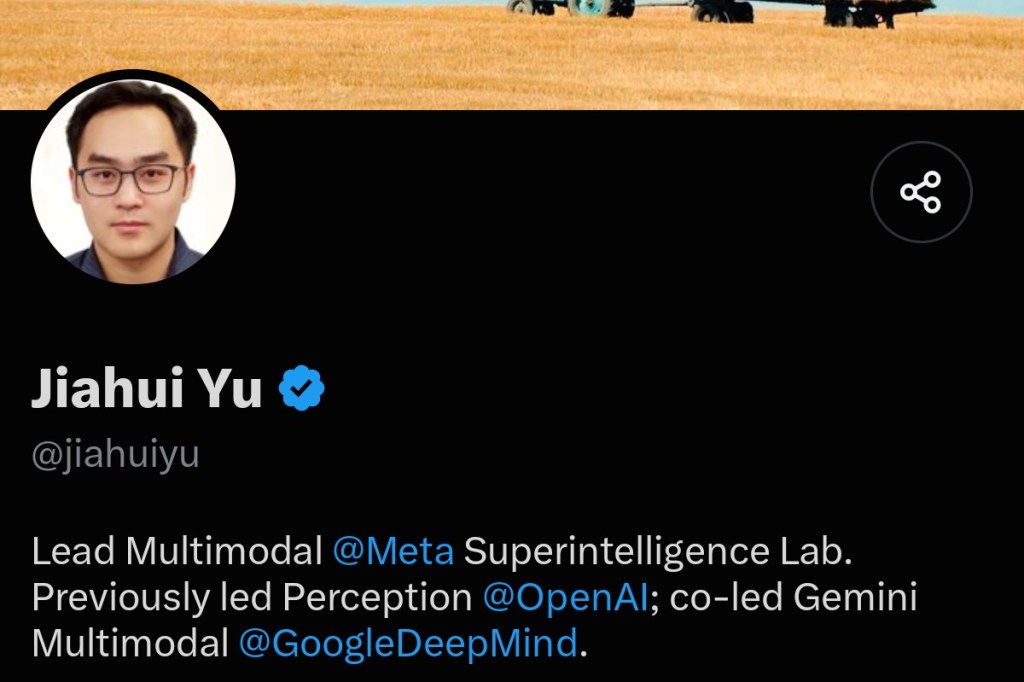
Meta Superintelligence Labs, or MSL, is facing another change in its senior research ranks. Multimodal AI researcher Jiahui Yu said on Aug. 14 that he is leaving Meta to start a new company, though he did not name the startup or spell out its research focus.
He said only that the new effort will center on a problem that is "crucial to humanity’s future" but still rarely explored.
Departure announced on X
Yu wrote on X: "I m leaving Meta to start a new company."
He said building TBD Lab at Meta alongside Mark Zuckerberg and MSL head Alexandr Wang had been a deeply inspiring and rewarding experience.
Yu also said he was proud of the multimodal team’s work on Muse Spark, Voice Mode, Muse Image and Muse Video, and proud of the team assembled to deliver those products.
Joined Meta from OpenAI last year
Yu has been one of the more visible figures in Silicon Valley’s recent fight for AI talent.
In June 2025, Meta recruited aggressively from OpenAI, with researchers including Shengjia Zhao, Jiahui Yu, Shuchao Bi and Hongyu Ren joining the company.
At the time, OpenAI CEO Sam Altman said publicly that Meta had made very large offers to OpenAI staff. For some roles, signing bonuses alone reached as much as $100 million, or roughly NT$3 billion, and annual compensation could be even higher.
Meta was then building out its superintelligence team, with former Scale AI CEO Alexandr Wang in a central leadership role.
Before joining Meta, Yu had served as research lead for OpenAI’s Perception team, focusing on multimodal systems, visual understanding and generative models.
His work at OpenAI included GPT-4o, GPT-4o Image Generation, GPT-4.1, as well as the o3 and o4-mini models.
Earlier in his career, he worked at Google DeepMind and took part in the development of the Gemini multimodal model. His personal website lists him as one of the co-leads of Gemini Multimodal.
Key figure behind Meta’s multimodal work
After arriving at Meta, Yu mainly worked on multimodal AI.
Earlier reports said that as part of Meta AI’s organizational reshuffle, he was expected to oversee multimedia work inside TBD Lab, expanding models beyond text so they could understand and generate other forms of content.
That direction has shown up in Meta’s steady rollout of the Muse product line this year.
Meta first introduced Muse Spark, a native multimodal reasoning model that supports tool use, Visual Chain of Thought and multi-agent collaboration. It later released Muse Image and previewed Muse Video. More recently, Meta published Muse Glimmer weights and has been preparing to release Muse Spark 1.2.
Yu had also publicly introduced Muse Image, saying the model could search, write code, self-reflect and call tools to complete generation tasks.
New company remains under wraps
Yu’s comments on what comes next drew as much attention as the departure itself.
He said that over time he had become increasingly drawn to one question: "This question will profoundly affect humanity’s future, yet remains largely unexplored."
Yu added that the topic now has his "full attention" and that he will share more once the work starts to take shape.