
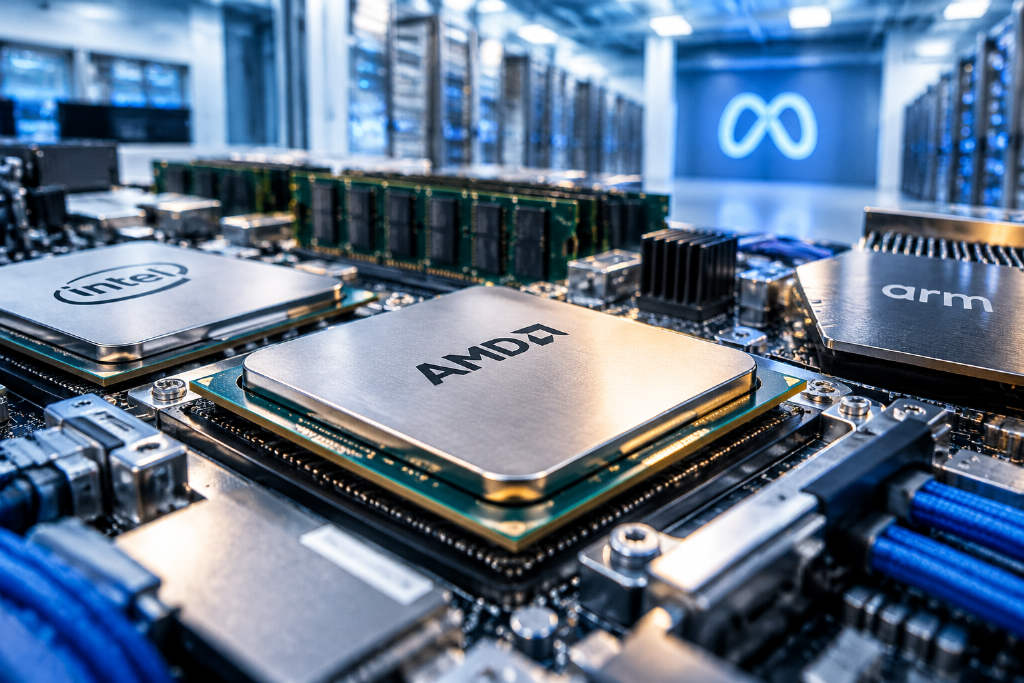
Meta’s AI agent Muse is reshaping how the market looks at AI infrastructure, with CPUs moving back into focus as demand patterns change. In its latest weekly report, TrendForce said server CPU lead times have stretched from a healthy 16 to 20 weeks to 25 to 30 weeks. DRAM supply remains tight as well, with lead times at 20 weeks versus an 8-week healthy baseline. Discussion in the market around tighter supply and higher prices from the fourth quarter of 2026 through the first quarter of 2027 is continuing to build.

Muse shifts AI demand toward CPUs
TrendForce said most earlier discussion around AI compute demand had centered on GPUs, but Muse has opened a new wave of demand. ABMedia wrote that the app surpassed ChatGPT in downloads within just a few days of launch.
The report drew a distinction between traditional request-response AI inference and AI agents, which stay online for extended periods, retain conversational memory, and carry out multi-step tasks on their own. Those features require persistent virtual machines, and the core resource in that setup is the CPU rather than the GPU.
As that theme gained traction, shares of AMD, Intel, and Arm moved sharply higher. AMD also crossed the $1 trillion market capitalization mark for the first time. Meta, meanwhile, introduced the handheld device Meta Charm at Connect 2026, extending the Muse-driven AI agent ecosystem from the cloud to edge hardware. OpenAI previewed a major new agent product for its DevDay event on Sept. 29, while xAI’s Grok teammates feature continued to add pressure, pointing to a fresh CPU demand cycle tied to AI agents.
Server CPU lead times are more than 50% above normal
TrendForce’s supply-chain tracking showed server CPU lead times rising from the normal 16 to 20 week range to 25 to 30 weeks. Using the midpoint, that is an increase of more than 50%.
The report said the longer lead times reflect faster in-house chip development by major cloud service providers, reducing flexibility in outside procurement.
ABMedia also cited a stock list compiled by @LIWEI_TWCapital based on the supply-chain survey, mapping six tight component categories to U.S. and Taiwan-listed names:
- CPU: Intel ($INTC), AMD ($AMD), Arm ($ARM)
- DRAM: Micron ($MU), Nanya Technology (2408), Winbond (2344)
- NAND / eSSD: Micron ($MU), SanDisk ($SNDK), Phison (8299)
- HDD: Seagate ($STX), Western Digital ($WDC)
- ABF substrate: Unimicron (3037), Nan Ya PCB (8046), Kinsus (3189)
- MLCC: Vishay ($VSH), Yageo (2327), Walsin Technology (2492), Holy Stone (3026)
Micron earnings will test the memory pricing cycle
Beyond the CPU demand reset, memory is another focus this week. Micron is scheduled to report fiscal fourth-quarter results on Sept. 30 for the period ended Sept. 3. ABMedia described it as the first full-quarter test after sharp increases in average selling prices for both DRAM and NAND.
The previous quarter already showed striking numbers. DRAM ASP rose about 60% quarter over quarter, NAND ASP climbed about 80%, and non-GAAP gross margin reached a record 84.9%, the strongest among the three major suppliers. The question now is whether that level can hold.
The market is watching three indicators in particular:
- Whether gross margin can stay near its record high
- Whether more long-term agreements are added; Micron has announced 16 Strategic Customer Agreements so far
- How HBM4 shipments are progressing
On HBM market share, the report said Micron still trails Samsung and SK Hynix, leaving HBM4 as a key point of attention for investors tracking whether the gap can narrow.
2nm production and advanced packaging are moving in parallel
The manufacturing race also produced a fresh milestone this week. At Snapdragon Summit on Sept. 22, Qualcomm introduced two flagship chips, Snapdragon 8 Elite Extreme Gen 6 and Snapdragon 8 Elite Gen 6. Both use TSMC’s 2nm N2 process and were announced just seven days after MediaTek’s Dimensity 9600 Pro.
That means the two main Android chip designers have now entered the 2nm era at the same time, setting up direct competition with Apple’s A20 Pro. For Taiwan Semiconductor Manufacturing Co. (TSMC), the development signals a notable concentration of orders: Qualcomm, MediaTek, and Apple are all moving into 2nm production, lifting both ramp pressure and order visibility for advanced-node capacity.
ABMedia added that Qualcomm’s new chips completed the first commercial mass-production validation for Samsung LPDDR6, confirming that the memory standard is ready to ship alongside next-generation processors.
The next packaging milestone is expected at the 3D IC 2026 conference in Atlanta on Oct. 1 and 2. As AI chips run into density limits in 2.5D packaging, the industry is turning toward 3D stacking. Rapidus is expected to present 300mm and 600mm panel packaging technology, while Kioxia is set to show its CBA, or CMOS Directly Bonded to Array, technology. The event will offer another test of whether advanced packaging becomes the next main path for AI compute growth.