

Meta's Spare Compute Triggers a Market Shakeup: From Scrambling for Hardware to Counting Pennies
AI stocks took a brutal hit this week after Meta signaled it might sell its excess AI compute capacity. Three years ago, this would have been unremarkable—cloud computing has always been about slicing servers and reselling them. Amazon, Microsoft, and Google have done it for years; CoreWeave and Nebius built their businesses on renting out Nvidia chips. But Meta has always been a self-consumer: buying chips and building data centers for its own models, ad systems, and Zuckerberg's superintelligence vision. Now, saying 'we might rent out temporarily idle machines' strikes at the heart of the AI capex narrative.
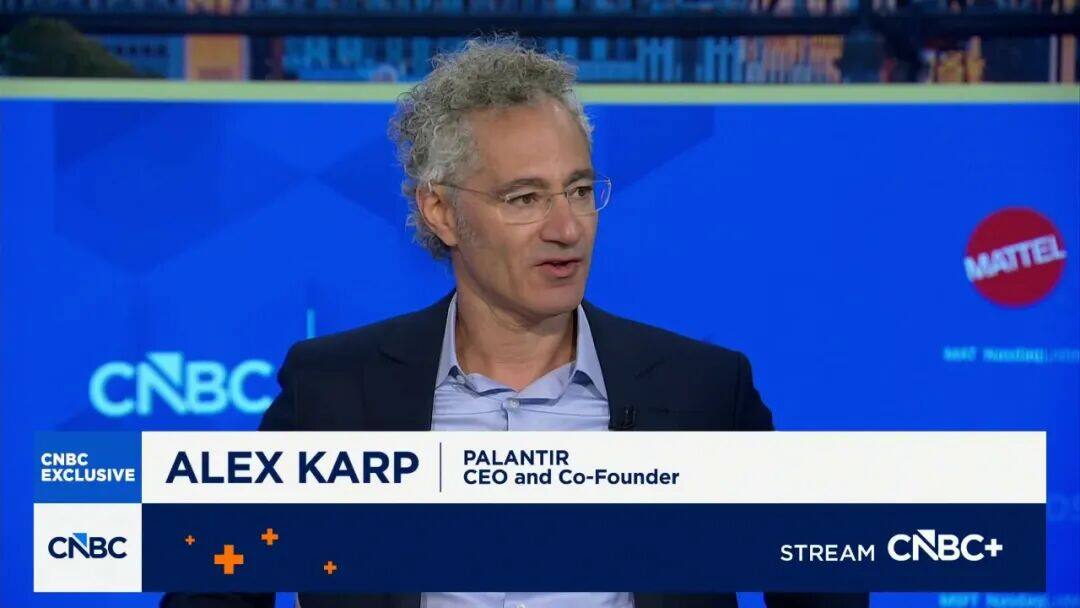
During the selloff, Palantir CEO Alex Karp vented on CNBC for nearly 20 minutes. He slammed the token-based pricing of OpenAI and Anthropic, claiming CEOs privately complain they are 'paying for tokens that create no value and handing over their data.' He called the soaring model bills a 'wealth tax on enterprises.' The market used to celebrate who spent fastest and most aggressively; now the question is: after buying machines, who can keep them running at full capacity?
Internally, Meta is exploring a 'Meta Compute' direction—either selling raw compute or offering model hosting like Amazon Bedrock. Zuckerberg previously noted that almost weekly, external companies ask to buy API services or compute slices, willing to pay above Meta's cost. But he added they haven't done so because Meta still needs the capacity itself. If capacity is temporary, renting is an option; if it's structural, renting becomes a balance-sheet painkiller. This puts the market in a dilemma: is Meta just creating a rental window during construction, or telling investors that a thousand-billion-dollar AI spend needs a nearer revenue line?
Demand Hasn't Disappeared—It's Becoming Selective
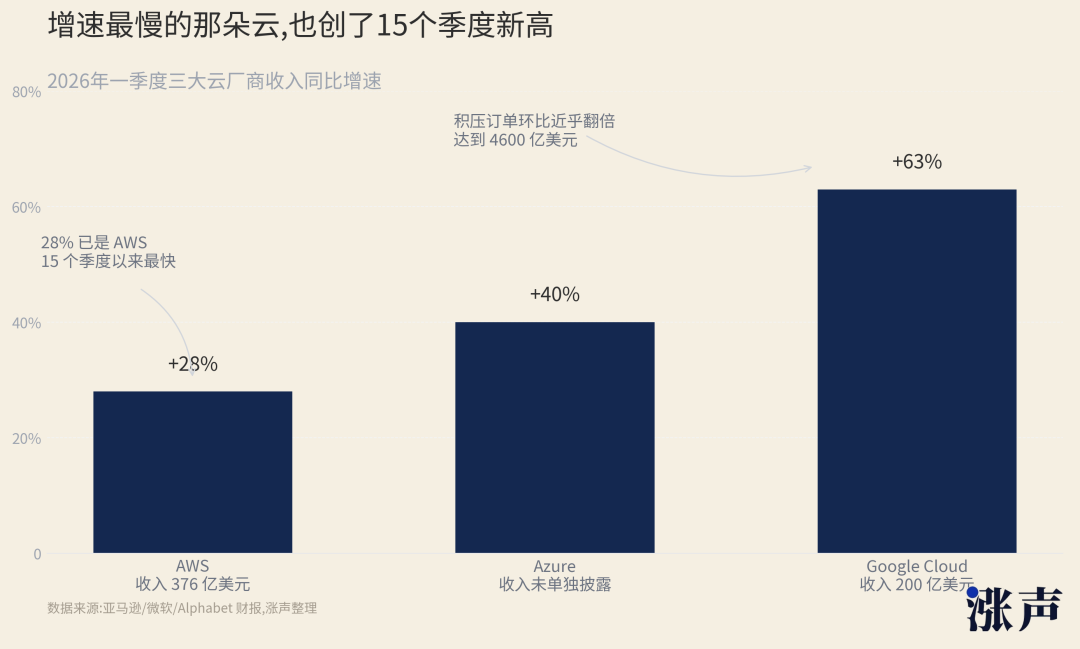
Many interpreted Meta's move as 'AI Capex is collapsing,' but public data suggests otherwise. AWS grew 28% in Q1 to $37.6B; Google Cloud soared to $20B; Azure still runs at ~40% growth. Amazon sees 2025 capex reaching $200B, Alphabet raised its 2026 guide to $180B–$190B, and Meta itself raised to $125B–$145B. These are not signs of collapsing demand; they signal a bifurcation.
Cloud vendors sell 'roads'—no matter who makes the vehicle, they collect tolls. AWS even raised prices on its GPU reservation service by ~20% in July (after 15% in January), a classic move during scarcity. But model companies aren't all comfortable. Anthropic is favored because users assign expensive tasks (coding, system changes, long-context) to it. Strong models face a bottleneck of hardware; weak models face neglect. xAI's decision to channel some compute to Anthropic says it all: machines don't care about founders, only who fills them. Google restricting Meta's Gemini usage further reveals this isn't traditional oversupply—Meta considers selling compute while simultaneously failing to buy enough top-tier model capacity for certain tasks. That's a mismatch. Bills are getting painful. Cloud vendors can raise prices because they sell certainty; enterprises need guaranteed GPU access. But after getting compute, CFOs ask: did these tokens save or earn us more money?
Enterprises Awaken: AI Goes from Toy to Tool—Spending Gets Harder
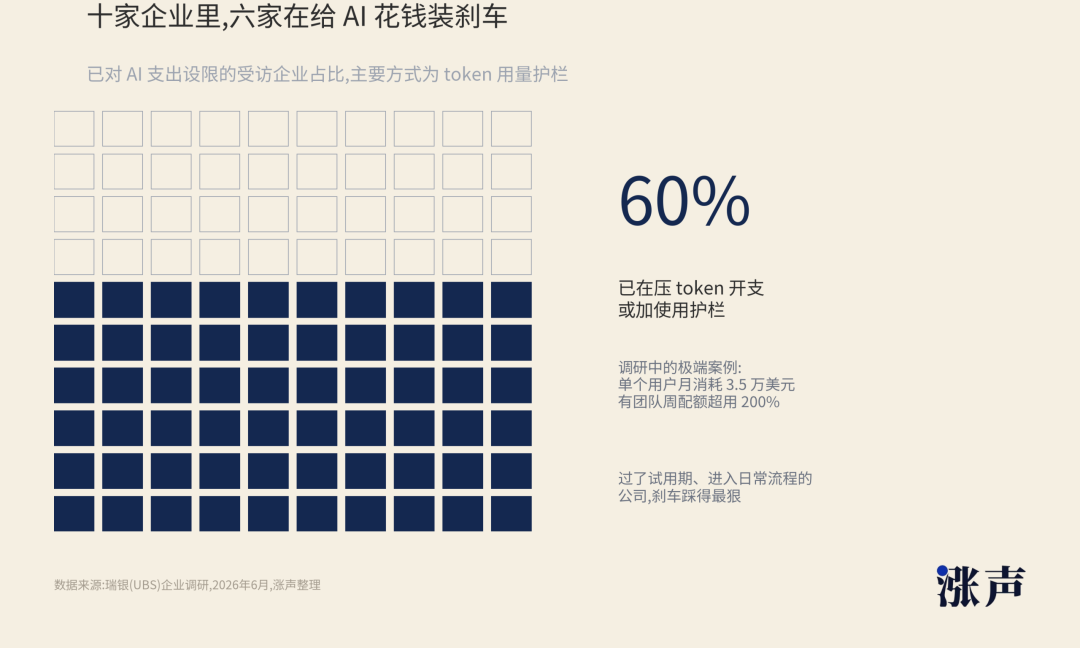
Karp put frontier labs on the spot: enterprises shouldn't hand over their data, processes, and business logic while paying an ever-growing token bill. Palantir sells not a generic API but an integrated system that ties data, approval workflows, permissions, and AI into one business process. UBS surveys show ~60% of enterprises are capping token spending and adding guardrails, especially after passing the pilot phase and integrating AI into daily workflows. As AI transforms from toy to tool, spending paradoxically becomes harder: bosses allocate budgets due to FOMO, but CFOs ask who saved man-hours, who sold more, who reduced risk.

AI agents amplify the problem. A Codex study by OpenAI and several universities shows active users grew more than 5x in H1 2026; legal roles within OpenAI saw a 13x increase in monthly token output compared to November 2025, while research roles surged 50x. Another study reveals that agentic coding tasks can consume up to 1,000x more tokens than standard chat, and runtime variance can reach 30x. This is the true underbelly of compute scarcity: software is turning into a swarm of small workers that read files, run commands, modify code, fail, retry, retry again—no lunch breaks, but every step consumes tokens.
When tokens become an electricity meter, who owns the power plant holds the leverage, but who wastes electricity gets audited first. CFOs will naturally ask: which tasks require the strongest model, and which can use a sufficiently capable one? At this point, open-source models like Zhipu GLM-5.2, Kimi, DeepSeek, and Qwen cease to be tech news—they become bargaining chips in enterprise procurement. Marc Andreessen of a16z noted that many AI practitioners now regard Zhipu GLM-5.2 as one of the first Chinese models to match or exceed top US public models on most tasks. Coinbase provides a concrete example: CEO Brian Armstrong said the company switched its default AI model to open-source ones like GLM 5.2 and Kimi 2.7, combined with model routing, caching, and context compression. Token usage continues to grow exponentially, but AI spending was cut by nearly half. For the first time, enterprises can decouple model procurement—assign the hardest tasks to the most expensive model, and leave routine summarization, customer service, information extraction, templated code, and internal QA to cheap or locally deployed models.
Compute Hasn't Vanished—It's Stratifying
Thus, 'compute oversupply' is too crude. A more precise term is 'compute stratification.' The top tier remains tight—the strongest models, best clouds, and most reliable GPU clusters are still fought over. AWS can raise prices because certainty has a price. The middle tier gets awkward—not bad, but not scarce enough; customers compare, negotiate, and ask why they shouldn't use cheaper models. The bottom tier gets squeezed by open-source and cost optimization; enterprises will route, cache, compress, and tier models.
Demand has grown up. Children don't read bills; adults do. As AI enters enterprises, it moves from pilot-stage FOMO to scale-stage accounting. After accounting, the industry chain is no longer homogeneous: some continue raising prices (cloud selling certainty), some switch to selling outcomes (Palantir), some are forced to cut prices (open-source alternatives), and some lease out machines (Meta). These happen simultaneously, making the industry seem contradictory: compute scarce yet for rent; token consumption soaring yet enterprise spending squeezed; frontier models improving yet open-source models getting cheaper. They aren't contradictions—they signal that AI has moved from a total volume story to a structural story.
Lessons from Railroads and Fiber: Assets Don't Care About the Future, Only Today's Utilization
During the 19th-century railroad bubble, the tracks were real—goods did move, cities did grow. Yet many railroad builders lost money because they built too early, built to areas without traffic, or borrowed too expensively for lines too slow to pay back. Internet fiber was also right—the entire world rode on it later. But the mistake was cramming decades of future demand into a few years of capital spending. AI data centers will leave behind many useful assets, but assets don't care about your faith in the future—they only care if someone shows up to use them today.

Meta selling spare compute is not the end of AI or semiconductors. It's more like the midpoint of the capital expenditure narrative, when someone first opens the door and lets the outside see how many machines sit in the warehouse. Some will be eaten by top-tier models, some rented by cloud customers, some cheapened in price wars, and some will quietly wait for an application that hasn't been invented yet. Two years ago, the market believed every machine would eventually find its destiny. Now it asks: who gets there first? Who never gets there? Who gets there but fails to make enough money? Once that question emerges, the AI story no longer belongs solely to those who buy machines fastest.