
Michael Burry’s paid newsletter, Cassandra Unchained, has crossed 300,000 subscribers just 231 days after launch. At the listed annual price of $379, that implies theoretical yearly revenue of about $113.7 million. At the same time, several of the AI and semiconductor stocks he has been shorting have rallied sharply this year, putting clear pressure on those bearish positions.
The contrast is hard to miss. Burry’s trading book has faced strain on the short side, while his subscription business may be generating far more attention and, in theory, far more money.
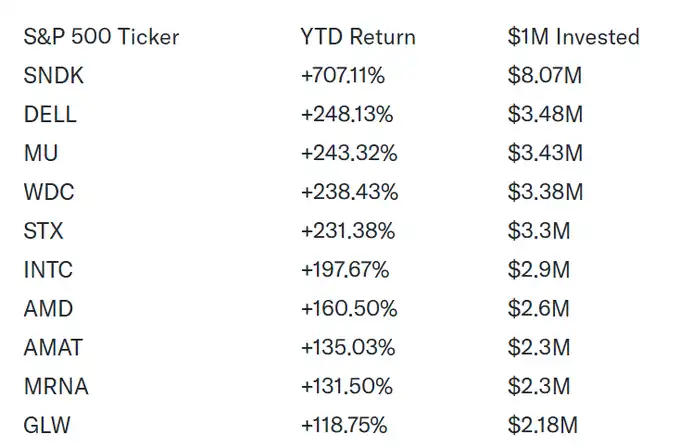
According to Stocktwits, putting $1 million into each of the 10 best-performing S&P 500 stocks this year would have produced about $34 million in total gains. That still comes in at less than one-third of the newsletter’s theoretical revenue figure.
300,044 subscribers in 231 days
In a post titled 「Short & Thankful: 300」, Burry said Cassandra Unchained had reached 300,044 subscribers and 346,680 followers. He said subscribers came from all 50 U.S. states and 212 countries, with 52% located outside the United States.
The growth trend has been steady. The newsletter had roughly 218,000 followers in January and nearly 347,000 by July.
Cassandra Unchained is priced at $39 a month or $379 a year, and it also has a free tier. Burry has not disclosed what share of readers are paying subscribers. Substack’s subscriber count includes both free and paid readers, and the headline calculation does not account for platform fees, so the $113.7 million figure is a theoretical ceiling rather than actual take-home income.
Burry launched the newsletter in November 2025, shortly after deregistering his hedge fund with the SEC, returning to social media, and resuming his criticism of the AI boom. The publication drew more than 60,000 subscribers at launch and later became his main channel for real-time portfolio updates, valuation analysis, and detailed trade records.
Long book: PayPal, Lululemon, Alibaba and JD.com
Burry has continued to disclose specific trades through the newsletter.
In April, he made his first large public portfolio disclosure, opening a PayPal Holdings (PYPL) position at about $49 with a 3.5% portfolio weight. He called it his top pick in software and payments, ahead of Fiserv (FI) and Adobe (ADBE). He later added to PayPal around $45 and bought Fiserv at the same time.
That month, he also initiated positions in Adobe, Autodesk (ADSK), and Veeva Systems (VEEV), arguing that 「fear of AI disruption has pushed software valuations below intrinsic value.」
Also in April, Burry reiterated his confidence in Molina Healthcare (MOH), saying expectations had 「fallen to rock bottom」 and that he would keep adding because the thesis was built on normalized earnings over the next several years.
In June, he turned to Lululemon Athletica (LULU) and added repeatedly. He wrote, 「Bad management is a value investor’s best friend.」 His view was that Wall Street had become too focused on management missteps, tariffs, and slowing growth while overlooking long-term value.
On China-related holdings, Burry disclosed in April that he owned more than 6% of Alibaba and had continued buying JD.com (JD). Last week, he said JD had become one of his top three holdings and wrote that 「as enthusiasm for AI and memory chips fades, capital will rotate into Hong Kong and Chinese stocks.」
Short book: Nvidia, Micron, Palantir and semiconductors
At the same time, Burry has been expanding his bearish exposure to AI and semiconductor names.
In April, he disclosed additional Nvidia (NVDA) put options, including January 2027 contracts with a $115 strike, while keeping earlier $100 puts. On June 30, he escalated that trade into a direct short position in Nvidia at $198.09.
The same update also showed new shorts in Applied Materials (AMAT), the iShares Semiconductor ETF (SOXX), Tesla (TSLA), and Caterpillar (CAT). He compared the current semiconductor boom to the dot-com bubble.
Burry wrote, 「The direct trigger for today’s rally was South Korea’s announcement of large-scale spending. I think this is the beginning of the end.」
Earlier this month, he disclosed a direct short in Micron Technology (MU), saying the memory-chip maker’s deviation from its 200-day moving average had exceeded every prior point since 1984.
He has also kept a close-watched short in Palantir Technologies (PLTR) since first disclosing it in November last year. Although he partially trimmed the position, he said again in June that there were still 「no signs of seller capitulation or exhaustion.」
Market moves have gone against the shorts
So far, the market has not backed Burry’s bearish calls on these names.
This year, many of the stocks he is short have outperformed the broader market. The SPDR S&P 500 ETF Trust (SPY) is up 22% year to date and the Invesco QQQ Trust (QQQ) is up 31%. Nvidia has gained 29%, Applied Materials has risen 206%, and Micron has surged 697%.
Those moves imply substantial mark-to-market pressure on the short book. That is why the scale of Cassandra Unchained’s theoretical revenue has drawn so much attention: while Burry’s trading positions have been under strain, the newsletter may have become one of his biggest sources of income this year.