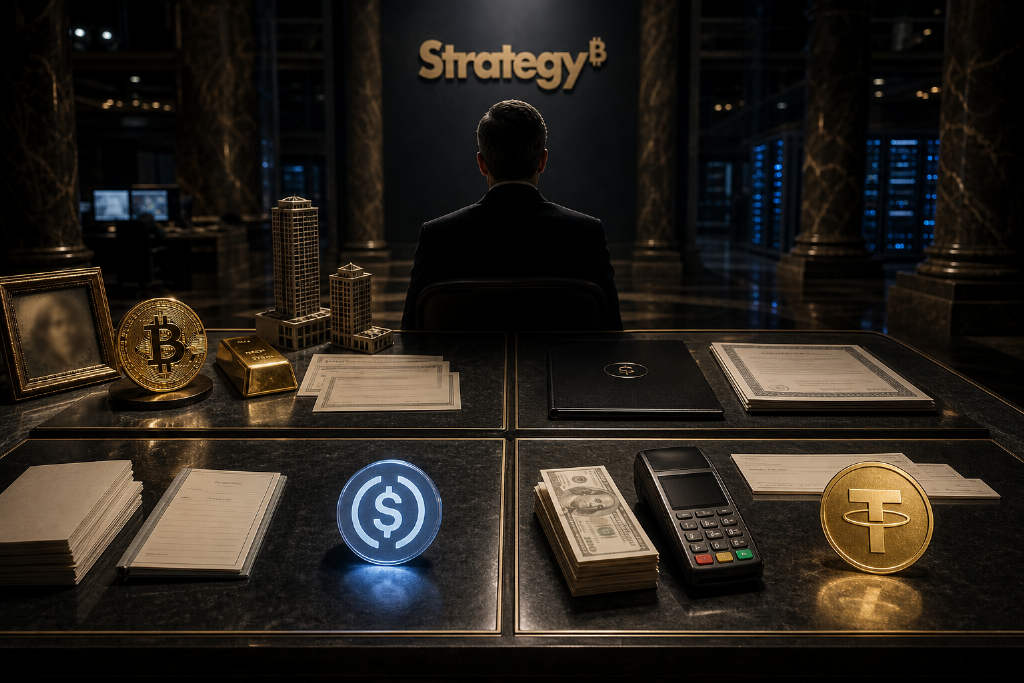
Strategy founder Michael Saylor said digital assets are not competing in a single category but across four distinct markets, which he described as a new financial architecture taking aim at traditional finance. In his framework, Bitcoin represents digital capital and competes for wealth against stocks, real estate, gold and art. STRC stands for digital credit and competes for income against bonds and private credit. Digital currency competes for savings against money market funds and Treasuries, while digital money competes for payments against cash and bank deposits. Saylor also referred to his previously outlined “monetary spectrum” for digital assets, classifying Bitcoin as digital capital, STRC as digital credit, SR-strcUSX as digital currency and USDT as digital money. He said volatility and return potential decline from left to right on that spectrum, while stability and transaction utility increase.
On Aug. 14, Strategy founder Michael Saylor said digital assets are competing across four separate markets, not as a single market but as what he described as a new financial architecture challenging traditional finance, or TradFi.
In Saylor’s breakdown, digital capital represented by BTC competes for wealth against stocks, real estate, gold and art. Digital credit represented by STRC competes for income against bonds and private credit. Digital currency competes for savings against money market funds and Treasuries. Digital money competes for payments against cash and bank deposits.
Saylor also said he had outlined the idea of a digital asset “monetary spectrum” in a post published a day earlier. In that framework, he classified Bitcoin as digital capital, STRC as digital credit, SR-strcUSX as digital currency and USDT as digital money.
According to Saylor, volatility and return potential gradually decline from left to right on that spectrum, while stability and transaction utility gradually increase. He described Bitcoin as the ultimate store of value — volatile, high-energy and sound bearer money — while USDT was described as the ultimate medium of exchange, stable and easy to transact with. Digital credit and digital currency, he said, serve as a bridge between capital and money.
This article was originally published by Bit.Fan. For more cryptocurrency news and market insights, visit www.bit.fan. Disclaimer:
The market information, project data, and third-party content displayed on this platform are for industry information sharing only and do not constitute any form of investment advice or return commitment.
Cryptocurrency trading carries high risks. Users should fully assess their risk tolerance and make independent decisions. All profits, losses, and legal responsibilities are borne by the users themselves.