
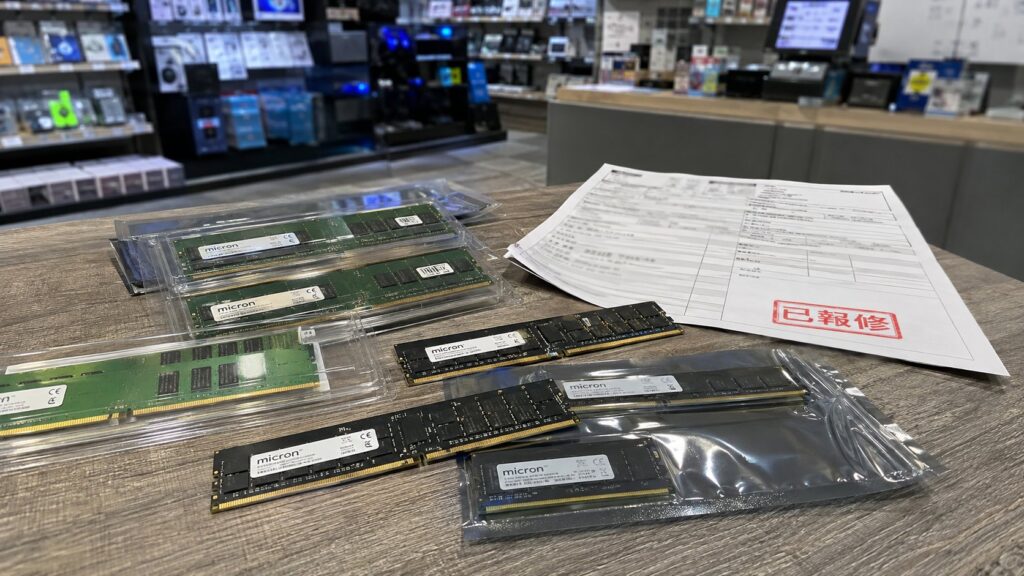
A Reddit user said on Aug. 5 that Micron refused to provide a replacement for a 48GB Crucial DDR5 memory kit submitted under the brand’s lifetime warranty, offering only a refund of the original purchase price: $241.86, including applicable taxes. The notice, as described in the post, said replacement products were no longer available for warranty claims because Crucial had shut down its consumer business earlier this year and the remaining inventory had sold out.
The user said an equivalent kit now costs about $1,400, which would put the refund at roughly 17% of current market value, leaving a gap of $1,158. He also said only one stick in the kit had failed, but the warranty process required the full kit to be returned, so he sent back the second stick as well even though it was still working. He added that he paid shipping both ways.
According to the post, Micron had initially proposed sending three CP16G64C32U5B modules as a replacement, with the same capacity and better speed, before later switching to a cash buyout of $241.86. The case spread through PC-building communities, and Gamers Nexus founder Steve Burke said in the comment section that he wanted to report on it and had contacted the user.
The dispute is about replacement cost, not the refund math
The article says the problem is not that $241.86 was calculated incorrectly. The issue is that the number reflects what the buyer paid in the past, not what it would cost to purchase comparable hardware now.
The poster said a similar 48GB DDR5 kit currently sells for about $1,400. The article points to broader memory-market inflation rather than treating the case as an isolated mismatch. Framework’s 48GB memory upgrade option was priced at $250 in June 2025 and $620 in December 2025, a 148% increase in six months. Gartner projected memory costs would rise 130% in 2026, with DDR5 up 110% in the first quarter of this year. TrendForce estimated that AI-related applications would consume about one-fifth of global DRAM wafer capacity in 2026.
In that context, the report says $241.86 is roughly in line with what a 48GB kit may have cost in mid-2025. Under normal pricing conditions, the original purchase price and replacement cost might not diverge much. In this market, the gap has widened to nearly six times.
Crucial’s warranty terms appear to favor the company
Commenters in the thread pulled up the wording of Crucial’s warranty policy. As cited in the article, Micron CPG may choose to repair the product, replace it, offer in-store credit, or refund the lower of the original purchase price and fair market value.
That phrase — the lower of the two — sits at the center of the dispute. The terms gave the company discretion from the outset and tied any refund to the lower number. The article also says some users with years of RMA experience described this wording as standard industry practice rather than something unique to Micron.
That is why the report frames the episode less as a company refusing to honor its warranty and more as a case where a warranty clause that already favored the manufacturer collided with an unusually sharp rise in memory prices. When Micron announced in December 2025 that it was exiting Crucial’s consumer business, the company said products already sold would continue to receive warranty and after-sales support under the original terms. Eight months later, those terms are still being applied, but in the form least favorable to customers.
The user rejected the refund and asked for hardware back or another settlement
The article says some commenters suggested asking Micron to return the originally submitted hardware. Even if that required the customer to pay shipping, it could still be better than ending up with no memory at all.
The user has formally rejected the refund, according to the report, and asked Micron either to return the physical hardware, provide equivalent Micron enterprise-grade DDR5, or offer a settlement amount that is closer to current replacement cost. He is waiting for a callback from customer support.
What the report says Taiwan consumers should watch
The article says Micron’s shipment deadline for exiting consumer channels falls in February 2026. After that, Samsung and SK hynix would effectively be the only two major suppliers left in the consumer memory market. For consumers in Taiwan still holding Crucial memory or SSD products, the report says similar cases may not be rare in future warranty claims because depleted inventory will not be replenished, leaving refunds as the likely remedy, based on historical purchase prices.
Its practical advice is to confirm first whether the warranty is handled by the manufacturer or by a local distributor in Taiwan, because the point of contact and the target for any claim are not the same. It also suggests asking in advance whether a no-stock situation would lead to a refund or a return of the original item before sending in working modules together with faulty ones.
The article also notes that Micron has recently been in Taiwan headlines for another reason: reports that the Micron union in Taiwan was considering strike action over bonuses and the cap on profit-sharing.
Two questions raised in the report
Is Crucial’s lifetime warranty still valid?
According to the article, yes, the warranty itself remains in place. In practice, though, Micron can no longer provide replacement products because Crucial’s consumer business has been shut and inventory has run out. Under the stated terms, the company may refund the lower of the original purchase price and fair market value, which means reimbursement can fall far short of replacement cost during a price spike.
What can customers do before filing a claim?
The report says buyers should confirm whether the warranty is handled by the original manufacturer or a Taiwan distributor, and ask in advance what happens if there is no stock: refund or return of the original item. If the rules require the full kit to be sent back, including working modules, that tradeoff should be weighed before proceeding.