
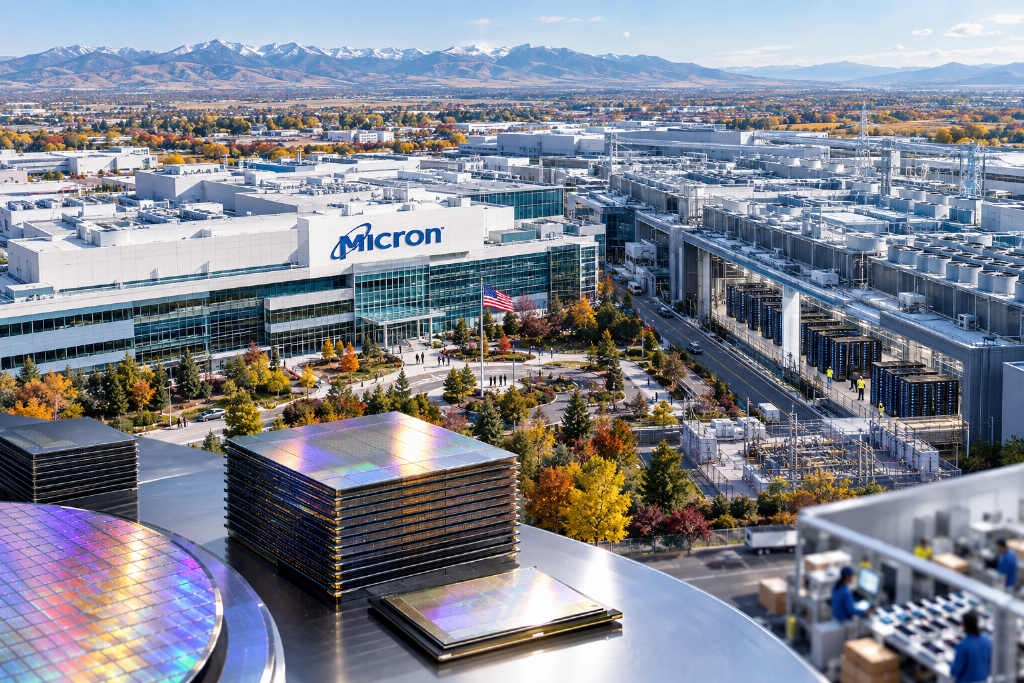
Micron Technology reported quarterly results and issued first-quarter guidance that both came in well above market expectations, according to ABMedia. The company said revenue for the first quarter of fiscal 2027 ending in November is expected to reach about $61.5 billion, with earnings per share of about $38.15. Analyst averages cited in the report were $56.8 billion in revenue and $36.02 per share.
For the fourth quarter of fiscal 2026 ended Sept. 3, Micron posted revenue of $54.2 billion and earnings per share of $33.42, ahead of market estimates of $51.5 billion and $31.83. Adjusted gross margin rose to 87%, above the expected 86.2%.
AI data center buildout lifts HBM demand
The report said the broad rollout of artificial intelligence technology has increased hardware demand for AI data centers, making high-bandwidth memory, or HBM, a key component. Micron, Samsung Electronics and SK Hynix have all benefited from rising memory prices, with orders remaining strong.
As high-end memory capacity is being absorbed by AI demand, the market is seeing a structural supply shortage. That has pushed up pricing for related products and also affected memory component supply for consumer electronics such as laptops and gaming consoles, the report said.
Guidance and recent quarter both beat expectations
For the first quarter of fiscal 2027, Micron also projected gross margin of about 86.3%. ABMedia said that points to pricing strength in memory products at a time when costs have not risen in the same way.
Micron shares (MU) rose about 2% in after-hours trading following the earnings release. The stock has gained 273% this year, making it the top-performing component in the Philadelphia Semiconductor Index.
Cycle risk and long-term contracts
The memory chip business has long been marked by pronounced boom-and-bust cycles. To reduce the impact of sharp market swings, Micron and its peers are actively signing long-term contracts with customers to lock in supply and demand terms, the report said.
Micron is still planning capacity expansion at its headquarters, but near-term supply remains tight. Under those conditions, market pricing is expected to stay elevated, with attention shifting from the strength of demand to how long the current high-price cycle can last.