
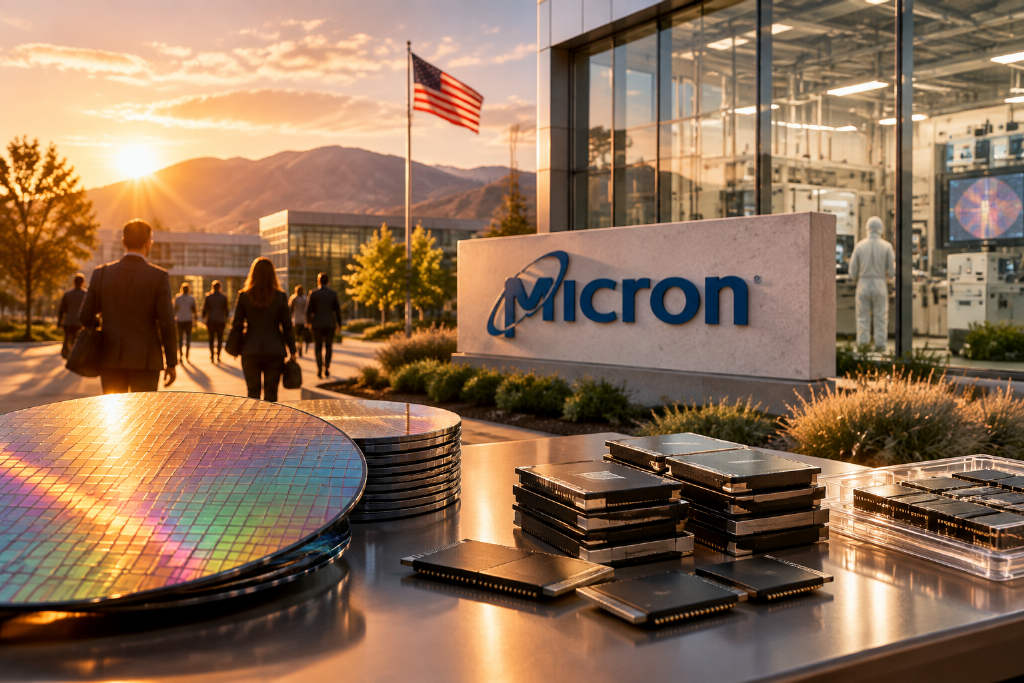
Micron Technology (Nasdaq: MU) will report fiscal fourth-quarter 2026 results after the U.S. market closes on Sept. 30. The market is no longer focused on whether the company can hit the quarter. The real question is how much longer this HBM-driven growth curve can keep extending.
Over the past four quarters, Micron’s quarterly revenue has climbed from $13.6 billion to $41.5 billion, while non-GAAP gross margin has risen from below 40% to 84.9%. The company’s own guidance for the fourth quarter calls for revenue of about $50 billion, plus or minus $1 billion. At this point, investors are not really pricing the current quarter’s profit. They are trying to figure out when the slope starts to flatten.
The answer sits largely with HBM. High-bandwidth memory is not just a more expensive form of DRAM. On the manufacturing side, it consumes several times more wafer capacity for a limited amount of bit output, making it both a margin amplifier for Micron and a shortage amplifier for the memory industry. Micron has also locked about 20% of its DRAM output and roughly one-third of its NAND output into five-year strategic customer agreements. That is why the most important parts of this earnings release are likely to be capacity, pricing bands, and the fiscal 2027 supply roadmap, not whether earnings per share beat consensus by a few cents.
A record quarter also created a very high comparison base
According to Micron’s fiscal third-quarter 2026 earnings release, revenue reached $41.456 billion, up 74% sequentially and 346% from a year earlier. GAAP net income was $28.243 billion, diluted EPS was $24.67, and non-GAAP EPS came in at $25.11. Operating cash flow was $25.39 billion. Net capex was $7.1 billion, and adjusted free cash flow hit $18.3 billion, a quarterly record for the company.
At the product level, management said in its prepared remarks that DRAM revenue was $31.3 billion, or 76% of total revenue. Bit shipments rose only by a low-single-digit percentage from the prior quarter, while pricing increased by a little more than 60% sequentially. NAND revenue was $9.9 billion, with bit shipments up by a mid-single-digit percentage and pricing up about 85% sequentially. The structure matters. The revenue surge came almost entirely from price, not volume.
By business line, cloud memory revenue was $13.769 billion with an 83% gross margin. Core data center revenue was $11.524 billion with an 87% gross margin. Mobile and client revenue was $11.521 billion with an 87% gross margin. Automotive and embedded revenue was $4.634 billion with a 79% gross margin. All four business lines moved to margin levels around 80%, something the memory industry has not seen before.
The balance sheet improved at the same time. Micron ended the quarter with $30.2 billion in cash and investments, $5.7 billion in debt, and $24.4 billion in net cash. Inventory stood at $8.6 billion, or 120 days, with DRAM inventory days below that level. In its third-quarter 10-Q, the company also disclosed that cost of goods sold was only 15% of revenue, down from 62% a year earlier.
Fourth-quarter guidance already points to slower pricing momentum
Micron guided for fourth-quarter revenue of $50 billion, plus or minus $1 billion, non-GAAP gross margin of about 86%, operating expenses of roughly $1.65 billion, and non-GAAP EPS of $31.00, plus or minus $1.00, based on about 1.15 billion diluted shares.
Sell-side expectations are slightly above the midpoint. Alphastreet’s compilation of 33 analysts shows consensus at $31.56 in EPS and $51.2 billion in revenue, with estimates ranging from $28.04 to $37.44 per share. The spread is wide.
The line that matters most is management’s qualifier in the prepared remarks: the fourth-quarter gross margin outlook already reflects a meaningful slowdown in the pace of price increases. In other words, 86% is not evidence of renewed acceleration. It is the result after deceleration has already been factored in. If actual gross margin comes in well above 86%, that would suggest stronger price transmission than the company expected. If it only matches the guide, then next quarter’s outlook will carry more weight than the reported number itself.
Why HBM is the core variable in this report
HBM is not the same as conventional DRAM
From an investment perspective, treating HBM as nothing more than higher-priced memory leads to the wrong conclusion. Standard DDR5 or LPDDR5X is a planar single-chip product with mature manufacturing, high yields, and fast turns. HBM is built by vertically stacking multiple DRAM dies through through-silicon vias, then packaging them together with a logic base die into a module that sits with the accelerator on an interposer.
That process adds through-silicon-via etching, ultra-thin wafer thinning, multi-layer bonding, and high-precision packaging. Each step introduces another point where yield can slip.
The technology curve is still getting steeper. Micron said HBM4, built on its 1-beta process, has entered high-volume shipments for major customer platforms. The ramp speed for 12-high HBM4 is about twice that of 12-high HBM3E, and cumulative HBM4 revenue has already exceeded $1 billion. HBM4E, based on the 1-gamma process, is under development and is expected to enter volume production in 2027. Every generation adds more layers, more speed, and more pressure on stacking and thermal design.
Why HBM consumes more wafer capacity
This is where the wafer trade ratio becomes important. The wafer area required to produce a unit of HBM bits is far higher than what is needed for the same amount of conventional DRAM bits. According to MarketBeat’s report on Micron management’s public comments, Chief Financial Officer Mark Murphy said the ratio in the HBM3 era was roughly 3-to-1, and that it would continue to rise as the industry moves to HBM4, HBM4E, and HBM5. In Micron’s third-quarter prepared remarks, the company also listed HBM growth and the rising trade ratio across generations as structural factors squeezing non-HBM supply.
Once that mechanism is placed into an industry model, the conclusion is straightforward. With cleanroom space fixed, every additional HBM wafer means fewer wafers for DDR5, LPDDR5X, or server RDIMMs. The stronger AI demand gets, the more capacity HBM absorbs, and the fewer bits remain for PCs, smartphones, and traditional servers. Prices for those products then move higher as a consequence. That is why this memory upcycle is not limited to AI-linked products. It is spreading across categories.
Micron also said NAND supply growth is constrained by manufacturers shifting cleanroom space from NAND to DRAM, on top of the broader limit on total cleanroom area.
How accelerator demand flows into memory demand
The upstream demand chain is fairly clear. Nvidia’s fiscal second-quarter 2027 results showed revenue of $96.2 billion for the quarter ended July 26, with data center revenue at $89.0 billion, up 117% from a year earlier. The company guided next-quarter revenue to $108.0 billion, plus or minus 2%, and said Vera Rubin had entered full production. Every accelerator needs HBM stacks. Growth in accelerator shipments translates into HBM demand in a nearly linear way, and each new platform often raises HBM capacity and bandwidth requirements per system.
AI is not lifting memory demand only through HBM. Micron said agentic AI is expanding data center infrastructure from accelerator-only racks to CPU racks that handle control-plane and program execution tasks, as well as storage racks that carry rapidly growing context storage. The company therefore raised its 2026 industry server shipment growth forecast to a high-double-digit percentage from a previous low-double-digit view. It also said part of that increase comes with a slight reduction in average DRAM capacity per server, because customers are prioritizing total system shipments under extremely tight memory allocations.
In the third quarter, Micron’s data center revenue exceeded $25 billion, implying an annualized run rate above $100 billion. Data center SSD revenue topped $5 billion and more than doubled sequentially.
Competition also matters. According to SK Hynix’s filing with the U.S. Securities and Exchange Commission, citing IDC data, the company held a 56.4% revenue share in the HBM market in the first quarter of 2026 and a 29.1% share in the broader DRAM market including HBM. The pace at which SK Hynix and Samsung Electronics move through the HBM4 generation will directly affect Micron’s room to gain share and its pricing power.
Where the pricing cycle stands and how long margins can hold
Contract price increases are narrowing
Price has been the main source of earnings elasticity in this cycle, which makes the second derivative of pricing more important than the absolute level. In its third-quarter 2026 memory pricing survey, TrendForce said conventional DRAM contract prices were expected to rise 13% to 18% sequentially, while NAND contract prices were expected to rise 10% to 15%. That was a clear slowdown from prior quarters, driven by consumer customers in PCs and smartphones nearing the limit of what they can absorb, while the comparison base has also moved higher.
In its fourth-quarter pricing outlook, TrendForce said demand from cloud service providers should continue to support DRAM and NAND prices, but the shift in capacity toward servers and HBM will keep pressure on consumer applications, leading to diverging price trends across end markets.
Aligned with Micron’s fiscal calendar, the framework is fairly clean: the previous quarter likely marked something close to the peak rate of price increases in this cycle, the fourth quarter enters a deceleration phase, and the first half of fiscal 2027 will depend on whether pricing can remain positive. Slower price increases do not mean falling prices. For a company already running at an 86% gross margin, the difference is enormous.
Strategic customer agreements put in a floor and a ceiling
Micron disclosed 16 strategic customer agreements last quarter, and they are central to understanding the future shape of margins. The prepared remarks said these agreements are generally five-year contracts covering calendar 2026 through the end of calendar 2030, while automotive customer agreements are usually three years. Together, the 16 agreements cover about 20% of Micron’s DRAM output and roughly one-third of its NAND output, including four hyperscale customers and three mid-sized customers. The structure is take-or-pay, with binding purchase commitments for specified volumes.
The pricing design is especially important. The largest agreements generally set a price ceiling for existing products based on market prices in the second quarter of calendar 2026, while also establishing a price floor over the life of the contract. Some agreements use fixed pricing or no price band at all. Micron expects that once all planned agreements are signed, the portion of revenue under fixed prices or price ceilings near current levels will account for about 40% of total revenue.
Management also said the price floors in agreements with pricing bands are sufficient to support gross margins “well above any prior cycle peak quarter.”
That cuts in two directions. On the downside, a meaningful portion of revenue will not fall below the contract floor even if the industry turns down, lifting the earnings trough. On the upside, if spot and contract markets continue to rise sharply, the revenue tied to price ceilings cannot fully participate, which lowers the earnings peak.
For financial modeling, that means Micron’s profit curve is moving away from the classic memory-cycle pattern and toward a structure constrained by pricing bands. The company began disclosing remaining performance obligations in the quarter ended in May. That figure stood at more than $5 billion at quarter-end, while the signed agreements represented about $100 billion in remaining performance obligations. Micron also expects to receive about $22 billion in customer deposits and related financial commitments, including about $18 billion in cash deposits.
The company also cautioned that remaining performance obligations are calculated using minimum committed volumes and minimum prices, which makes the figure conservative and not a direct revenue forecast.
Capacity is the only cure, but it does not arrive until 2027
The mix of capex matters more than the amount
Micron guided fourth-quarter capex to about $10 billion and full-year fiscal 2026 capex to about $27 billion, net of expected government incentives. For fiscal 2027, the company said quarterly capex will be above the fourth-quarter level, and more than half of the year-over-year increase will come from construction capex used to pull forward cleanroom capacity. On operating expenses, Micron expects an increase of about $1 billion in fiscal 2027, mainly for research and development, with the increase weighted toward the second half.
Construction-heavy capex is often misread as a sign that expansion means the cycle is peaking. The actual implication is the opposite. Money spent on buildings and cleanrooms does not turn into bit supply over the next few quarters. Construction cycles usually take two to three years. In the near term, that spending only weighs on free cash flow. It does not relieve shortages. The medium-term supply balance changes only when equipment spending and process transitions start producing more bits.
The timeline for new capacity
The prepared remarks laid out specific milestones. Idaho’s ID1 fab is expected to begin wafer output in mid-2027, while ID2 is expected by the end of 2028. The first fab in Micron’s New York manufacturing cluster broke ground in January 2026.
At the newly acquired Tongluo site in Taiwan, the existing 300,000-square-foot fab is expected to reach meaningful product shipments in mid-2027, about one quarter earlier than previously expected. Micron has also started building a second cleanroom of similar scale there, designed to support extreme ultraviolet lithography tools.
In Manassas, Virginia, the company has started initial volume production wafers for 1-alpha DDR4 to support legacy demand from automotive, industrial, medical, aerospace, and defense customers. Micron also signed a multi-year extreme ultraviolet lithography equipment supply agreement with ASML to support the 1-delta node and later generations. On the packaging side, the Singapore site will become another advanced packaging center of excellence after Taiwan, and is expected to make a meaningful contribution to HBM packaging capacity starting in the first half of 2027.
The broader industry view is just as important. Micron expects industry DRAM bit shipment growth in calendar 2026 to be in the low-20% to mid-20% range, with NAND around 20%. The company said its own DRAM supply growth should be broadly in line with the industry, while NAND supply growth should be slightly below the industry. On supply-demand balance, management said tightness is likely to persist beyond calendar 2027. It expects industry supply to improve gradually in 2028, but still does not see a clear point when supply catches up with demand. The reasons include long global fab construction cycles, shortages of skilled technical labor, complex approval processes, and the need for supporting energy infrastructure.
Valuation, technical levels, and the real risk around earnings night
Cheap or expensive depends on which year’s earnings you use
If Micron’s reported non-GAAP EPS is added across fiscal 2026, using $4.78 in the first quarter, $12.20 in the second, $25.11 in the third, and the midpoint of $31.00 for the fourth-quarter guide, full-year EPS comes to about $73. At the Sept. 28 closing price of $1,053.29, that implies a price-to-earnings ratio of roughly 14 times for the current fiscal year.
That multiple is very low relative to Philadelphia Semiconductor Index constituents, but memory stocks have a long history of showing their lowest P/E ratios near the top of the cycle because the denominator is at its peak.
That is also where the disagreement starts. The Motley Fool, citing 57 analysts, put the median 12-month target price at $1,600. Stockanalysis.com, based on 49 analysts, showed an average target of $1,515, with the overall rating at strong buy. The bullish case is that strategic customer agreements and their price floors mean earnings in fiscal 2027 and 2028 no longer fit the traditional cycle template, so 14 times earnings should not be read as a cycle-top signal. The bearish reply is that price ceilings limit upside elasticity, while new capacity after 2027 will eventually arrive.
Key levels and positioning risk
Technically, Micron shares are up nearly 280% this year. According to TradingKey market tracking, the stock rebounded about 17% from a low near $926 on Sept. 16, closed at $1,082.28 on Sept. 25, and moved above the Sept. 9 high of $1,042. Robinhood’s quote page showed a Sept. 28 close of $1,053.29, with a 52-week range of $155.18 to $1,255.00.
That source also said near-term resistance sits around $1,120. If the stock can hold above that level, it could open a path toward $1,200 and potentially a retest of the prior high at $1,255.
For traders, this setup leaves the risk-reward around earnings looking uneven. Consensus expectations are already elevated, the stock is not far from its record high, and the options market is pricing in a move close to a double-digit percentage for the event. In that kind of setup, position size and entry timing matter more than directional conviction.
The original article also noted that for investors who want to express a view during the earnings window without opening an overseas brokerage account, MEXC offers two routes: USDT-settled stock contracts and tokenized U.S. equities, which differ in rights, trading hours, and risk characteristics.
The three numbers that matter more than the headline EPS
First is guidance for fiscal first-quarter 2027. Revenue and gross margin guidance will show the actual slope of pricing deceleration. If gross margin stays flat or slips modestly into an 84% to 86% range, that would be consistent with management’s earlier description of a normal slowdown. If it falls clearly below 84%, that would suggest the drag from price ceilings is showing up earlier than expected.
Second is the amount and composition of capex. The company has only said that quarterly capex in fiscal 2027 will be above the fourth-quarter level. If full-year fiscal 2027 guidance comes in well above $40 billion and equipment spending takes a larger share, that would imply Micron is leaning harder into supply additions for 2028 and beyond, potentially pulling forward the medium-term balance point.
Third is progress on strategic customer agreements. Micron said that once all planned agreements are completed, about half or more of company revenue is expected to fall under such contracts. Updates on the number of agreements, the share of revenue covered, and the scale of customer deposits will be direct signals for whether the market can reprice the stability of earnings.
Three categories of risk remain in focus
The first is pricing risk. TrendForce has already observed that consumer customers are nearing the limit of what they can absorb. If PC and smartphone makers respond with lower specifications, delayed purchases, or even production cuts, non-HBM demand could soften before AI demand does. That matters because non-HBM products still account for a meaningful share of Micron’s high-margin revenue.
The second is execution risk, centered on HBM4 and HBM4E. Higher layer counts and faster speeds can magnify yield volatility, and packaging ramps carry their own uncertainty. If customer qualification slips, Micron’s market share and pricing power could be affected, especially with SK Hynix still leading the HBM market.
The third is cycle risk, which is mostly about timing. Micron itself expects industry supply to improve gradually in 2028, while several new fabs begin contributing after mid-2027. In memory history, the overlap between concentrated supply additions and slowing demand growth is often where price inflections appear. Strategic customer agreements can lift the floor, but they cannot erase the cycle.
James Mitchell’s view: do not read the 86% gross margin guide as a simple bullish confirmation
In James Mitchell’s view, the easiest mistake in this earnings setup is to treat the 86% gross margin guide as a straightforward bullish confirmation while ignoring the qualifier management wrote into the same document: the outlook already reflects a meaningful slowdown in the pace of price increases.
In the prior quarter, DRAM bit shipments rose only by a low-single-digit percentage sequentially, while pricing increased by a little more than 60%. Revenue elasticity came almost entirely from price. For any earnings curve driven mainly by price, the second derivative tends to send the signal before the first derivative does. That is why the real information density in this report is not in the current quarter’s headline figures, but in the pricing slope implied by fiscal first-quarter 2027 gross margin guidance.
Mitchell also argued that the market may be misreading the nature of Micron’s strategic customer agreements. They are widely seen as purely positive, but in practice they represent a symmetrical exchange of risk. The price floors do raise the earnings trough to what management described as a level “well above any prior cycle peak quarter,” which is a structural change for the memory industry. But if roughly 40% of revenue ends up under fixed prices or price ceilings near current levels, that portion cannot fully participate if spot prices keep rising.
Put differently, Micron is giving up part of its upside elasticity in exchange for lower earnings volatility. For long-term investors looking for a valuation rerating, that may be a favorable trade. For traders betting on an extreme cycle peak, it means peak earnings could come in below what a pure price extrapolation model would suggest.
Mitchell said the variable worth tracking next is the relative contribution of bit shipment growth versus price increases. When bit growth contributes more than price to revenue growth, capacity release has likely started and the cycle is moving into its later stage. As long as price remains the main driver, the shortage has not been resolved.
Related indicators include inventory days, which stood at 120 at the end of the last quarter, with DRAM below that level. If that metric rises for two consecutive quarters, it could become early evidence of a turn in supply and demand. Another point to watch is the split between equipment spending and construction spending in capex, because construction spending turns into capacity only after two to three years, while equipment spending can translate into bit growth within a few quarters.
From a cross-asset perspective, the implications go beyond Micron. If memory shifts from a commodity product to a strategic resource constrained by contracts, the cost structure across the AI infrastructure chain changes with it. Accelerator makers face higher bill-of-materials costs. Cloud providers face higher unit compute costs. Device makers face a larger memory share in their bill of materials. That also helps explain why this round of price increases has spilled over into PC and smartphone pricing.
It is also worth noting that the current AI hardware profit pool, driven by pricing, still needs to be validated by downstream AI application revenue. Until that full chain is proven out, unusually high profitability in any single link should still be viewed as a point in the cycle, not a new steady state.
Frequently asked questions
When will Micron report fiscal fourth-quarter results?
Micron will release fiscal fourth-quarter 2026 results after the U.S. market closes on Sept. 30, 2026, and will hold its analyst call the same day. The company previously guided for revenue of $50 billion, plus or minus $1 billion, non-GAAP gross margin of about 86%, and non-GAAP EPS of $31.00, plus or minus $1.00. Market consensus is slightly above the midpoint, at about $51.2 billion in revenue and $31.56 in EPS.
What is the difference between HBM and conventional DRAM?
Conventional DRAM is a planar single-chip product with mature manufacturing and high yields. HBM vertically stacks multiple DRAM dies through through-silicon vias, then packages them with a logic base die so the module can sit with an accelerator on an interposer. That adds thinning, bonding, and high-precision packaging steps. The result is higher pricing and higher gross margin, but also much higher wafer consumption per bit.
Why does HBM push up prices for ordinary memory too?
Because cleanroom space is limited. Micron management has said the wafer trade ratio in the HBM3 generation was roughly 3-to-1, and that it will continue to rise in HBM4 and later generations. With total capacity fixed, every additional HBM wafer means fewer wafers for conventional DRAM. The stronger AI demand gets, the more supply is squeezed out of server, PC, and smartphone memory, which pushes those prices higher as well.
Can Micron’s gross margin keep rising?
Non-GAAP gross margin was 84.9% last quarter, and the company guided to about 86% for the fourth quarter, while also saying the outlook already reflects a meaningful slowdown in pricing momentum. TrendForce expects conventional DRAM contract price increases in the third quarter of 2026 to narrow to 13% to 18% sequentially. A more reasonable expectation is for gross margin to fluctuate at a high level rather than keep climbing in a straight line, with the next quarter’s outlook carrying the stronger signal.
What do strategic customer agreements mean for Micron?
The 16 signed agreements are generally five-year contracts covering about 20% of DRAM output and roughly one-third of NAND output under take-or-pay terms. Fourteen of them correspond to about $100 billion in minimum-price contract revenue. The agreements set price floors and, for some products, price ceilings. That raises the earnings floor and reduces volatility, but it also limits revenue elasticity if prices continue to move sharply higher.
When can new Micron capacity ease the shortage?
The main milestones are concentrated after 2027 begins. Idaho ID1 is expected to start wafer output in mid-2027, with ID2 by the end of 2028. The Tongluo site in Taiwan is expected to reach meaningful shipments in mid-2027. Advanced packaging in Singapore is expected to begin making a meaningful contribution to HBM packaging capacity in the first half of 2027. Management expects tight supply-demand conditions to persist beyond calendar 2027, and while industry supply should improve gradually in 2028, it still does not see a clear point when supply catches up with demand.
What is the biggest risk around this earnings release?
The main risk comes more from positioning than from the underlying business. Micron shares are up nearly 280% this year, closed at $1,053.29 on Sept. 28, and are not far from the record high of $1,255. Consensus expectations have also moved above the company’s own guidance midpoint. In that setup, results that merely meet expectations may not be enough to push the stock higher, while any negative detail on slower pricing or HBM qualification progress could be magnified. The options market is pricing in a move close to a double-digit percentage for the event.
Should investors focus only on whether EPS beats expectations?
No. In the current pricing environment, an EPS beat is not especially hard to produce. What matters more are three things: the pricing slope implied by fiscal first-quarter 2027 revenue and gross margin guidance, the size and equipment mix of fiscal 2027 capex, and the coverage ratio and customer deposit progress tied to strategic customer agreements. Those three factors will say more about earnings durability than a single quarter’s accounting result.