
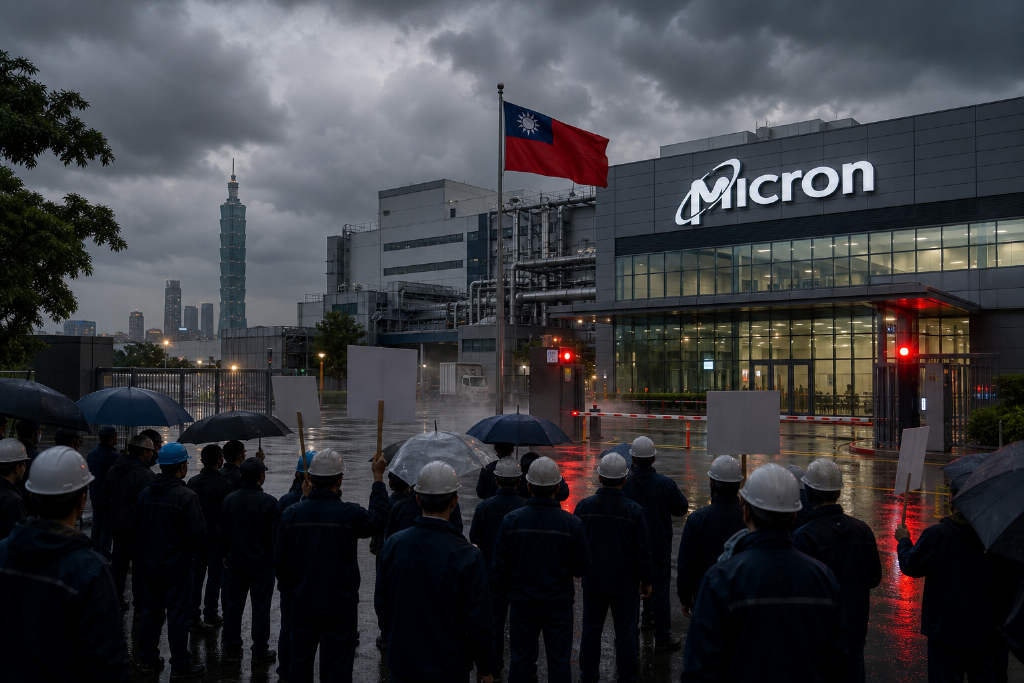
Labor tensions are rising at Micron Technology’s Taiwan operations, where two company unions have launched formal mediation over the current performance bonus system and could move to a strike vote as early as September if negotiations break down.
The two groups involved are the Micron Wafer (Taoyuan) Enterprise Union and the Micron Memory (Taichung) Enterprise Union. They say Micron’s existing Incentive Performance Pay, or IPP, is opaque and trails peer companies in payout levels. Mediation meetings have been scheduled for late August and mid-September. If both sessions fail, a strike vote could begin in September.
An initial internal poll cited by the unions shows about 80% of union members backing strike action. The two unions together represent about 10,000 members and have been holding briefing sessions to explain their objections to the current bonus structure.
Union says Micron profits have climbed, while compensation has not kept pace
Lin Zherui, chairman of the Micron Wafer Enterprise Union, said the company has delivered record operating performance and strong profits in recent years under the AI boom, while employee pay has risen only in a limited way. The union’s core complaint is not only the payout level, but also the lack of a clear profit-sharing formula inside the IPP system.
According to Lin, employees cannot determine how bonuses are calculated and cannot tell whether the payouts are linked to the company’s profit growth. He said the union is not simply asking for higher wages. Its demand is for a reasonable and verifiable profit-sharing mechanism, and it is calling on the company to show sincerity in negotiations.
Unions compare Micron with Samsung, SK hynix and Taiwan chipmakers
The unions have laid out comparison data from other semiconductor companies. They say Samsung’s DS semiconductor division allocates 10.5% of operating profit to employee bonuses, while SK hynix uses 10% of operating profit as the basis for distribution.
For Taiwan companies, the union data says Macronix allocates 15% of net profit after tax, while Taiwan Semiconductor Manufacturing Co. (TSMC) allocates 4.7%. Nanya Technology, Powerchip and Winbond are listed with standards of 6%, 5% and 2%, respectively.
Against that backdrop, the unions argue that Micron’s current performance-bonus payout appears to lag far behind its peers. Their proposal is to replace the current IPP arrangement with a profit-sharing system built on an explicit ratio, so employees receive returns that match periods of strong corporate earnings.
Mediation must come first under Taiwan labor dispute rules
According to Commercial Times, Taiwan’s Act for Settlement of Labor-Management Disputes requires mediation before a union can hold a strike vote in disputes over adjustment matters with an employer. If mediation fails, a strike vote can proceed only through a direct and secret ballot of all union members, and legal strike action requires approval from more than half of them.
The first mediation session is set for late August and the second for mid-September. If both fail, the unions could begin a strike vote in September. Lin said a strike is a last resort rather than the union’s preferred option. He also called on more Micron employees to join the unions to strengthen collective bargaining power. He said support for a strike has reached 80% so far.
South Korean memory-sector bonus changes have become a reference point
The report says the latest labor push in Taiwan has been shaped in part by compensation changes at South Korea’s two major memory makers. Last year, SK hynix announced the removal of its long-running cap on bonuses and adopted a new system based on distributing 10% of operating profit.
At the time, estimates cited in the report put SK hynix’s 2026 operating profit at about 250 trillion won, implying a company-wide bonus pool of as much as 25 trillion won. That would translate into performance bonuses of about 700 million won per employee on average, or roughly NT$15 million, according to the report.
That move also stirred Samsung Electronics employees. Their union pushed for a similar approach and went further by demanding a 15% operating-profit allocation. After repeated deadlocks in talks, the union had at one point planned a full strike in late May. The dispute was later resolved after emergency mediation by South Korea’s labor minister, ending in an agreement for a special 10-year performance bonus system for the semiconductor division, using 10.5% performance as the standard and distributing the bonus in stock.
ABMedia said the compensation changes at South Korea’s two major memory manufacturers have become the most direct benchmark for Micron Taiwan unions in the current dispute. As one of the three major memory makers, Micron employees are also seeking a share of the gains linked to the AI wave.