
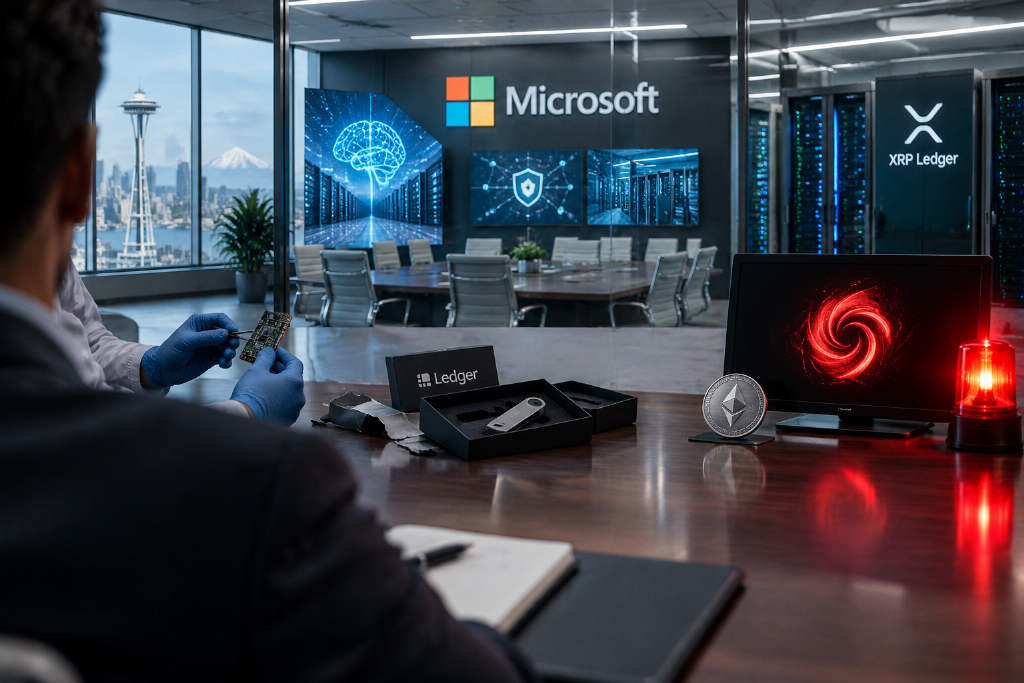
Policy, security, and market-structure stories dominated the latest round of crypto headlines from Oct. 11 to Oct. 12. Microsoft CEO Satya Nadella outlined a governance framework for superintelligence systems, the Ledger hardware-wallet supply-chain case kept widening, and the XRP Ledger Foundation moved to clarify questions around a recent security fix.
Microsoft CEO says superintelligence cannot rest on AI black boxes
Microsoft CEO Satya Nadella said in a post that the industry needs to rebuild its trust architecture for AI as superintelligence systems improve quickly. In his view, responsibility for actions taken by AI systems should not simply be pushed onto model providers.
Nadella said traditional software deployments over the past several decades generally allowed people to trace behavior back to specific code paths. Frontier AI models now exceed traditional software in capability, he wrote, but their outputs cannot be clearly attributed to a particular training-data source or a specific weight configuration.
That matters because companies are already giving complex AI agents access to sensitive data and the ability to carry out critical tasks. Nadella argued that superintelligence systems should not be treated as incomprehensible nested black boxes where users only choose whether to accept or reject a recommendation. What is needed instead, he said, are controllable systems that can observe behavior, test boundaries, and restrict actions at any time.
He laid out several governance principles for such systems:
- Model diversity, so that no single model becomes the sole dependency for critical decisions.
- Full observability, with all important AI actions leaving tamper-resistant, human-readable records.
- Continuous validation, including ongoing testing under failure, attack, and abnormal conditions.
- Independent control and audit, meaning a model should not both control system behavior and verify the evidence of that behavior itself.
- Risk isolation, built on the assumption that a model can fail and that the system must be pausable or shut down at any time.
- Incident disclosure, with timely explanations of causes and remediation steps after failures or security events.
Nadella also said chain-of-thought, or CoT, transparency is an important foundation for AI governance, but not enough on its own because reliable interpretability still cannot be guaranteed. The most trustworthy superintelligence systems in the future, he wrote, will not simply be the ones with the most trustworthy models. They will be systems that can still operate safely even when the model itself cannot be fully trusted.
Ledger-linked attacker moved 2,990.3 ETH into Tornado Cash
Addresses tied to the CryptoBilis Ledger hardware-wallet incident deposited 2,990.3 ETH into Tornado Cash between Oct. 9 and Oct. 10, worth about $7.45 million.
Monitoring data showed the attacker had first split the funds across 14 addresses, then used NEAR Intents to bridge the assets into the ZEC network, where additional privacy-preserving steps were taken.
Researchers said the transfer trail still showed signs of address linkage. Some withdrawal transactions reused wallet addresses that had previously been used for deposits. Other withdrawals were initiated by wallets linked to the wallet address that paid gas fees during the theft, giving investigators more clues to follow the money.
The funds have now been moved and obscured through multiple on-chain routes. CryptoBilis had previously been identified in connection with a Ledger hardware-wallet supply-chain security incident. Ledger said it had confirmed an unauthorized hardware implant in one affected user device and that it was working with relevant parties and law enforcement on the investigation.
Ledger had earlier warned users not to use devices bought through affected reseller channels if initialization had not yet been completed. Users who had already set up their devices were told they could consider moving assets to a new device secured with a new seed phrase.
Suspected Ledger supply-chain attack may have reached Europe
Security researcher Johannes disclosed that a user found an unauthorized hardware implant inside a wallet purchased from an official Ledger reseller in Europe several weeks after the purchase.
According to the disclosure, the device contained suspicious wiring not present in standard Ledger hardware, suggesting the wallet may have been physically tampered with before sale. The researcher said the implant appeared to use an earlier design, while newer implant components may be hidden behind the screen, making detection harder.
No theft has been reported from that device so far. The researcher said it remains unclear whether the implant malfunctioned or whether the attacker is still waiting until more user devices are under control.
The earlier CryptoBilis Ledger case had already raised concerns about hardware-wallet supply-chain security. With suspected related cases now appearing in Asia, South America, and Europe, worries over the scope of the campaign have grown.
Researchers also said Ledger’s Genuine Check software is mainly designed to verify device authenticity. If the original Secure Element has not been compromised, the tool may fail to detect unauthorized physical hardware modifications.
XRPL Foundation says bug did not create new XRP
The XRP Ledger Foundation said in a post that a recently patched XRP Ledger vulnerability did not create any new XRP. Total XRP supply was fixed at 100 billion when the ledger launched, the foundation said, and no transaction can mint more. The bug could have bypassed that rule, but it was fixed in version 3.4.1 about two weeks ago.
All ledger data is publicly available, the foundation added, and about 99.986 billion XRP currently exists.
On why the issue was not discovered earlier, the foundation said ordinary payment transactions were far from enough to trigger the bug. Exploitation would have required hundreds of deliberately constructed operations. It also said AI is helping both malicious actors and security researchers find this kind of flaw faster. In response, the foundation said it will strengthen formal verification, AI adversarial testing, collaboration with security researchers, and its bug-bounty program.
On decentralization and the repair process, the foundation said a public amendment vote would have exposed the location of the vulnerability in advance. Instead, the community, including XRPLF, RippleX, core developers, and validators, reached social consensus to publish a direct patch. No single party could make that decision alone, it said.
The foundation added that each validator and node operator remains free to choose what software to run. Mandatory enforcement of version 3.4.1 followed the normal amendment-voting process, requiring support from more than 80% of validators for two weeks. Protocol changes, it said, still follow the amendment route.
Large token unlocks are scheduled for next week
Data from Token Unlocks showed that CRO, ARB, STRK, and several other tokens are set for major unlocks next week.
- Cronos (CRO): about 1.17 billion tokens at 9:03 a.m. Beijing time on Oct. 17, equal to about 2.33% of circulating supply and worth about $69.5 million.
- Arbitrum (ARB): about 92.65 million tokens at 8:00 p.m. Beijing time on Oct. 16, equal to about 1.56% of circulating supply and worth about $18.4 million.
- Starknet (STRK): about 127 million tokens at 8:00 a.m. Beijing time on Oct. 15, equal to about 3.37% of circulating supply and worth about $13.9 million.
- deBridge (DBR): about 618 million tokens at 8:00 a.m. Beijing time on Oct. 17, equal to about 10.25% of circulating supply and worth about $12 million.
- Aptos (APT): about 11.31 million tokens at 4:00 a.m. Beijing time on Oct. 12, equal to about 0.64% of circulating supply and worth about $9.5 million.
- Sei (SEI): about 55.56 million tokens at 8:00 p.m. Beijing time on Oct. 15, equal to about 0.84% of circulating supply and worth about $3.7 million.
Michael Saylor posts another Bitcoin Tracker message
Michael Saylor posted another Bitcoin Tracker-related message on X, writing, 「There’s always room for more orange」. Based on prior patterns, Strategy usually discloses changes in its bitcoin holdings the day after such a post appears.
US Treasury Secretary Bessent comments on Trump expectations
US Treasury Secretary Bessent said President Donald Trump expects no military conflict before the midterm elections. Bessent also said diesel trade with Russia is beneficial to Americans and that the United States will use all lawful authority to conduct diesel trade with Russia.
Trader Killa outlines two BTC paths around the US midterms
Trader Killa shared his view on bitcoin’s next move, saying the ideal setup would be for BTC to keep rising before the US midterm elections, strengthen the bullish narrative, and break above its previous high. After that, he said, the market could see a post-election pullback similar to prior cycles, though he does not expect that decline to set a new cycle low and instead sees the possibility of a higher low.
If BTC falls before the midterms, Killa said he thinks a rebound is more likely after the election, with attention on the $95,000 area.
He said midterms are often treated as a potential bullish or bearish catalyst. Based on current price action, market sentiment, and recent long liquidations, he believes shorts may now face greater risk than longs.
Killa also cited historical data, saying that in three of the past four US midterm cycles, weaker market conditions appeared one to two months after the election. On that sample, he put the probability at about 75%. His conclusion was that the market may be more likely to see a clear risk release after the midterms rather than before them.
He added that his view is based on historical data and market statistics, not on a simple desire for prices to rise. He said he still holds a previously established 10x BTC long, along with long positions built near $62,600 and $76,400, and that all positions remain fully allocated.
Darkfost says BTC may need to clear $84,000 to $85,000
Crypto analyst Darkfost said that when bitcoin reached $83,000, about 53% of capital cost basis sat above that level, meaning current buyers were carrying a higher cost basis than more than half of market participants.
Darkfost said the $84,000 to $85,000 range is bitcoin’s largest supply cluster, where many investors are likely to react. He described that zone as a key resistance area for the next leg of price action. If BTC pulls back, he said the $79,000 to $77,000 range could act as potential support.
PaperTrade responds to fairness and manipulation criticism
PaperTrade responded to community discussion after launch, saying that its fair-launch mechanism, small-order priority, and BTC and ETH market volatility had all been considered during the design stage. The team said trading volume in the first six hours after launch exceeded that of the stock market over the same period.
One day after launch, the platform said it was operating as an exchange offering up to 1000x leverage, with a liquidity pool of $5 million and $25 million in rewards already distributed to staking users.
On criticism of the fair-launch mechanism, PaperTrade said technical constraints make it impossible to give small and large orders exactly the same priority. Doing so, it said, could expose the front end to large volumes of spam requests and create congestion that hurts the overall trading experience. The current queueing system, according to the team, is the fairest design available under those limits.
On unusual BTC and ETH trades and manipulation allegations during launch, PaperTrade said the issue was not an oversight in a mechanism built over six months. Instead, it said, the platform had set a relatively loose open-interest cap at launch to handle heavy demand. Tightening those limits too early while queue pressure was high could have made user experience worse.
As launch traffic eased, the team said it had started tightening OI limits both on-chain and at the relay layer to reduce room for manipulation. Manipulation can always occur in systems like this, the team said, but the goal is to tune parameters so that manipulation is not economically attractive and attempts become costly.
PaperTrade added that some users who tried to manipulate Hyperliquid BBO, or best bid and offer, did not sustain profits. One such user kept trying after making gains and later returned most of those profits to the platform through subsequent trades. Some users also chose to cancel affected trades in exchange for Paper points. The team said it wants to build a trading mechanism that can operate at scale in an adversarial environment while continuing to refine market parameters so that neither the platform nor traders gain an unreasonable edge.
Adam Weitsman buys 117 Pudgy Penguins NFTs
Billionaire Adam Weitsman said in a post that he bought 117 Pudgy Penguins on-chain over the weekend. He said the project is going through a difficult period, but he wants to support one of his favorite collections.
In August last year, Weitsman bought more than 5,000 NFTs from Yuga Labs, including Otherdeeds, Mega Kodas, and Weapon Kodas, to expand his collection further.
Coinbase CEO says fine-tuned Qwen3.5-9B performed better on fraud prevention
Coinbase CEO Brian Armstrong said the company fine-tuned the open-weight Qwen3.5-9B model with proprietary internal data and found that it outperformed frontier large models on the specific task of fraud prevention while also running faster and at lower cost.
Armstrong said this pattern is likely to become more common inside companies: frontier models will remain strong at general tasks, while specialized models built for narrower domains may do better in those areas. Coinbase is simplifying the process for employees to fine-tune models internally, he said, even providing internal skill instructions to help teams start training quickly. He added that some backend services may eventually be fully replaced by this kind of architecture.
Ethereum Foundation-linked wallets send 4,393 ETH to Kraken
Two wallets linked to the Ethereum Foundation transferred 4,393 ETH, worth about $11.13 million, to Kraken four hours earlier.
The wallet that sent ETH today had received 59,751 ETH from an Ethereum Foundation wallet 10 years ago. Of that amount, 49,751 ETH was gradually transferred to Kraken over the past decade at an average price of about $658.
South Korea’s Jeonbuk Bank launches bitcoin-backed KRW loan product
Jeonbuk Bank, part of JB Financial Group, has launched what it described as the first KRW loan product in South Korea’s banking sector linked to digital assets. The initial rollout is limited to corporate clients, with bitcoin as the only accepted collateral and loan proceeds restricted to business operating funds.
The bank does not directly hold or manage the bitcoin. Custody is handled by a qualified virtual-asset service provider. In the event of default, the bank does not take ownership of the virtual asset. Instead, under revised civil execution rules, it recovers claims by liquidating the collateral through court auction and related procedures.
Jeonbuk Bank said it has completed stress testing and established a valuation system based on weighted average prices across multiple global exchanges.
Binance bStocks to distribute Micron dividend to MUB holders
Binance said it will distribute Micron Technology (MU) stock dividends to users holding MUB through bStocks. After applicable withholding tax, fees, and other related charges are deducted, the net cash dividend will be automatically reinvested into the same underlying security. Eligible users will receive the distribution in the form of MUB stock tokens.
Users holding MUB balances on-chain will receive the bStocks dividend through a multiplier adjustment. The eligibility snapshot is set for 8:00 a.m. Beijing time on Oct. 14.
Binance said it will suspend the 1:1 conversion service between MU stock and MUB bStocks, as well as MUB deposits, withdrawals, and conversion functions, at 7:30 a.m. Beijing time on Oct. 14. Services will resume automatically after distribution is completed. Dividends generated in other accounts will be credited to spot accounts.
KOSPI extends decline to 3%
South Korea’s KOSPI index widened its loss to 3% and was quoted at 6427.08. SK Hynix fell more than 4%, while Samsung Electronics was down nearly 4%.