Moderna shares jumped about 131% on Wednesday after the company and Merck reported a positive first Phase 3 readout for their personalized mRNA cancer therapy, sending the stock to nearly $148 after an intraday high of $163. The move marked a record one-day gain for Moderna, which trades under MRNA.
Merck, which sells Keytruda and is Moderna’s larger partner in the program, also rose on the news.
Phase 3 trial met key survival goals
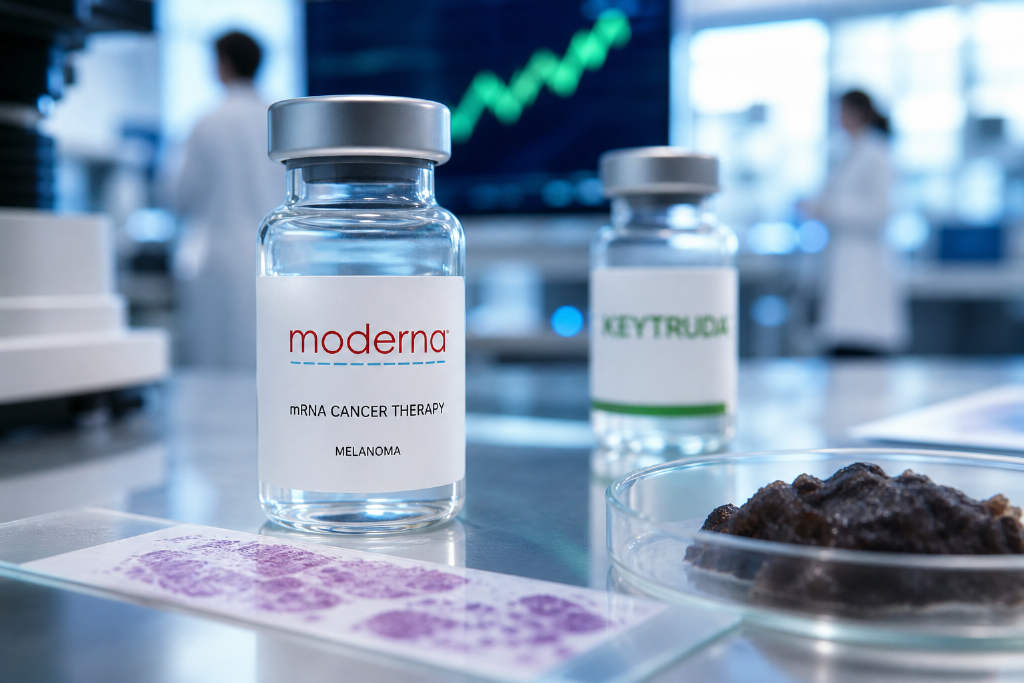
The companies said the Phase 3 INTerpath-001 trial of intismeran autogene plus Keytruda met its recurrence-free survival and distant-metastasis-free survival goals in patients with stage IIB-IV melanoma whose tumors had been surgically removed.
The result was described as the first positive Phase 3 outcome for a personalized neoantigen therapy and the first positive Phase 3 result for an mRNA-based cancer treatment.
How the treatment works
Intismeran autogene, also known as V940 or mRNA-4157, is not a mass-produced treatment. Doctors sequence a patient’s tumor, identify its specific mutations, and use mRNA to instruct the body to produce neoantigens, or protein fragments that train the immune system to recognize and attack cancer cells.
Keytruda is an anti-PD-1 drug that removes inhibitory signals on immune cells. The combination is designed to clear out cancer cells that may remain after surgery.
Comparison with current standard of care
The Moderna-Merck combination beat Keytruda alone, the current standard of care, on both endpoints. The report said this was the first time a personalized neoantigen therapy showed a clinically meaningful advantage over the blockbuster immunotherapy in the adjuvant setting, meaning treatment given after surgery to reduce the risk of recurrence.
For Moderna, the readout arrived at a critical time. The report noted that the company had leaned on a COVID franchise that had since collapsed and was carrying one of the heaviest short positions among large-cap stocks.
Short pressure intensified after the rally
The report said heavily shorted stocks that rise sharply can force short sellers to buy shares back to limit losses, the same short-squeeze dynamic that shook markets during the 2021 GameStop episode. It also noted that recent rallies in crypto-linked equities handed short sellers $2.6 billion in losses, and Moderna’s move was larger.
"With each shorted share now down almost $100, that is exactly the kind of pressure that can trigger a squeeze," ORTEX co-founder Peter Hillerberg said in a statement.
Trial will continue
The study will continue to evaluate overall survival and other secondary endpoints that have not yet been reported.