

Moore Threads suffered its first limit-down move since listing, with the stock falling to RMB 415.48 on Sept. 7 just minutes after opening at RMB 498. It never recovered during the session.
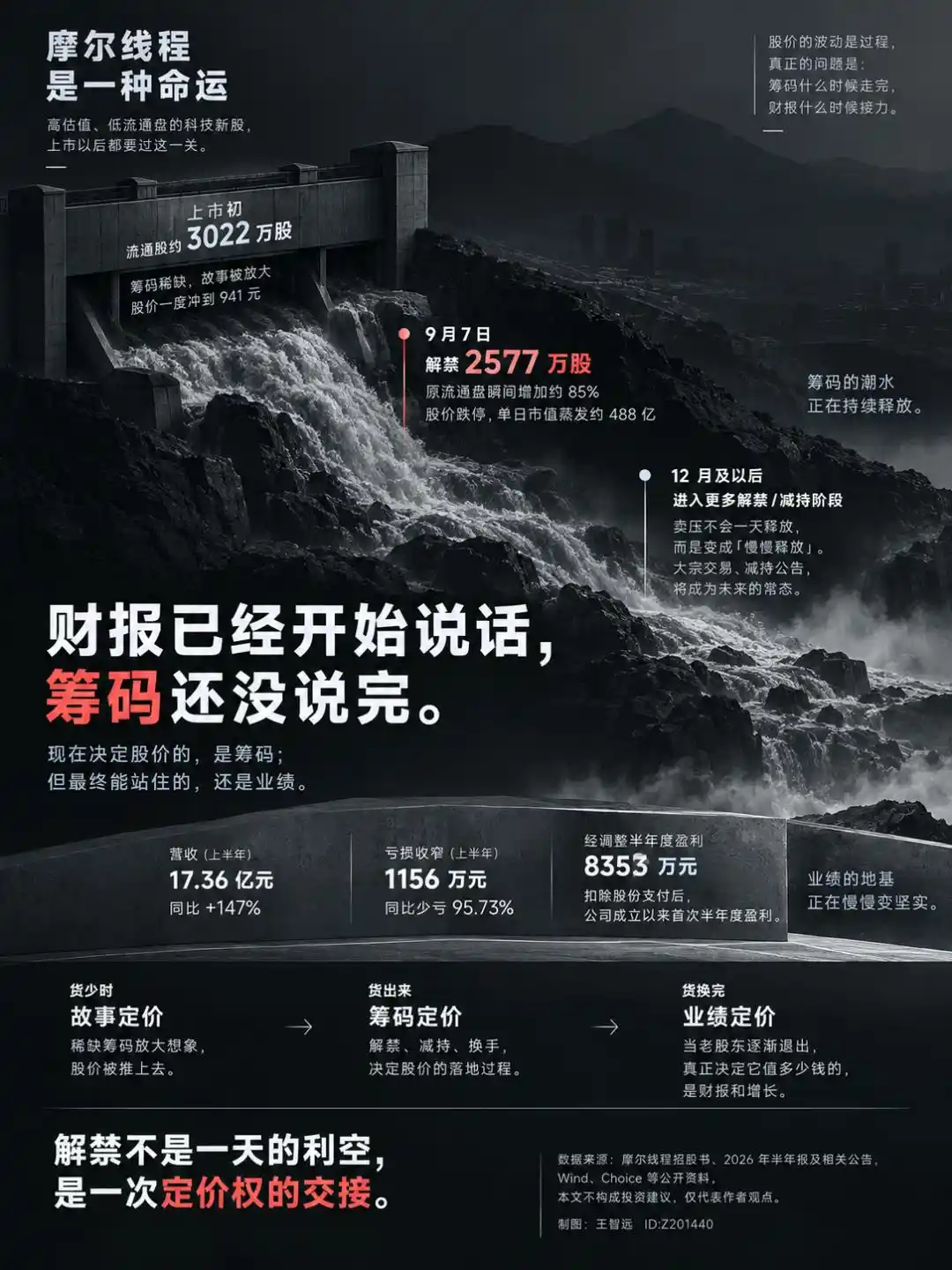
Based on the figures cited in the source article, the company lost about RMB 48.8 billion in market value in a single day, pushing its total market capitalization below RMB 200 billion. Turnover reached RMB 3.467 billion, turnover rate was close to 15%, and volume ratio topped 12 times.
Strong first-half figures did not stop the sell-off
The sharp move drew extra attention because it came shortly after Moore Threads released what many saw as a solid first-half report.
Revenue for the first six months reached RMB 1.736 billion, up 147% from a year earlier. Losses narrowed to RMB 11.56 million, down 95.73% year over year. Excluding items such as share-based compensation, the company posted adjusted profit of RMB 83.53 million for the first half, its first adjusted half-year profit since inception. Gross margin stood at 56.95%.
Still, the company was not fully profitable on a reported basis. The article says non-recurring-item-adjusted loss remained RMB 151 million, while second-quarter net loss attributable to the parent came in at RMB 41 million. It argues that subsidies and investment gains were still helping support the headline numbers.
The piece makes a simple point: operating performance and stock pricing are not the same thing. Those first-half numbers were disclosed in early August, and the market had already had about a month to digest them. Even after the Sept. 3 earnings briefing, the share price showed little reaction.
The real catalyst was the first unlock
The article ties the Sept. 7 collapse to the start of the company’s lock-up expiry schedule.
From that day, 25.77 million shares became eligible for trading, equal to 5.48% of total shares outstanding. On its own, that percentage may not look dramatic. What mattered more was the starting point: before the unlock, only 30.22 million shares were freely tradable. Once the newly unlocked stock entered circulation, the free float expanded by roughly 85% overnight, close to a doubling.
The article argues that this helps explain both the stock’s earlier surge and its abrupt reversal. When float is tight, concentrated buying can push the price quickly. It notes that Moore Threads once climbed to RMB 941 after listing, driven not only by the domestic GPU narrative but also by a shortage of tradable shares. The same mechanism works in reverse when supply rises sharply.
Its conclusion is blunt: in the short run, pricing is driven by supply of stock, not by the story behind the company.
Who held the first unlocked shares
According to the article, the shares unlocked on Sept. 7 were mostly allocated to institutional investors that joined the IPO offline placement. The holder list included public funds, social security funds, insurers and foreign investors. It specifically mentioned large fund houses such as E Fund, China Southern Fund and ICBC Credit Suisse Fund as investors that had taken positions worth hundreds of millions of yuan at the time.
These institutions entered at the IPO price of RMB 114.28. Even if they sold at around RMB 415 on the limit-down day, they would still book a gain of roughly RMB 300 per share. After holding the stock for about nine months, they remained up by more than two times on paper.
The article also explains why the stock did not collapse when the unlock notice was published on Aug. 29. The company disclosed the upcoming share release then, and the stock continued trading around RMB 519 for the next five sessions. What changed on Sept. 7 was not awareness but eligibility to sell.
Large shareholders usually need to follow reduction quotas and file notices 15 days in advance. By contrast, the institutions in this tranche held shares that had already been placed at listing, so they could sell as soon as the lock-up expired. That, in the article’s reading, is why the selling pressure only became real on Sept. 7.
On the same day, the broader semiconductor sector rose 3.36%, while Cambricon closed up nearly 2%. Moore Threads was the outlier. The company said operations remained on an improving track and that new products based on its Huagang architecture would launch within the year, urging investors to view the move rationally. The article says there was nothing obviously wrong with that response because the day’s price action was not about a sudden deterioration in business.
Total volume for the day was 8.24 million shares. On the source article’s estimate, that means at most around 30% of the unlocked shares changed hands, leaving most of the newly tradable stock still with institutions.
A bigger overhang is due on Dec. 7
The source article says the more important test may arrive three months later. Another 186 million shares are due to mature on Dec. 7, more than seven times the size of the Sept. 7 tranche.
Even so, it warns against applying the same script too mechanically because the shareholder base is different. The Sept. 7 unlock involved IPO placement shares. The Dec. 7 batch mainly comes from shareholders already on the register before the listing.
Using figures from the prospectus and market data terminals, the article divides pre- and post-listing holders into three broad groups.
- The first group is strategic placement, about 12.6 million shares in total. Investors named include Tianyi Capital, Beijing E-Holdings, National Fund Phase II and CPIC Investment Fund, mostly state capital and insurance money. Their 12-month lock-up expires in December.
- The second group entered in the final pre-IPO round. At the end of 2024, 38 institutions subscribed for 70.02 million shares at RMB 74.64 each.
- The third and largest group consists of older investors from funding rounds between 2020 and 2023, including funds affiliated with Sequoia and Shanghai Guosheng Capital. Their entry prices ranged from a few yuan to several dozen yuan per share.
Not every shareholder can sell freely
The article stresses that the shareholders with the fattest paper gains are not necessarily the ones who can sell first.
The pre-IPO investors that bought in at the end of 2024 paid RMB 74.64 per share, so their paper gains are substantial at current levels. But because they invested less than a year before the company filed for listing, their stock falls under rules for late-stage pre-listing investment. The article says those shares are locked for 36 months and cannot be sold until the end of 2028 at the earliest.
That means the Dec. 7 overhang mainly relates to older shareholders that came in from 2020 to 2023.
Even then, sales are not unrestricted. The article says pre-listing shares must follow reduction rules after the lock-up ends. If sold through centralised bidding, shareholders can dispose of at most 1% of total shares outstanding every 90 days. If transferred in block transactions to institutions, the quota can increase by another 2%. Venture capital funds with the right filing status may move faster depending on holding period, but not every holder meets those thresholds.
It cites examples including Qianyao and Minghao, which entered in 2020 and only just met the 60-month line by the time of listing, while investors such as Sequoia and Shengxin that entered in 2021 still fell short and would have to use the 1% per 30-day pace.
Why December may not repeat September’s instant limit down
The article notes that an earlier unlock of 840,000 shares on June 5, equal to 0.18% of total shares, drew little attention. At the time of issuance, lock-up periods for IPO placement investors were deliberately staggered into different buckets, including six months and nine months, to avoid a single-day wave of supply.
For that reason, the author argues that Dec. 7 is unlikely to replay the exact four-minute plunge seen on Sept. 7. If the focus is immediate one-day shock, the unconstrained portion inside the December batch is mainly the 12.6 million strategic placement shares, less than half the 25.77 million shares that unlocked this time. The article also says few expect those state-backed and insurance-related holders to rush for the exits on the first day.
The larger issue may be a series of reduction announcements over coming quarters rather than one specific date. In the article’s framework, the November circulation notice is only the opening step. After that, whenever major shareholders want to sell, they will need to file reduction plans saying how much they intend to sell and when. Each filing could become a fresh sentiment test.
Cambricon is the reference case
To think about how long this supply overhang might last, the article looks back at Cambricon.
In July 2021, Cambricon faced its first major post-listing unlock while still carrying the halo of being the first AI chip stock. The article says the unlocked shares amounted to more than half of its market value at the time, and the stock fell 7% that day. What followed was harder: shareholders kept announcing reductions, and the stock dropped 75% from its high over the next year and more.
At that stage Cambricon was still deeply loss-making, with annual losses above RMB 800 million and more than RMB 1.2 billion in its weakest year. The eventual turning point came when earnings turned positive. The article says Cambricon posted its first full-year profit in 2025, with net profit above RMB 2 billion. Its share price rose from RMB 348 in mid-2025 to RMB 1,620 over the following 11 months, and by June 2026 its market value had crossed RMB 1 trillion.
The piece says Cambricon took four years to move from unlock-driven selling pressure to earnings-led rerating. It also says Moore Threads may not need that long because the company is less than a year past listing and is already profitable on an adjusted basis after removing share-based compensation.
Three signals the article says investors should watch
For medium- and short-term investors, the source article highlights three practical indicators.
- Reduction plans in November. The key questions are who wants to sell, how much they plan to sell, and how far ahead of the unlock date the filing appears. If a plan comes only a few days before eligibility starts, the article reads that as less urgent. If holders use up their quota almost immediately, the signal is stronger. It says filings from state-backed holders would deserve particular attention.
- Discounts in block trades. In the article’s shorthand, a 10% discount is still relatively orderly, while a 15% discount suggests more urgency. If discounts narrow or disappear, that could indicate the selling pressure is fading.
- How Muxi trades on Sept. 17. The article says Muxi is due to unlock 13.966 million shares that day, equal to 3.49% of total shares outstanding. Its pre-unlock float is even smaller than Moore Threads’, so the new supply would amount to 75% of its existing free float. If Muxi stays stable, that may suggest the market’s fear of unlocks is easing. If it also breaks sharply lower, the pressure may extend beyond one stock to the broader domestic GPU segment.
Can the company itself absorb the pressure?
The article’s answer is no, at least for now.
It points to the company’s own financial commitments. Research and development spending was RMB 769 million in the first half. Inventory stood at RMB 3.55 billion. Cash plus wealth-management products fell by RMB 1.4 billion from the start of the year, and operating cash outflow in the first half exceeded RMB 2.1 billion. At the same time, the company is planning a Hong Kong listing.
Founder Zhang Jianzhong also has little room to act. The article says his directly and indirectly controlled stake is about 30%, all still locked. Before the company achieves true reported profitability, he does not even qualify to reduce holdings. On the limit-down day alone, the paper value of the portion he directly held fell by about RMB 4.6 billion, according to the article.
As for new money, the article says it will likely wait for more of the unlock calendar to pass and for several quarters of results to do the talking. It leaves the final question open: how long will the slow release of supply continue, and when will pricing power return to the financial statements?
The source article said its data came from Moore Threads’ circulation and unlock notices, its 2026 interim report and issuance materials, reduction rules published by the China Securities Regulatory Commission, and Sept. 7, 2026 market and unlock data from Wind and Choice. It also stated that the piece did not constitute investment advice and reflected only the author’s review.